Greetings, BugFans,
2026: In the early days of BOTW, the BugLady wrote a series of episodes about household bugs, including fleas, house centipedes, moth flies, meal moths, pseudoscorpions, wireworms/dermestid beetles, silverfish, long-bellied cellar spiders, and camel crickets (which lived in the basement with the milk snakes). One episode starred fruit flies. Her old house was a fertile ground. Since then, she has read that the average home contains between 32 and 211 species of arthropods – the number increases from North to South.
Fruit flies are notably jumpy, which is why a few always dodge the BugLady’s capture efforts and repopulate. Here are some glamour shots from contributors to bugguide.net, who were better at getting them to pose.
The fruit fly season is winding down in the BugLady’s kitchen, and the flies that she manages to trap go out into a chillier world than they might have chosen.
2010: Each summer the BugLady undertakes to outsmart her resident fruit flies, and the results are mixed. She does manage to transport scores of them outside by trapping them inside the compost bucket, and they happily finish up their life cycles at the compost heap. Alternately, she puts an apple core or rotten raspberry in a small container overnight, and in the morning, she wets a piece of paper towel, sneaks up on the container, and drops the paper towel over it. But, in this David and Goliath contest, David severely outnumbers Goliath.
The “fruit flies” in the family Drosophilidae (meaning “lover of dew”) are more correctly called “pomace flies,” because the name “Fruit fly” was already bestowed on a different family, Tephritidae (home of the peacock fly that causes the goldenrod ball gall and of the Mediterranean fruit fly that devastates commercial fruit growing areas). Scientists and non-scientists alike stick with the familiar name for this critter. Drosophila is a huge genus, with better than 1,500 species. Drosophila melanogaster, aka the Laboratory fruit fly, everyone’s favorite fruit fly, is a native of the Old World tropics that now occurs on 6/7 of the earth’s continents.
Scientists love D. melanogaster because its short life cycle, its simple needs, and the super-sized chromosomes in its salivary glands combine to make the species easy to rear in huge numbers (its reproductive success makes bunnies jealous) and easy to do genetic research on (according to Eaton and Kaufman in the Field Guide to Insects of North America, chromosome mapping shows that fruit flies and humans have about 20% of their genes in common). Anyone who has raised fruit flies will verify that, like Easter grass, once you have them, you have them forever.
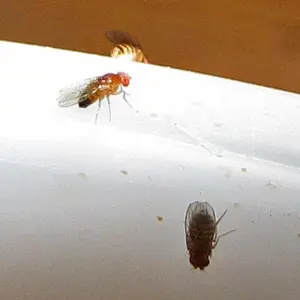
Fruit flies are tiny (3/16”), chunky flies with red eyes. Females are slightly larger than males; males are slightly more colorful; and males’ abdomens may be banded. The function of the “sex combs” on males’ front legs is unknown, and you will hear no speculation from the BugLady. Sensory-wise, fruit flies tend to be attracted to light and their eyes can register differences in light intensity. Hairs on their backs detect air currents.
Their names – fruit fly, sour fly, vinegar fly and wine fly are tributes to their food habits. Fruit flies like fruit – soft or rotting fruit. Ecologically speaking, they are scavengers. Adults feed on nectar, sap, fruit, and fermenting materials, and larvae feed on yeasts and fungi produced during decomposition/fermentation. Since rotting fruit has a short shelf life, so do fruit flies, and their life cycle is timed so the larvae are in sync with the decomposing fruit. Females are ready to breed when they are a half-day old, and males play their courtship songs with quivering wings. Eggs that are laid in that over-the-hill banana or other soft fruit in your fruit bowl take only 2 days to hatch and another 3 to 4 to mature enough to pupate. After resting for 4 to 5 days as a pupa in the fruit, they emerge as adults – unless someone eats the fruit first (think of them as a little extra protein).
The larvae develop optimally in warm temperatures, which explains the absence of fruit flies from the mountainous regions and chillier latitudes of the continents they inhabit (where availability of food may also be a limiting factor). The larva of one Drosophila, D. sigmoides lives as an inquiline (a “squatter”) in the froth of spittle insects; it gets shelter and food from the arrangement but gives nothing back in return.
Fruit flies, for good reason, are considered pests, but they play a surprising role in winemaking. According to Swain in The Insect Guide, the yeast spores that fruit flies carry on their bodies “contaminate” the grapes they walk and feed and lay eggs on. This tiny infusion of yeast multiplied by all the fruit flies and all the grapes in the vat means that it is unnecessary for winemakers to add more yeast to the grapes during fermentation.
The BugLady