
Howdy, BugFans,
When the BugLady was wandering around in a patch of Baptisia/Blue False Indigo in mid-summer, she noticed bunches of caterpillars under webs on the leaves (thanks to BugFan Freda, who got to the ID of the caterpillars much faster than the BugLady would have).
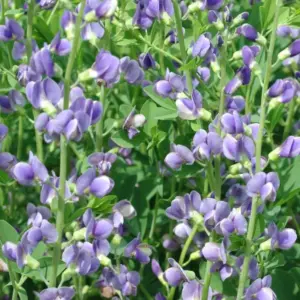
[Botanical note: Blue False indigo (Baptisia australis) (from the Greek “bapto,” for “to dip or dye”) is a native prairie plant whose sap was used by both Indians and settlers to make a blue dye. The dye wasn’t very dark and wasn’t very permanent, and everybody was happy when the non-native “true” indigo (Indigofera tinctoria) was introduced from Africa/Asia. Baptisia blooms spectacularly at the end of May, and bumble bees love it.]
They were caterpillars of a Crambid moth (family Crambidae) named the Genista broom moth, aka the Genista caterpillar aka the Sophora worm (it feeds on plants in the genus Sophora). It’s a native species, but it eats some non-native landscape plants and garden escapees along with native vegetation.
One source speculated that it may be a Mexican species that has moved north. If so, it has been successful – its journeys have taken it over much of the US (and the Caribbean), except for our northwest quadrant and the far, far Northeast. It remains more common in the South than in the North.
Mature caterpillars are about an inch long, and moths have wingspans of one to one-and-one-quarter inches. The caterpillars have (harmless) long, white hairs sprouting from raised, black and white dots. The coloring of both the moth and the caterpillar is considered “aposematic” – warning – coloration.
Like Baptisia (and lupine, Wisteria, Scotch broom (a European import that’s invasive in parts of America), Acacia, and Sophora) many of the caterpillar host plants are in the Pea family, but it’s also found on other plants. Many of its host plants have toxic alkaloids in their leaves that deter grazers, but not Genista caterpillars, which store the chemicals in their bodies, making the caterpillars bitter and/or toxic to most predators. Baptisia is toxic, but not lethal, to humans and livestock (a few folks showed up in an ER in Texas, once, after mistaking the very young plants for asparagus).
The caterpillars are social feeders that browse on leaves, making webs as they go. They may cause aesthetic/cosmetic damage or defoliation, but established plants can survive a heavy year. Genista broom moths have periodic population irruptions.
There are multiple generations Down South, where some may overwinter as moths, but here in God’s Country, there’s probably only one generation. They (here) overwinter as pupae near their host plant and complete their metamorphosis in spring. In the far South, where they’re in the air all year, they may pupate beneath the webbing they feed under.
As the North Carolina Extension folks say, “the moths emerge the following year to mate and lay eggs” “from which hatch the tiny, hairy caterpillars that soon grown into larger hairy caterpillars.” They mate at night, and the caterpillars are generally active during the day,
The BugLady