Howdy, BugFans,
The title of the Oklahoma Extension circular about Pecan weevils, “Pecan Weevil – Wanted DEAD, Not Alive,” says it all.
Weevils! Those lovely beetles with clubbed, “elbowed” antennae growing from their downcurved rostrum (snout) and chewing mouthparts located at the snout’s tip. Some have short, blunt snouts, and some others have slim, graceful snouts that are as long as their body. The Curculionidae (the snout beetles or true weevils) are a huge family (77,000 species) within a huge order Coleoptera (beetles) (400,000 species). The Curculionidae are the largest ANIMAL FAMILY (for now – scientists aren’t finished counting the Ichneumon wasps and the Rove beetles). Every 4th LIVING THING is a beetle.
Weevils tend to be chunky, drab, and scaly/bristly. Most are vegetarians both as larvae and as adults. Females use their mouthparts to excavate vegetable matter both to feed and to lay their eggs in, and their larvae grow up within the plant tissue, eating their “walls.” Many weevils are very picky about their larvae’s host plants, and some of those host plants are important agricultural plants, like cotton, alfalfa, and pecans. Weevils are famous for playing dead when they’re alarmed, dropping to the ground, where they’re hard to find, and playing dead.
Along with 350 other species worldwide (30 in North America), the Pecan weevil is in the genus Curculio (the nut and acorn weevils), but not all curculios are Curculios. The name has been co-opted by some unrelated weevils and even by some non-weevils (which is what makes common names so much fun!).
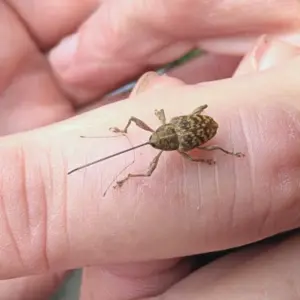
THE PECAN WEEVIL (Curculio caryae) (aka the Hickory nut weevil) can be found throughout the East and Midwest, where its host plants – trees in the genus Carya (hickories and pecans) – grow. It has expanded its range, with alarm bells sounding whenever it shows up in a new state (Virginia 1992, New Mexico 2016).It’s gray/brown/rusty-colored and fuzzy, with long, spindly legs, and it measures about a half-inch, not counting the snout. As is typical of the weevils, the female’s snout is longer than a male’s.
Unlike many of the BugLady’s subjects, there is plenty of info available about Pecan weevils.
Adults emerge from their pupal cases in the soil before the nuts ripen, often after a rainstorm, anytime from mid-summer through fall, in the market for immature nuts to feed on. They drill through the husk/shuck and into the shell, leaving a tiny hole, and their long snouts enable them to feed on the developing nut meats inside (inserting that slim snout into a shell and pulling it out again can be tricky). After they mate (usually right there on the nut) the female bores into it, creates some chambers just below the surface of the shell, and lays an egg in each chamber.
The legless larvae (grubs) feed on the nut meats until fall. When multiple eggs are laid in a nut, only two or three survive, and in any case, the nut meat is demolished and economically worthless. She has enough eggs to populate about 30 nuts during her one-month life.

After about a month, the larvae make a BB-sized exit hole in the nut, drop to the ground below the tree, and burrow down as deep as ten inches below the surface to create a pupal cell. Some emerge as adults the following year, and others remain underground for another year or even two, staying in the soil for a year as adults after they metamorphose. It’s called “prolonged diapause” (diapause is a delay in development, or “arrested development”).
Several sources pointed out that hickory (and other) trees have “mast” years – years when they produce an exceptionally large nut/seed crop, and that pecans alternate heavy and lighter years. Masting is thought to be the trees’ way to handle grazers. A large crop of nuts or fruits raises the odds that at least some will germinate. Also, a large crop of nuts one year encourages extra reproduction of grazers that year, but a normal crop the next year strands them. One bulletin pointed to the weevils’ quixotic schedule of spending an extra year or years underground before emerging as their way to outfox the trees.
Weevils damage the nuts both by feeding on them (weevils feeding on developing nuts may cause the nuts to drop off the tree) and by laying eggs in them. One area of research involves tracking the adults as they emerge and head for the nut trees. Do they walk to the tree? Fly to the trunk and walk up it? Fly directly into the tree’s crown? Fly from tree to tree? Seems like a moot point, since the outcome will be the same, but knowing this could allow growers to target pesticide applications, since the larvae and pupae are “untouchable.”.
The weevil photo came from BugFans Freda, Catie and Alon – it was a joint effort. Thanks, guys!
The BugLady