
Howdy, BugFans,
It’s August!!! Or, to put it another way, it’s August – yikes! Halfway(ish) through summer. Here are some of the sights that the BugLady has enjoyed so far. Many of these have already starred in a BOTW of their very own – you can look them up in the UWM archives by Googling “UWM Field Station (name of insect).”

FOUR-LINED PLANT BUGS: Most Mirid plant bugs are small and green or beige or mottled, and therefore pretty inconspicuous. Not so the Four-lined plant bug, which is as showy as a nymph as it is as an adult. These urban/suburban/grassland bugs feed on plants – wild, cultivated, and agricultural, especially the mints – by piercing the plant tissue and feeding on the sap.

TREEHOPPER EXUVIA: On a recent trip to Spruce Lake Bog the BugLady noticed a number of Buffalo treehoppers, and then she found this shed skin (exuvia). Buffalo treehoppers have improbable nymphs that leave equally improbable skins behind when they shed. Adult treehoppers communicate with each other and with their young by vibrating their abdomens against whatever surface they’re sitting on.

EASTERN AMBERWING: Good things come in small packages! At 0.90” long, the Eastern Amberwing is our second-smallest dragonfly, but one of our flashiest.
CLYTUS RURICOLA: What a dynamite beetle! It’s a long-horned beetle (family Cerambycidae) that is sometimes called the Round-necked long-horned beetle, and it’s disguised as a wasp (just when you thought it couldn’t get better, here are some relatives). Look for the adults on flowers, eating pollen. The larvae live concealed in rotting wood, especially maple.

BLINDED SPHINX: Back in mid-June, the BugLady threaded her way down a narrow boardwalk with tall grasses on all sides hoping to find some damselflies. On her way back, she saw a male Blinded Sphinx moth and an egg-laden female in a state of disarray. She hadn’t noticed them on her first pass, when she apparently brushed against them as they were sharing a “Get-a-Room” moment. She added insult to injury by shoving a camera in their faces before she tiptoed away.

CRAB SPIDER: The BugLady loves trying to spot mini-crab spiders lurking on flowers. Goldenrod crab spiders (obviously not restricted to goldenrods) can change color from white to yellow to white again, though each change takes a few days.
BLACK AND YELLOW MUD DAUBER: A solitary, thread-waisted wasp. Yes, she can sting, but you’d have to work at it (bees and wasps that defend large, communal nests/hives are the most dangerous). The mud she collects will be fashioned into a globular nest containing (usually) 6 to 15 egg cells that she provisions with spiders for her eventual young (she sips nectar, but her larvae are carnivores).

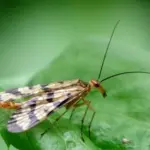
SCORPIONFLY: First of all, Scorpionflies are not true flies (order Diptera), they’re found in the Order Mecoptera, along with several groups of odd-looking insects like hangingflies, forcepflies, and Snow scorpionflies. And they’re not scorpions, either, though males of one family (Panorpidae) have a bulbous, stinger-like, appendage at the tip of their abdomen (they don’t sting, either). For more details about Scorpionflies, see here. In the final paragraph of that account, the BugLady says that there are more than 80 episodes in the BOTW. Now there are more than 800.
WASP ON WATER: Insects that fly too close to the water risk getting trapped on the surface film – the water molecules that are exposed to air at the surface are “stickier” than those below. What happens next? If it’s lucky, the wasp will bump into something to climb up onto. Otherwise……..
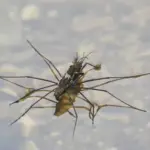
WATER STRIDERS…..Otherwise, it will become prey for some predator, and these water striders are likely candidates (this is a pair, indulging in a bit of hanky-panky). They were skimming along the surface just a few feet from the wasp but were otherwise occupied. Water striders are sometimes called Water spiders (they’re not – we need to enunciate) or Jesus bugs (because they walk on water). Water striders monitor the water’s surface with their two front legs as they locomote with their four hind legs, and they are attracted by the mini-ripples produced by an insect struggling on the surface.

BLACK-SIDED MEADOW KATYDID – the BugLady loves finding infant katydids, although this one didn’t want to be found – it immediately ducked in back of the nearest plant stem. The folks at bugguide.net did a better job. They grow up to be pretty spiffy, and they sing (exceedingly softly) from perches at the edges of wetlands in late afternoon and at night.

ARROW CLUBTAIL DRAGONFLY: It takes about 45 minutes to get to this stage after the dragonfly naiad has climbed out of the water and pushed its head out of its split skin. Its wings need a little more length and strength before this teneral (newly-minted dragonfly) can launch itself straight up into a tree. It takes a few days before a teneral gains it’s adult coloring and the duckling turns into a swan.
WASP WITH SPIDER: A small, life-or-death struggle had already been decided when the BugLady saw them. It was “man bites dog” – a wasp (Episyron quinquenotatus)(probably) had collected a small orb-weaver, paralyzed it, and was dragging it to a tunnel where she would stuff it into a chamber, lay an egg, and close the chamber off. When the egg hatches, the eventual larva will feed on the spider, pupate in its chamber, and emerge the following summer.

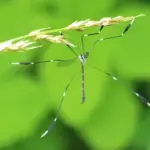
PHANTOM CRANE FLY: Someone asked the BugLady recently if she believes in magic. The obvious answer – How can you be out in Nature and not believe in magic? Example: Phantom crane flies, flickering along in dappled sunlight at the edges of wetlands. As Dar Williams sings, “We find magic everywhere.”
Go outside – find some magic!
The BugLady