
Howdy, BugFans,
Way back in 2008, deer flies appeared briefly (two paragraphs) in a BOTW episode called “A few Flies,” sharing the spotlight with mosquitoes and horse flies. Amazingly, that’s the only time deer flies have appeared in BOTW, and it’s past time to flesh out their story.
Deer flies are in the family Tabanidae, the horse and deer flies, and they’re in the subfamily Chrysopsinae, the deer/sheep/yellow flies (although one source says that they should be called “human flies”). There are 120 species of deer flies in North America, with more abroad, and a combined total of 30 species of horse and deer flies live in Wisconsin (lots of write-ups treat deer and horse flies together, because their life stories are similar).
They are found worldwide, and although the fast-flying adults may wander away from them, they are tied to wetlands because their larvae grow up in the water or in adjacent, damp soils. Adults can also be found patrolling sun-dappled woodlands and edges.
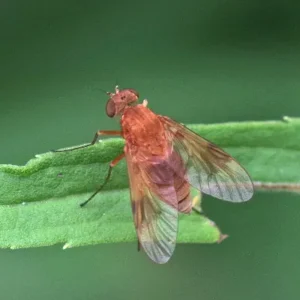
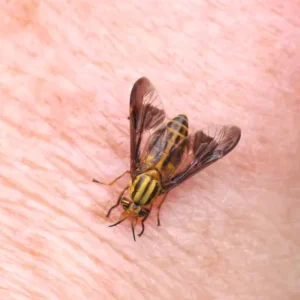
How do you know you’re looking at a deer fly? There are some scientific/microscopic measurements involved, but in general, deer flies are smaller than horse flies but larger than house flies, and many have yellow and black-striped bodies, wings with pigmented splotches on them, colorful eyes that are adapted to function well in the bright sun of late spring and early summer, and noticeable mouthparts.

Famously/infamously, deer flies use those mouthparts to bite people and other mammals. Only the females bite – she needs the blood to facilitate the development of her eggs. Males are vegetarians who use their mouthparts to take nectar and pollen from flowers (she will also feed on nectar and pollen when she’s not in egg-laying mode). The female’s mouthparts are described as “scissor like” – she uses them to make an x-shaped cut, and then she laps up the resulting blood, keeping it flowing with anticoagulants in her saliva. Deer fly larvae are mainly carnivores that clean up on smaller invertebrates they find in water or moist soil.
Deer fly larvae are eaten by larger, aquatic carnivores like fish, predaceous diving beetles, and dragonfly naiads, and the adults fall prey to toads, killdeer, aerial insectivores like flycatchers and swallows, and dragonflies, and to wasps and hornets looking to stash them in their egg chambers as food for their eventual offspring.
Science word of the Day: deer flies are “hydrobionts,” which means they need wet areas in order to reproduce. The dance may start with a breeding swarm where boy meets/pursues girl (in most species, the boys hatch out a couple of days before the girls). What starts in the air is consummated on the ground, and then females go looking for a blood meal before tucking masses of 100-plus eggs onto vegetation near/over water. When the eggs hatch, the larvae (which come equipped with a “hatching spine” that helps facilitate their exit) drop into the water or onto damp soil. They may take more than a year to mature, depending on the size of the adults.
While she was doing her research, BugLady came across a few “Where are the deer flies this year?” articles (not that anyone was complaining). One attributed the low number of flies in their area to a very wet summer that flooded the breeding areas, and the other to a very dry summer that shrank the breeding areas. Deer fly pupae crawl up on plant stems or moist wetland edges just before they emerge, so too much or too little water can affect them. One article asked why there were so many deer flies that year, and the answer circled back to a wet spring and a hot summer (apparently, when it comes to precipitation, deer flies are like Mama Bear). Happily, they aren’t on the scene long – if mosquito season is a marathon; deer fly season is a sprint.
Much has been written about a female mosquito’s use of our individual cocktail of odors as she zeros in on potential targets – that personal jean es se qua that’s made up of our CO2, sweat, fruity-smelling shampoo, and scented laundry detergent, deodorant, and hand lotion (it’s difficult to be unscented in the 21st century). But deer flies hunt largely by eye, stimulated by the sight of large, dark, warm, moving objects (including cars), so the repellants that deter mosquitoes don’t work on deer flies. The good news is that although a number of microbes have been identified in a deer fly’s “mouth,” there’s only one disease they are known to transmit in North America – tularemia (aka rabbit fever) is spread by deer flies in the western US.

The pain from a deer fly’s bite is in bee sting territory (it’s been described as “poking a red-hot needle into your skin”). Her saliva may cause further pain and itching, and some people are allergic to deer fly bites. If DEET won’t do it, what will? Dressing for success helps, in light-colored, loose-fitting long sleeves, long pants, and a hat (because when deer flies check us out, they start at the top), and some folks add mesh netting over the cap. Some swear that deer flies are attracted to the color blue. Several sources promised that deer flies are inactive at temperatures under 70 degrees F, but others laughed at that notion.
People have gotten pretty creative in aid of avoiding deer flies, using devices that are homemade and store-bought, sacred and profane, and just plain embarrassing. Sticky patches to attach to your hat, and hats with built-in sticky patches are easy to find in sporting goods stores (see picture Why are there so many deer flies in Vermont this summer? | Vermont Public), or you can DIY with loops of duct tape. One author wrote of spreading sticky stuff like Tanglefoot on a cup (think red or blue 16 oz Solo cup) and taping the cup to the top of his hat on his walks.
The BugLady wears a hat on her perambulations, and she enjoys listening to the deer flies bouncing off of it.
Here are a few gems that the BugLady found while she was Googling.
From the Missouri Department of Conservation:
“In the 1800s, the upland prairies of Missouri’s Audrain County were late to be settled in large part due to the presence of these insects. The WPA-produced Missouri: A Guide to the “Show-Me” State (1941) put it this way: ‘At certain times of the year, the flies made day travel impossible, and even plowing and other farm work had to be done at night.’ Many other prairie regions in the American Midwest had similar problems with tabanid flies; in some cases, horses were said to be driven mad by the incessant attacks of horse and deer flies.”
From the Audubon Beidler Forest website:
“If you were to ask me which cloud of biting insects I would prefer, mosquitoes or deer flies? Well, you can outrun mosquitoes. Running away from deer flies just gets them excited.
A deer fly is also characterized by its ability to withstand a fairly good smack after it lands on a person and begins to bite. Often the fly falls lifelessly to the ground after being struck, yet within a few seconds uprights itself and then eventually takes to the air again in an attempt to make another attack.”
From Michigan State University Extension:
Deer flies “apparently have their place in U.S. history: Ross Arnett, author of American Insects, A Handbook of the Insects of America North of Mexico, reports the following. ‘It is said the Declaration of Independence was signed by July 4, 1776 instead of a later date that would have permitted further discussion because the horse flies in Philadelphia were biting so fiercely at the time that the delegates decided to adjourn just to get away from them.’”
And finally, from “the World Around Us” podcast and blog, which “seeks to arouse your sense of wonder and motivate you to act on behalf of nature at every opportunity.”:
Blogger Sarah O’Malley reminds us that every organism has a job to do, and that deer flies do theirs very well. She concludes that, “No body likes hanging out with deer flies. But all the same, I prefer a world where they exist, a world as full as it can be with as many different kinds of organisms as possible, a world rich and damp and squirming with life. That is truly the point of it all, and we can’t do it without the biters and scratcher anymore than we can do without the cute furry babies and the fluffy little birds. They all count, every last knife like mouthpart wielding one.”
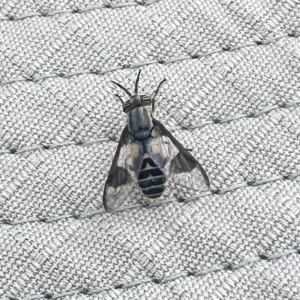
Thanks to BugFan Sophie for taking the picture of the cute little deer fly on the BugLady’s hat.
The BugLady
PS – BOTW was born (as a joke) back in August of 2007. What with the reruns and the time-outs, it’s taken a while to get here, but this is, by the BugLady’s count, episode #800. Thanks, BugFan Patrick – and we’re both still going strong! (-ish)