Howdy BugFans,
It’s almost time for Snowbirds to head back north to rejoin us here in God’s Country for the final days/weeks/months of winter. The BugLady read recently that the number of days below freezing in March here in God’s Country has drastically decreased in the past 25 years, and March is increasingly considered a spring month rather than a winter month (but when the BugLady was a kid……..). The temperature may be moderating, but March still has plenty of tricks up her sleeve, and most of them involve snow.
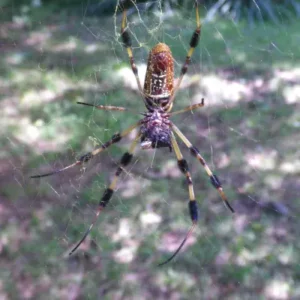
BugFan Tom supplied the pictures of this big, beautiful spider that inhabits the South from Virginia to Texas (and beyond, to Argentina and Peru). Thanks, Tom.
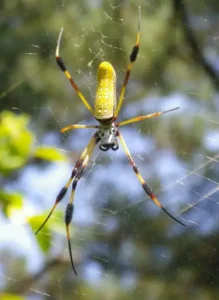
The brightly-patterned females may be more than two inches long with a five-inch leg span, (males are much smaller Next Suitor? Or Dinner…. – Trichonephila clavipes – BugGuide.Net). A spider this big (probably our largest orb weaver) that makes big webs necessarily gets noticed and collects lots of names, like Banana Spider, Golden Orb Weaver, Calico Spider, Golden Silk Spider, and Giant golden Orbweaver, and people who walk into the webs while hiking probably have other names for them. MUCH has been written about their golden silk Golden Orb Weaver Spider – Trichonephila clavipes – BugGuide.Net – more about that later.
The Golden silk orb weaver (Trichonephila clavipes) was formerly known as Nephila clavipes. Nephila means “fond of spinning” and clavipes means “club-footed,” possibly a reference by Linnaeus to the dark tufts of hair on six of the female’s legs. Recently, it and a dozen other genus members were moved to the genus Trichonephila – the Golden orb weavers. Historically, GSOWs were the only member of that genus in North America, but in 2014, an East Asian species called the Joro spider found its way to Georgia, and it’s been spreading out through the Southeast Joro Spider – Trichonephila clavata – BugGuide.Net.
Look for GSOWs in open areas in woods or edges, preferably near wetlands or coastal areas.
Male GSOWs spin trap webs until they reach maturity, but then they set off to find a mate. When they find a female’s web, they quietly move onto its periphery and feed on some of the prey she catches, and a female’s web may host a number of males. Dewdrop spiders Dewdrop Spider – Field Station and Spiney-backed orb weavers Spinybacked Orbweaver– A Spider for Snowbirds – Field Station also live on the web’s outskirts and share in the bounty. An amorous male will approach the female while she is distracted by a meal, and he signals by vibrating both the web and his abdomen (he’s cautious, but there’s not a lot of sexual cannibalism in this species). Males don’t produce much sperm, and they replace it slowly, so they favor newly-molted females who have not mated yet. After he mates/attempts to mate, a male may move on to a new web.
Females place two or more egg sacs, each containing a few hundred eggs, on surfaces near their web Golden Silk Orbweaver Egg Sac – Trichonephila clavipes – BugGuide.Net. Hatching may be triggered by environmental cues in their damp habitats. The spiderlings stick together for about a week after hatching Golden Silk Orbweaver Spiderlings – Trichonephila clavipes – BugGuide.Net, and then they disperse. By late summer, the tiny spiderlings of spring have reached full size and are making conspicuous webs.
This is a big spider that builds a big, strong web (up to six feet in diameter) that is capable of snagging some big prey, like moths, fast-flying horse flies, dragonflies (which are both GSOW eaters and eat-ees), butterflies Giant Swallowtail in a Golden Silk Orbweaver’s Web – Trichonephila clavipes – BugGuide.Net, beetles (this one is June-beetle-size) Golden Silk Orbweaver – Trichonephila clavipes – BugGuide.Net, cicadas, and grasshoppers. Though they trap both small and large prey, they prefer to eat the bigger insects.
The webs are sturdy enough to capture birds. Daniel M. Brooks, in an article titled “Birds Caught in Spider Webs: A Synthesis of Patterns” published in the Wilson Journal of Ornithology (2012), wrote that a review of international literature and list servers found 69 accounts of birds trapped in webs. Nephila species, especially GSOWs, accounted for half of the reports of mostly hummingbird-sized birds (though a small dove was reported, and the author personally observed a Swainson’s thrush tangled in a web), and while some were able to free themselves, a significant number had been killed and wrapped by the spider.
The asymmetrical, orb-type web is usually located between two and eight feet off the ground (but may be at treetop height). When prey is abundant, GSOWs may cache as many as 15 wrapped insects in a “barrier web” – a debris-strewn area along one side that serves to warn/block predators and help keep the web clean. One source said that the organic waste held in the barrier web may attract insect prey by its odor.
GSOWs’ main predators are wasps that collect them to provision their egg chambers, and birds.
Unlike many species of orb weavers that replace their webs daily, eating the old web to harvest its protein, GSOWs repair damaged webs. Researchers believe that the yellow tint, the intensity of which the spiders can control, may attract bees, and it may also help to camouflage a web in the shade. A number of females may make webs close to each other Golden Silk Orbweaver – Trichonephila clavipes – BugGuide.Net.
This is some serious silk!!! Nephila/Trichonephila silk has a high thermal conductivity, is stronger, by weight, than steel (it’s being studied with hopes of replicating its extreme strength), and it has some interesting medical applications. Wikipedia reports that it may be beneficial in surgeries involving the nervous system because it may guide and encourage neuronal regeneration.
Wikipedia also reports that hunters in New Guinea make fishing nets from the silk.
Finally, enterprising folks have experimented with it as a textile, creating garments (thanks to the labors of millions of spiders) Golden Spider Silk Cape – Wikipedia.
FUN FACT ABOUT SPIDERS: the tips of the legs of spiders that wander around and don’t make trap webs point outwards, and the tips of the legs of trap-web-spinners point inwards.
FUN FACT ABOUT NEPHILA/TRICHONEPHILA SPIDERS: The genus Nephila is not only the oldest-known surviving spider genus (165 million years), but it includes the largest-known fossil spider.
The BugLady