Howdy, BugFans,
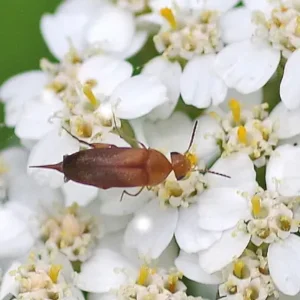
Way back in 2010, when the BugLady wrote an episode called “Big Beetle – Tiny Beetle,” the tiny beetle was a generic Tumbling flower beetle. There are a whole bunch of (unrelated) beetles that share the common name “flower beetle” – hermit, bumble, shining, soft-winged, and more, along with the long-horned flower beetles. Tumbling flower beetles are interesting little critters, so here’s an enhanced biography – new words, new pictures.
The psychological principle called “The Law of Closure” explains that when we see text with partial or misspelled words, our brains tend to serve up the missing information, often without our even noticing its absence (which is why over-familiarity with a text makes for bad proof-reading). The incomplete becomes complete. That being said, the BugLady must confess that whenever she sees the name of the Tumbling flower beetle family – Mordellidae – her brain always fills in the name of a kind of lunch meat, Mortadella. BugFans may come to their own conclusions/diagnoses about that.
Tumbling flower beetles, so-called because of their method of locomotion, are also called Pintail beetles, because of their pointy anatomy. There are more than 2,000 species of Tumbling flower beetles distributed over six continents, with 200-plus species in North America, and 68 of those in Wisconsin. They seem to be in continuous taxonomic limbo – there’s been a lot of shuffling and more is expected to happen. They can be a very confusing bunch – to tell the difference between some of the species, you have to count the ridges on the hind tibia and tarsus (leg and foot). All of the species in North America belong in the same subfamily (Mordellinae), and speaking of names, there are some very fine genus names like Mordellistena (the largest genus), Hoshihananomia, and Yakuhananomia.
These small (about ¼”), active, caraway-seed-shaped beetles always remind the BugLady of a flea on a flower. Tumbling flower beetles are wedge-shaped (tapered toward their pointy rears), and are covered with short hairs that are silky and slippery and that may give them an iridescent shine. They have long, flattened, hind legs (the better to tumble with, my dear) and hump-backed bodies, with heads angled down almost under the first segment of the thorax (sort of a “pre-somersault” position). Their elytra (wing covers) are shorter than their abdomen.
Tumbling flower beetles are generally dark, but some are more decorative
9013405 Mordellid – Mordella marginata – BugGuide.Net
Tumbling Flower Beetle – Tomoxia lineella – BugGuide.Net
Tumbling Flower Beetle – Hoshihananomia octopunctata – BugGuide.Net
9013559 Mordellid – Variimorda pubescens – BugGuide.Net
spotted Mordellid – Mordellaria serval – BugGuide.Net
Mordellistena cervicalis? Male? – Mordellistena – BugGuide.Net
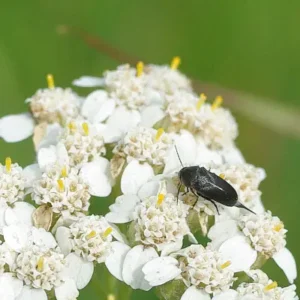
In an article in the journal PSYCHE (1987) Deyrup and Eisner write that “The Mordellidae are small, wedge-shaped beetles commonly found in one of the most dangerous of all insect habitats, the open inflorescences of plants.”Food and habitat-wise, Tumbling flower beetles tend to be generalists. Adults feed on nectar and pollen (their hairy bodies make them effective pollinators), and some nibble on the flowers a bit.
The larvae, concealed within plant stems Mordellidae, Smilax herbacea – BugGuide.Net, leaves, galls, dead trees, or shelf fungi, feed on dead wood, the pith of herbaceous plants, and woody fungi, and larvae of a few species may be predaceous. Most sources agreed that although they like sunflowers, the larvae aren’t considered an agricultural pest. Downy Woodpeckers find the larvae in plant stems, and crab spiders capture adults on flower heads.
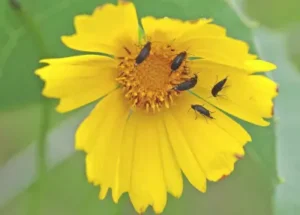
Do they tumble? Oh my, yes! When alarmed, which seems to be often, they bail, letting go of the flower and tumbling or jumping off. Part way down, they may spread their wings and fly (they are good flyers) or they may fall all the way to the ground, where they are impossible to find. They jump by pushing off into a spiraling somersault using one of their extra-long back legs, and they rotate clockwise or counterclockwise in the air, depending on which leg they pushed off on. Sources say that these gymnastics help the beetle position itself for flight.
Deyrup and Eisner again: “Their chief protection against the many predators that frequent flowers is a series of convulsive leaps followed by rapid flight, as acknowledged in their common name, “the tumbling flower beetles.” Their escape from a predator’s grasp is facilitated by their wedge shape and covering of smooth, backward-pointing hairs, while their movement and purchase among stamens and floral hairs may be assisted by rows of tibial and tarsal setae strongly reminiscent of the combs of fleas. These escape mechanisms, while undoubtedly effective against many predators (including entomologists), have the disadvantage that they involve abandonment of the feeding site.”
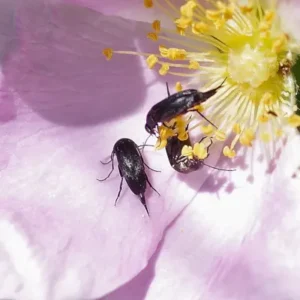
Adults emerge in late spring, romance ensues, and females lay eggs in decaying wood or in living plant tissue (there may be as many as 40 larvae in a single sunflower). Tumbling flower beetles often find themselves in the company of other Tumbling flower beetles and are said to be aggressive toward them. They overwinter as larvae in their food plant, and there’s only one generation per year.
An article about Tumbling flower beetles on the Beyond Pesticides website states that “the tumbling flower beetle’s ancestors were some of the earliest insects to utilize flowers for food and habitat. In doing so, these ancient pollinators began an important collaboration between flowers and beetles which continues today.”
The BugLady