Salutations, BugFans,
2026 – When the BugLady wrote this episode in February of 2013, she kicked it off by griping about the weather – a favorite, February, indoor sport. This year, we’ve had many days of below average, below freezing, and below zero temperatures. How cold is it? Three weeks ago, one of her water pipes froze and burst, and when she tossed the sodden beach towels out the door into the yard, they froze instantly. They’re still stuck solidly to the ground.
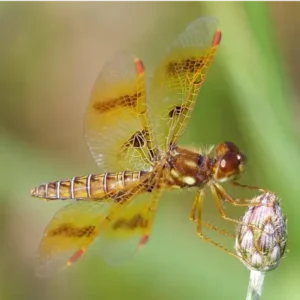
This rerun contains a few new words (because who can look at a 13-year-old manuscript and not tweak it?), but all new pictures, because the Eastern Amberwing is a wondrous creature to photograph, even when it’s hovering just out of range.
2013 – The weatherman keeps saying “Mixed precipitation” and it’s making the BugLady plenty crabby, so she’s going to think about dragonflies, instead. Here’s a little bit of sunshine on the wing.
Several BugFans have asked the BugLady how she selects the stars of BOTW. First, she needs a decent picture to spin the tale around, and Eastern Amberwings have posed prettily (some of them). This tiny dragonfly has some interesting stories to tell.
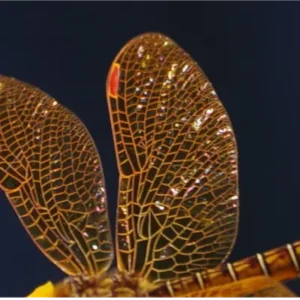
At a hair under an inch in length, the Eastern Amberwing (Perithemis tenera) is the second smallest dragonfly in Wisconsin (the very-uncommon Elfin Skimmer is a bit smaller and is not yellow). Some damselflies, like this Spreadwing Species Lestes unguiculatus – Lyre-tipped Spreadwing – BugGuide.Net, are longer than Amberwings, but damselflies are slim and dragonflies are bulky. Their flashy wings make them look bigger than an inch to the BugLady. The male EA’s wings are pure gold; the female’s wings are brown-spotted on a sometimes-amber background (she resembles a tiny Halloween Pennant, of previous BOTW fame). Males and females have yellowish legs and have rings around the segments of their abdomens. The abdomens of both are thick (the female’s looks especially swollen).
Because of their coloring, their rapid, erratic flight, and the way they twitch their wings and abdomens when at rest, EAs are considered wasp mimics. Their wasp “disguise” may save them from aerial and terrestrial predators, but the BugLady found a website instructing fly fishermen on how to tie an EA fly, so apparently fish are willing to take a chance.
Where do you find them? Over most of the US, east of the Great Plains and south into Mexico. Here in God’s Country, they fly in mid-summer, but they grace the landscape year-round in the southernmost parts of their range. Look for them near quiet or very slowly-moving waters (the BugLady often sees them in the bays and inlets along the shore of the Milwaukee River). Look for them, too, far from water, hunting at grass-top-height over weedy fields or perched on vegetation at a woodland’s edge.
Where do you find them, entomologically speaking? In the order Odonata (the dragonflies and damselflies) and in the family Libellulidae (the Skimmers). Perithemis apparently is a reference to Themis, a figure in Greek mythology, and a number of other Skimmer genera incorporate Themis’s name. According to Berger and Hanson in Dragonflies, tenera is Latin for “tender,” “delicate,” or “soft” and implies youth (a dragonfly is called a teneral during the first few days of adult life).
They are “perchers,” and unlike most dragonflies, may be seen sitting on flowers (they are not considered pollinators, despite the picture caption in one photo site). On hot, summer days, they may lower their wings to shade their thorax and point their abdomens skyward to reduce direct contact by the sun’s rays. Eastern Amberwings find food by patrolling or by perching and watching; they catch insects in flight, but they generally perch to eat them. Females often raise their abdomens while in flight.
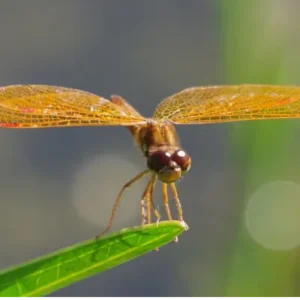
The aquatic young (naiads) eat tiny fellow-aquatic invertebrates, and unlike the more specialized naiads of other dragonflies, they use all parts of their habitat, hunting at any depth in their pond’s water column. For their carnivorous ways, Eastern Amberwings and other dragonflies are given a thumbs-up by a Florida pest control service, which says, “From the tiny Eastern Amberwing, to the flamboyant Halloween Pennant, dragonflies are some of the most important and charismatic beneficial bugs. They’re indiscriminate predators of many pest insects, including mosquitoes, flies, ants and wasps…… Next time you see one zip across your yard, consider saying thanks to the dragonfly for helping to control the pest population.”
Eastern Amberwings sure know how to court a gal. A male flies low over the water, patrolling a territory of choice egg-laying turf (weedy aquatic sites) about 20 feet wide and defending it vigorously – darting out at intruders and displaying with those spectacular wings. When a female approaches, he follows and courts her, swaying back and forth, abdomen raised. If she’s agreeable, she follows him home. He hovers over his territory while she evaluates it, and if she likes it, she gets him along with it. After mating, she lays eggs – usually alone, but sometimes under his watchful eye. The blob that she releases from the tip of her abdomen explodes as it enters the water, releasing as many as 150 eggs over the water’s surface. In his zeal to protect his “investment,” the male sometimes grabs an intruding male and flies in tandem with him, keeping him away from the female.
It’s not surprising that a critter that’s as flashy, as unmistakable, as widely distributed, and that has so many interesting behaviors has attracted the scientific community. A number of different studies have demonstrated, at least, that Eastern Amberwings have attitude. Here are some of the things that have been discovered about them:
- Site fidelity – Once a male finds what he thinks is a high-quality spot to lay eggs (an oviposition site), he protects it by day (he leaves at night to roost in a tree). He will defend it for days, especially if he has mated there. If he deliberately changes territories, he “moves up” to a higher quality site. He can be evicted from his territory by a feistier male.
- Heterospecific pursuit – Besides chasing each other, male Eastern Amberwings chase after any flying insect that could be mistaken for another Eastern Amberwing (that’s heterospecific pursuit). They’ve been observed pursuing large horse flies and small skipper butterflies, but they ignore larger dragonflies. Researchers concluded that following a horsefly was simply a case of mistaken identity of a similar-sized insect, but there may be something about the skipper’s coloration that pushed the Eastern Amberwings’ buttons.
- The cost of doing business – Defending a territory is “expensive,” and the more “close neighbors” an Eastern Amberwing has, the costlier it is for him. Having more neighbors results in more intrusions. More intrusions mean more energy spent chasing intruders or simply darting around being territorial. Expensive? Yes, but non-territorial males rarely get to pass on their genetic material.
- Home field advantage – Unlike those of some other Skimmers, Eastern Amberwing’s territorial disputes may escalate, but they are non-contact sports. If the aggression does not build, the territory-holder tends to win, but if the conflict escalates, victory often goes to the younger Eastern Amberwing. Males who had fewer interactions overall tended to have more energy and win low-key conflicts. The territory-holder may win other face-offs because he psyches out the competition or because the intruder decides he doesn’t like the territory enough to fight for it.
- Spatial learning – Dragonflies can remember the locations within their habitat where they find food, breed, and roost, and they know the routes between those places. A male will be more faithful to a territory where he has mated and less interested in a territory where he’s been beaten by a rival.
The BugLady