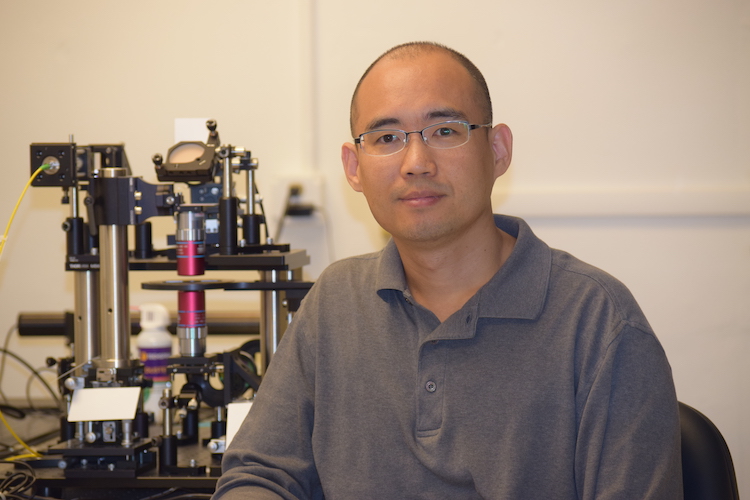
When you think of a microscope or a medical scan, you probably imagine peering into a hidden world — structures too small to see with the naked eye. But for Yongjin Sung, those tools are just the beginning.
He’s building imaging systems that reveal far more than ever before, transforming how we see the microscopic world.
Sung’s work was recognized with the “Office of Research/UWM Foundation Research Award” and presented at the UWM Employee Excellence Awards on Oct. 15.
Sung invented “snapshot optical tomography,” a technique that captures a full 3D image of a specimen in a single shot — no scanning required. That innovation opened the door to “4D” chemical imaging, allowing scientists to observe how materials or biological samples change over time.
His research, supported by the National Science Foundation, National Institutes of Health and the U.S. Department of Defense, has biomedical, semiconductor, and pharmaceutical applications.
Working with Massachusetts General Hospital, Sung also helped pioneer next-generation X-ray technologies, including phase contrast and dark-field imaging that provide much more detail than conventional X-rays. He even co-invented a motion-free CT system that is a potential game changer for clearer, faster scans and patient comfort.
Now, Sung is collaborating with researchers at Stanford and the University of California, San Francisco, to create a microscopic version of the PET scan. This breakthrough could allow scientists to track diseases at the cellular level, offering new insight into how illness begins — and how it might be stopped.
The UWM Excellence Awards were established in 1978 and continue to recognize and encourage UWM assistant and associate professors who have demonstrated potential to achieve distinction in their academic disciplines.
Read about his most recent work here.