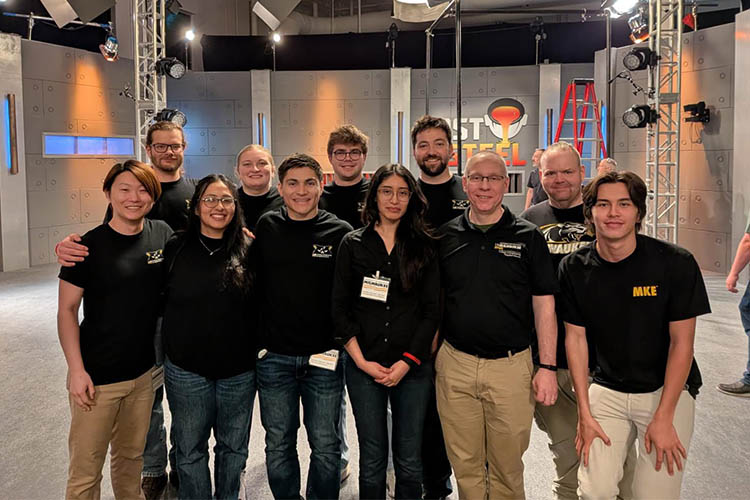
What happens when engineering students spend months designing a steel axe, then put it to the test against teams from across the country? For a group of students in the college, it ended with a national award – and plenty of sparks flying along the way.
Eleven students forming three teams represented UWM in the Cast in Steel Competition, in Grand Rapids, Mich., where they earned a cash prize in one of the six categories, the award for “Best Investment Casting.”
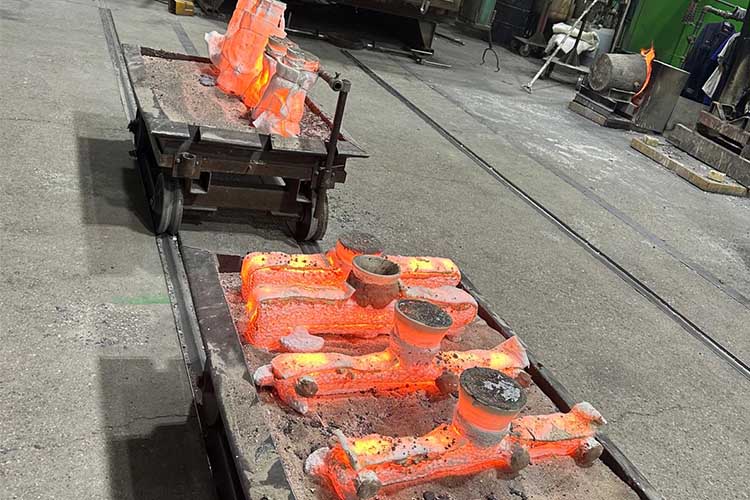
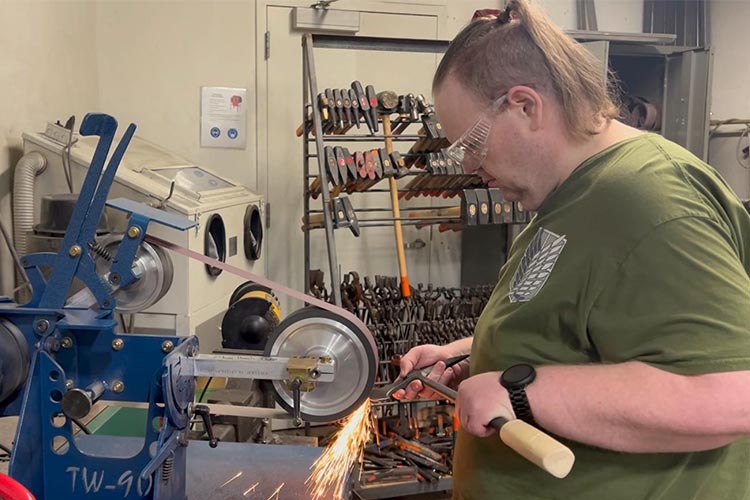
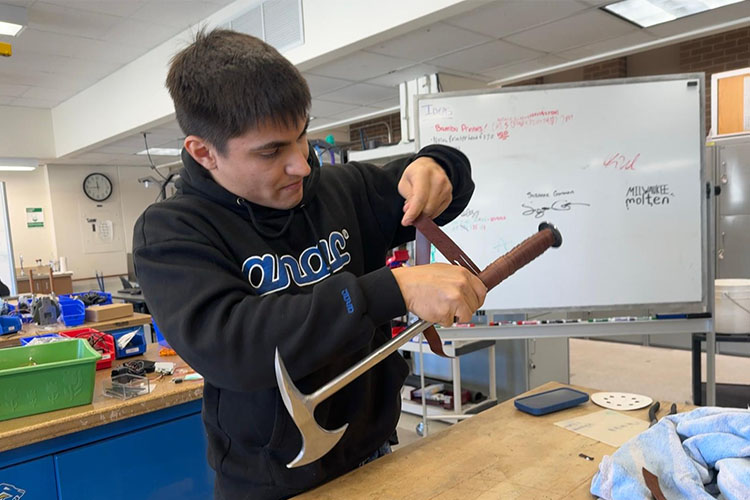
The challenge: to design and cast a functional weapon – a horseman’s axe, inspired by those used by Robert the Bruce, medieval king of Scotland.
Organized by the Steel Founders’ Society of America and held during Metalcasting Congress, the competition challenged 58 university teams to design, cast and test their axes. Success depended on more than just making an impressive-looking tool – teams had to create an axe that could withstand demanding mechanical tests while showcasing precise manufacturing techniques.
Preparation for the competition began in September 2025. Over months of work, students from both the Mechanical Engineering and Materials Science & Engineering departments, developed designs and ran simulations. They decided to use investment casting – a highly detailed manufacturing process.
What is investment casting?
In investment casting, a mold of the product is made by first creating the design in wax and then coating the outside several times with a ceramic slurry until you get the right thickness, said team member Carol Martinez, a senior in materials science & engineering.
“In the process, you melt out that the internal wax and then pour in the molten metal into the cavity that’s left,” Martinez said. “It’s called ‘investment’ because it takes a longer time than sand-casting. But we were thinking about the surface finish of our part.”
Sandcasting can give you a rough surface finish that would then have to be smoothed with machining afterward, she said.
Partners with industry
To bring their designs to life, the UWM students partnered with MetalTek International in Watertown, Wis., which has experience with investment casting and helped the team achieve the precision and finish they were aiming for.
At the competition, students not only tested their axes but also networked with industry professionals and observed a wide range of metal casting technologies in action.
“They were showing more than technical skill,” said faculty advisor Ben Church, associate professor, materials science & engineering. “They exhibited teamwork, persistence, and the kind of hands-on experience that allows them to apply classroom concepts.”
The team also thanks the UWM Prototyping Center and ThermTech in Waukesha for supporting the project.