Shamar Webster, a computer science master’s student, was featured in a May 22 Spectrum News segment “UWM Connected Systems Institute seeks to move manufacturing forward.”
Spectrum News features UWM’s Connected Systems Institute
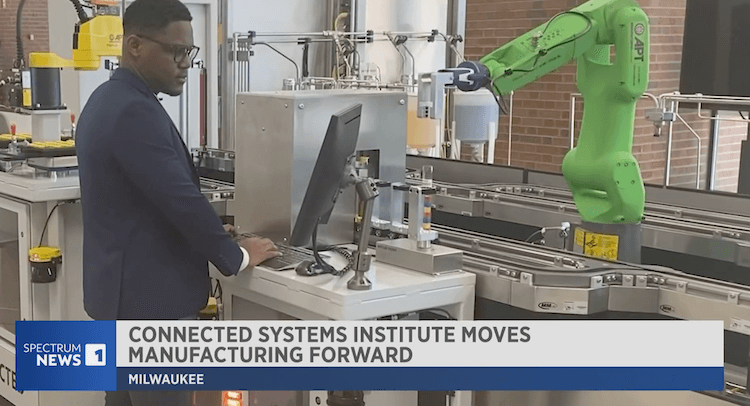
Shamar Webster, a computer science master’s student, was featured in a May 22 Spectrum News segment “UWM Connected Systems Institute seeks to move manufacturing forward.”

They are proud to be heading to college and setting examples for younger siblings. They play guitar, design clothing, volunteer at food pantries and perform improv comedy. They recognize the sacrifices made by their parents.
Meet the recent graduates from Milwaukee high schools who were awarded full-ride Nadella Scholarships to UWM to study computer science, data science and information technology. Their 10 scholarships are being funded through a gift from UWM alumnus and Microsoft Chairman and CEO Satya Nadella (’90 MS Computer Science) and his wife, Anu Nadella.
Eight of the Nadella Scholarship recipients intend to major in computer science. One intends to major in information science and technology and another in information technology management.
“It feels good for someone to invest in my future and give me a chance to better my life,” wrote Latrelle Jackson, Rufus King International High School. “It lets me know that I am doing right and that I should keep working.”
About the Nadella Scholarships
This is the second cohort to receive Nadella Scholarships, which are specifically for students who graduate from Milwaukee high schools.
The scholarships provide financial and academic support, and cover tuition, fees, room and board for up to five years at UWM. Each recipient is assigned a dedicated success coach, an academic advisor, and a peer mentor, and is provided additional tutoring and support opportunities to lead to successful student outcomes.
Chanyeop Park, assistant professor, electrical engineering, is working with researchers at Georgia Institute of Technology to develop and test an environmentally neutral alternative to the substance currently used in high-voltage electrical distribution equipment.
As infrastructure ages, the substance—sulfur hexafluoride—is becoming a worrisome contributor to global warming.
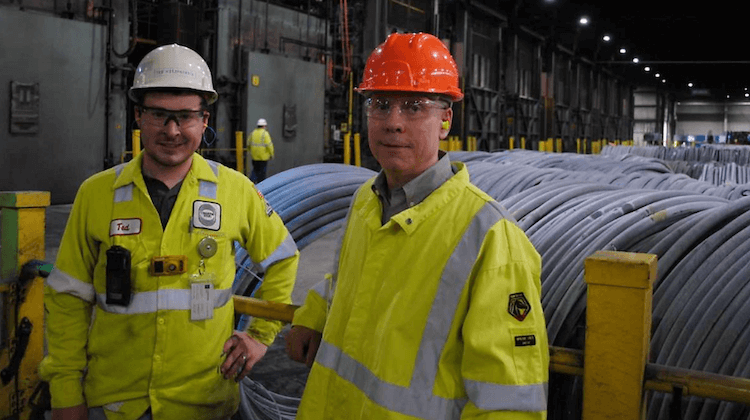
In their senior year, all students at UWM’s College of Engineering & Applied Science team up and partner with industry representatives to solve real-world problems. These problems aren’t easy to solve, but UWM students have knocked it out of the park on more than one occasion. On all occasions, they’ve had a taste of professional life and become better prepared for successful careers.
You can get a sense of our senior design projects in this Spectrum News story about one student team that was tasked with solving a problem for Charter Steel: UW-Milwaukee engineering students turn $72 investment into $43,000 in savings for Milwaukee-area company.
Or read about another team of students that created an inventory solution for AAA Sales and Engineering that was met with praise by experienced machinists and management: UWM engineering students create solution that save a company $840,000 a year.
For full descriptions of all projects our students have tackled in the last couple of years, please read our Senior Design Project page.
The U.S. Department of Energy (DOE), through Pacific Northwest National Laboratory (PNNL), awarded UWM’s Deyang Qu $900,000 in April to develop high energy density, all solid-state lithium batteries, which are considered to be the next generation of energy storage.
Qu is a distinguished professor and the Johnson Controls Endowed Professor in Energy Storage in UWM’s College of Engineering & Applied Science.
The three-year grant comes from the prestigious Battery500 Consortium, a public-private team of battery experts—led by PNNL—that is collaborating to develop electric vehicle batteries that are more reliable, higher performing, safer, and less expensive than current batteries. Battery500’s focus is on lithium metal batteries. Two researchers on the team have won Nobel Prizes in chemistry for their contributions to developing lithium-ion batteries, the world’s most powerful battery and a rechargeable energy source.
Now, researchers are aiming to create a battery that holds twice as much energy.
“Developing batteries with higher energy density is key to the battery revolution and society’s decreasing reliance on fossil fuels,” said Qu, who applies his knowledge of chemistry and technology to advance electrification. “Solid-state batteries increase the capacity of electric vehicle batteries.”
Qu’s battery research backed by $7.7 million of grants
Since joining the college in 2015, Qu has procured more than $7.7 million of external grants and contracts from the National Science Foundation, the U.S. Department of Energy and companies including Johnson Controls (now Clarios).
The DOE awarded him $1.25 million to research the roadblock to producing higher-density energy storage in lithium batteries: dendrite growth.
His other awards include $2 million to research lithium-sulfur batteries and $650,000 to study all solid-state lithium-ion batteries.

UWM industrial engineering students recently developed a way to save a Milwaukee-area company $840,000 annually.
Last fall, in their senior design class, undergraduates Easton Dobson, Colin Haagensen and Ryan O’Day were charged by Oak Creek-based AAA Sales & Engineering with improving the company’s inventory traceability. Industry mentor Steve Coolidge estimates that the students’ solution will save the company $840,000 annually. More.
This isn’t the first time that UWM engineering students helped a company solve a problem. Last year, a group of mechanical engineering students created a system that is saving a Saukville specialty steel manufacturer more than $43,000 annually. More.

Zhen Zeng joined UWM’s Computer Science Department in March as an assistant professor. Her primary research focuses on AI-based solutions for securing the network and cloud environment. She also is interested in cloud networking, cloud infrastructure, cybersecurity and computer science education.
“Professor Zeng’s work is of critical importance – both for research and for what students must understand to be effective in the workforce,” said Susan McRoy, professor and chair of UWM’s Department of Computer Science. “Cloud computing creates fantastic opportunities for everyone to benefit from complex data-driven software, but also huge risks to those who upload proprietary resources.”
Zeng has worked in the high-tech industry for years. She recently earned a PhD in computer science from Arizona State University.
Imagine never having to clean your glasses again.
An inventor at UWM’s College of Engineering & Applied Science has developed a self-cleaning coating that could be applied to commercial products, including eyeglasses, building glass and car windshields.
Junjie Niu, Richard and Joanne Grigg associate professor, materials science & engineering, was issued a U.S. patent in November for the technology, called 3D hybrid composite coating.
“It’s a super-hydrophobic coating,” Niu says. “When it gets wet, it activates and repels water and prevents particles from adhering to the surface.”
In addition to reducing the need for cleaning, the coating could reduce water consumption—in public urinals, for example—and prolong the life of products such as pipelines and sensors that are at risk of corrosion.
Decreasing consumption of energy and water are goals
At UWM, Niu and his 10-person research team have partnered with many Milwaukee-area companies in the past few years on several projects with the goals of decreasing energy consumption and decontaminating drinking water and water that is discharged from sewage lines into the environment.
In the past five years, he has been awarded more than $2.5 million in grants—from federal agencies, local agencies and industries—for research in these areas.
“Worldwide, energy conservation and clean water are the big topics of our time,” says Niu. “My background is interdisciplinary and I combine chemistry, physics and materials science in my research.”
His research on self-cleaning coatings has been supported by Sloan Valve, the Water Equipment and Policy (WEP) Research Center, and the University of Wisconsin System.
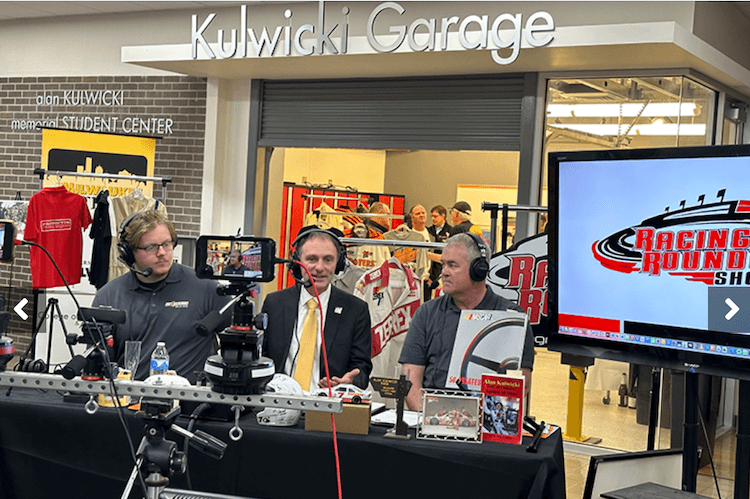
Former pit crew members and friends of the late Milwaukee NASCAR Hall of Fame member Alan Kulwicki (’77 Mechanical Engineering) shared memories at an event March 31 to mark the 30th anniversary of Kulwicki’s death. The event was held outside the Kulwicki Garage in EMS.
More.
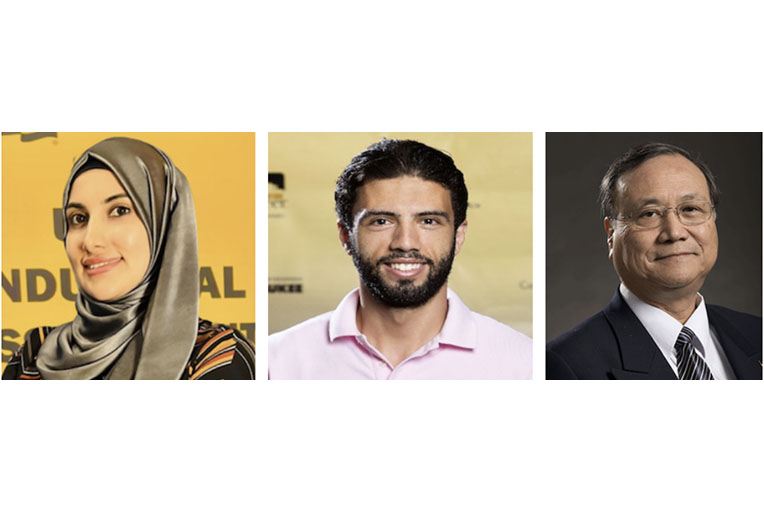
In March, the U.S. Department of Energy (DoE) recognized nine of the nation’s leading student researchers for their outstanding accomplishments in researching and promoting practices, principles and procedures that increase an industry’s energy saving efficiency and manufacturing productivity.
Of these nine, two—Walaa Saadeh and Abdel Rahman Salem—are graduate students at UWM’s College of Engineering & Applied Science.
Saadeh and Salem each received a 2023 Industrial Assessment Center Outstanding Student Award at the DoE’s 2023 IAC (Industrial Assessment Center) Student and Alumni Awards. The nationwide competition is open to students and alumni from 37 IACs. (Alumni awards also were presented at the competition.)
The next generation of energy engineers
DoE-funded IACs train the next generation of energy engineers.
UWM’s IAC is Wisconsin’s sole site and is under the direction of Ryo Amano, professor, and Richard and Joanne Grigg Faculty Fellow, in mechanical engineering.
The center provides in-depth energy assessments to small- and medium-sized manufacturers and utilities. The goal is to increase their productivity and competitiveness by reducing energy and water consumption, enhancing electrification, decarbonization, cybersecurity, and adopting smart manufacturing technology.
“Our IAC has many talented students who are well qualified to conduct energy assessments at nearly professional levels,” Amano said.
To date, more than 600 companies and water treatment plants have used the center’s services. On average, they received energy-consumption recommendations to save about $150,000 annually, higher than the national IAC average of $130,000.
The UWM IAC, Amano says, has achieved annual savings for Wisconsin manufacturers of 41 million kilowatt hours (kWh), 98,000 kilowatts (kW) of demand and 3.5 million therms.