WEP announces a call for research proposals for 2025
The Water Equipment and Policy Center (WEP), an Industry-University Cooperative Research Center supported by the National Science Foundation, is soliciting research proposals for 2025. WEP will award a total of $500,000 for projects that faculty members will work on with industry members.
Deadline for submission of proposals is Friday, August 16. Awards will be announced in November.
WEP brings together researchers at both UWM and Marquette University together with industry partners to create new devices, novel materials and innovative systems that will help industry members solve problems and policymakers manage stressed water resources.
The maximum award size for new projects is $50,000 per year, but the maximum award size for continuing projects may be up to $100,000 per year. For continuing projects, proposals need to be submitted annually with a summary of prior accomplishments and well-defined milestones and deliverables for funding requested for the specific year.
Continuing projects will compete with new proposals received in the same round.
The center currently has 11 industry members, including: A.O. Smith Corporation, Badger Meter, GE Appliances, Milwaukee Metropolitan Sewerage District, NEW Water, Sentry Equipment, Sloan, Pentair Inc., the U.S. Environmental Protection Agency, Watts Water Technologies, and the Wisconsin Department of Natural Resources.
Submit proposals through AirTable. For more information, contact Professor Qian Liao, WEP center director, at liao@uwm.edu.
New cohort of 11 Nadella Scholars announced
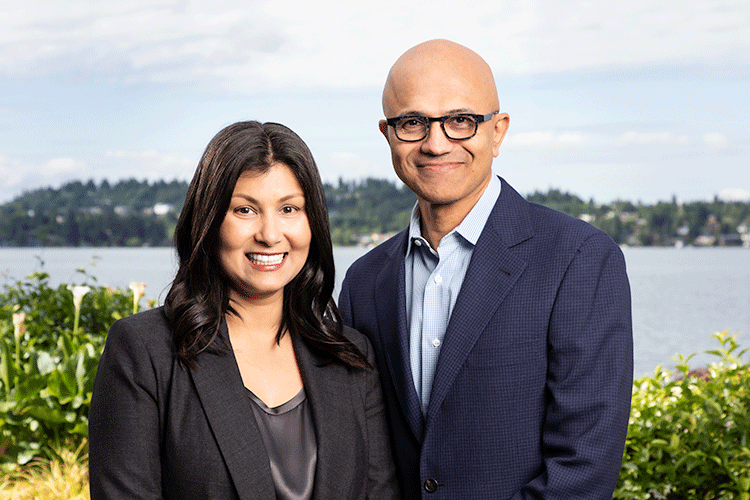
UWM has named a third cohort of full-ride scholarship winners who are funded through a gift from UWM alumnus and Microsoft Chairman and CEO Satya Nadella (’90 MS computer science) and his wife, Anu Nadella.
Eleven students were chosen for 2024 from eight Milwaukee high schools, all majoring in computer science or computer engineering.
With the new group, the College now has 23 recipients of the scholarship at the freshman, sophomore and junior levels for this fall.
Recipient Sheldon Clarke expressed a common sentiment among the members of the group.
“With this scholarship, I’ll be able to focus on my career goals without worrying about money, which is truly a blessing and an honor that I couldn’t be more thankful for,” said Clarke, who graduated from Carmen High School, northwest.
The Anu and Satya Nadella Scholarship is specifically for students who graduate from Milwaukee high schools and intend to study computer science, computer engineering, data science, or information studies. Each scholarship provides financial and academic support and room and board for up to five years.
Each scholarship recipient is assigned a dedicated success coach, an academic advisor and a peer mentor, and is provided additional tutoring and support opportunities to lead to successful student outcomes. The inaugural cohort began in Fall 2022.
The Nadellas’ $2 million gift supports the Fund for Diversity in Tech Education at UWM, which helps the university attract, retain and graduate students from marginalized communities, preparing them with the skills needed to pursue high-tech careers.
Spectrum News highlights research from Rahman’s Biorobotics Lab
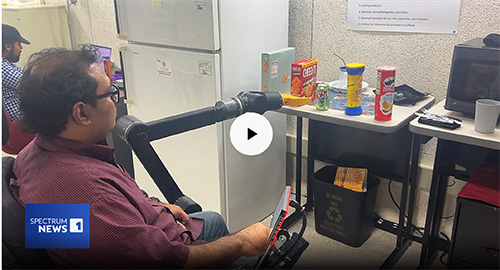
Spectrum News featured student researchers in the biorobotics lab of Associate Professor Habib Rahman, as they demonstrated the robotic arm they have created for people who use a wheelchair and have limited use of their upper body.
The report, which aired June 5, featured three graduate students who displayed the variety of objects that the robotic arm can grasp: Samiul Haque Sunny, biomedical engineering and health informatics; Nayan Banik, computer science; and visiting student Ishrak Zarif.
The researchers in Rahman’s lab have designed the robotic arm so that it can be controlled in a variety of ways, including with the chin. The arm, which can help people with disabilities maintain their independence, is funded by the National Institute on Disability, Independent Living, and Rehabilitation Research. Watch the segment.
Students weigh in on their ‘green’ internships with Milwaukee’s water and energy businesses
Experiencing an internship at some of Milwaukee’s largest water- and energy-related businesses has given some UWM students a chance to use their education to make a positive difference. For others, the internship has helped to better define their career options.
For all of them, the Clean Energy and Clean Water Internship Program, funded by a grant from the Wisconsin Department of Workforce Development (DWD), has meant learning skills they would not have gotten in the classroom.
Three students from the College spoke about their involvement in the extremely competitive program that recently came to an end. A total of 415 students applied for the internships, with only 44 (39 from the College) hired by a pool of 16 companies in the water and energy sectors.
The DWD provided funding for the paid internships through its Fast Forward program that was expanded in 2023 to include engineering opportunities in water and energy.
“It’s been a healthy mix of student backgrounds,” said Sean Lybeck-Smoak, Clean Energy and Clean Water Internship Coordinator. “For some this was their first experience. Others had co-op, internship, or research experience before.”
Below some of the interns discuss their internship experiences.
Helping the company automate an intake process used to prepare sales proposals.
Why were you interested in this particular internship program?
The internship attracted me because it allows you to give back, whether that’s to serve people or to serve the environment. I wanted to contribute to society with my degree. That’s my major goal and it has been my major goal from my undergraduate program.
Why UWM?
I wanted to study in the U.S. for my master’s degree. I did get accepted into other universities but UWM grabbed my attention because it was an R1 research university so I knew there would be opportunities here. And the place here is just too good! I’m already in love with Milwaukee!
Laura Schneider, solar coordinator for the residential sector at Arch Solar:
I know nothing about computer science, so [my colleague and I] were brainstorming a wish list of stuff that we could do with a person who has that skill set. And we came up with this idea, although during her interview we believed the task would be impossible. She has made it possible!
Employer: A.O. Smith
Greta Boehm, junior, biomedical engineering
Her role:
She is on a team that is prototyping a variety of water-related sensors.
Why UWM?
I’m from Verona, but I chose Milwaukee, rather than Madison, because it I knew it would push me out of my comfort zone. UWM has so many resources. But the successful people that I see are the ones that really use those resources.
Just after Roy completed a co-op at the company, working on research in metallurgy, he was offered the internship. His projects are related to water filtration systems, product validation and PFAS.
What are you getting from the experience?
Having the two different experiences makes me holistically a bit better [employee] candidate in terms of understanding what a product is and what a company is working toward.
Why UWM?
Before beginning as a freshman, I applied for the Support for Undergraduate Research Fellows (SURF) program to be in a research team with Dr. Pradeep Rohatgi. So I got involved in his research team way before I actually stepped into the U.S.
Rebecca Tallon, engineering director, water treatment technology, at A.O. Smith:
There’s a lot you can learn in an internship, like just how businesses operate and what professional behavior looks like. But they [interns] also learn the technical skills. We work on big projects with a lot of people involved. So, it’s learning to navigate that space before you actually hit the workforce as a full-time employee.
Strong partnerships drive increased global exchange opportunities
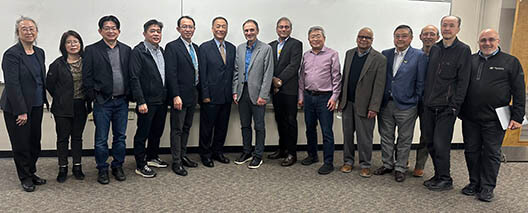
A delegation from Chung Yuan Christian University (CYCU) in Taiwan visited UWM in May to tour research facilities and discuss potential expansion of the partnership the university has with the College of Engineering & Applied Science. CYCU has shared a dual master’s degree program with the College since fall of 2017.
Then, last fall, the partnership grew to include CYCU undergraduates who come here for their final two undergraduate years, called the 2+2 Program. Once completed, the credits they earn are transferrable to their home institution and students receive their degrees from both institutions.
This first 2+2 program cohort included 17 students, with 16 more enrolling at UWM for Fall 2024.
The CYCU trip here follows one made in February by Dean Brett Peters, UWM Provost Andrew Daire, Jennifer Gruenewald of the Center for International Education, and professor emeritus David Yu to CYCU and Chang Gung University (CGU), another institution in Taiwan that has an existing joint degree program with the College.
The College’s legacy of building strong partnerships with universities around the world continues to pay off this year, from record-breaking enrollment of international students from South Asia to talks of expanding ties with Taiwanese universities.
Global partners across campus
“Embracing international student and faculty research exchange is beneficial, not only because it enhances the academic culture, but also because the challenges facing society are global in scale,” said Dean Brett Peters. “The College has shown a commitment to fostering these global ties. But we’re also one part of a campuswide tradition at UWM.”
Of the 46 universities that UWM’s Center for International Education has listed as having an admissions agreement or dual degree program at UWM, 31 have a partnership with the College of Engineering. Now Daire is exploring whether some of the global partners with the College would be interested in extending their academic agreements with other UWM schools and colleges.
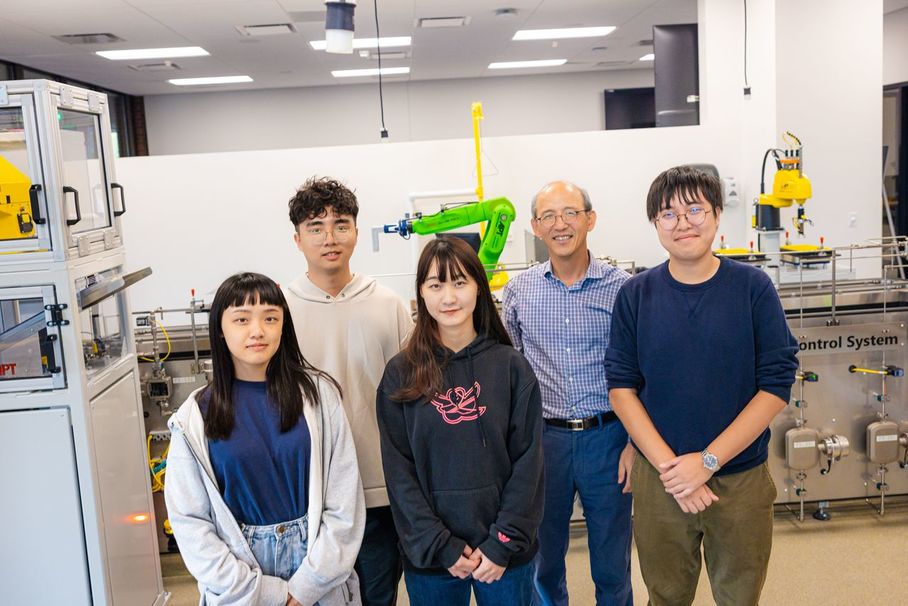
Industrial engineering chair Jeajin Jang (second from right) shows master’s students from CYCU around UWM’s Connected Systems Institute. Students (from left) are Hsuan Yuan Siauw, Wei Tse Liao, Tien Tzu Liu and Hao Yu Wang. The students are participating in the dual master’s degree program with the College.
That was the situation when a partnership with CGU was forged in 2019, when dual programs were created at both the College and UWM’s Zilber School of Public Health. It includes undergraduate, non-degree exchange programs and dual graduate degree programs.Yu, professor emeritus, electrical engineering, worked with UWM’s Center for International Education and the Graduate School to form the College’s Asian partnerships.
Nurturing our relationships
“One lesson learned from our CYCU relationship is that it is not enough to sign a memorandum of understanding, but to attentively nurture our inter-institutional relationships through regular dialogue – and visits – between faculty and students,” said Prasenjit Guptasarma, associate dean for academic affairs at the College.
Guptasarma has traveled to nearly 15 universities in India in an effort to build and maintain UWM’s relationships there. Although the College also has students from Germany, Iran and China, among others, students from India represent the largest slice of enrollment from other countries.
In fall 2023, the College had 213 graduate students and 33 undergraduate from India, Bangladesh and Sri Lanka alone. Those numbers were rivaled at UWM only by similar South Asian enrollments in the Lubar School of Business.
Cheng Yu Yeh is a member of the first undergraduate cohort from CYCU.
An undergrad weighs in
Cheng Yu Yeh, a junior in computer science, chose to attend CYCU because it gave him the opportunity to participate in the new undergraduate joint program with UWM. He is excited to be in the first cohort of the new 2+2 program for undergraduates and hopes to work in the U.S. after graduation.
So far, he said, the coursework is more rigorous here than in Taiwan, but the larger class sizes at UWM give him the feeling that he is part of a learning community.
“In lecture courses here, we have to communicate with our classmates which is really good,” he said. “We don’t study on our own as much as we do in Taiwan. I feel that I’m learning much more.”
Computer science hosts lunch with top students
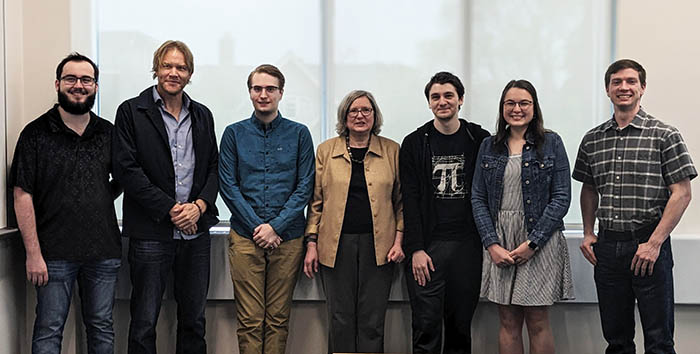
Each semester, the Computer Science faculty vote to recognize some of our top graduating seniors. This semester’s awardees included: Hudson See, Nathan Leverence, Zachary Dunn, Jacob Hansen, Anna Fronk, Michael McLaughlin, and Mitchell Ladwig.
To identify these students, the faculty members start with copies of transcripts for the top 15% of students. They also consider performance in challenging classes and achievements in projects or undergraduate research.
After the students are selected, the department chair creates personalized certificates to recognize the achievement. Students also received a gift and were treated to a catered lunch at the LEC where they discussed their respective journeys in computing and plans for the future.
Another stellar Order of the Engineer celebration and graduation
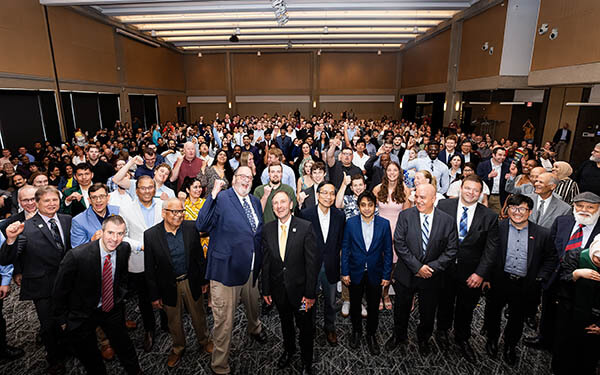
More than 120 students from the College participated in the Spring 2024 Order of the Engineer (OOTE), representing both undergraduates and graduate students and all departments. They were among 283 students who applied for graduation this spring or summer.
Bill Selle (’84 BS Mechanical Engineering) served as emcee of OOTE, as he has each semester since 1996. The event included a tribute to Jeff Kautzer, Chief Electrical Engineer at GE HealthCare, to recognize his 43 years of service as an adjunct professor, teaching senior design in electrical engineering.
Many students reported their post-graduation plans to join employers such as HNTB, Eaton, Generac, Johnson Controls, JP Cullen, and We Energies.
Student attending the OOTE celebration contributed some of their favorite memories at the College, which were displayed on a rotating PowerPoint reel. Among the memories shared were:
Friends made in the Tutoring Center
Late-night Scrabble
The Poster Competition & Experiential Learning Expo
Charlanique Hueneke, an undergraduate in civil engineering, has won one of four scholarships awarded by STEM Forward to area college students.
STEM Forward, a Milwaukee non-profit advancing STEM workforce through STEM education and programming, awards the scholarships each year. Each recipient has demonstrated academic success in a STEM field, and substantial involvement in extracurricular activities and organizations.
In her video, Hueneke, a non-traditional student, describes her educational journey.
“Coming to the University of Wisconsin-Milwaukee has literally changed my life, my outlook, and the trajectory of my future,” she said. “Reentering college was the best choice I could have made for myself.”
Akundi named to leadership role in IISE
Congratulations to Aditya Akundi, who has been named Assistant Vice President for Student Development for the North American Operations Board (NAOB) of the Institute of Industrial and Systems Engineers (IISE).
The NAOB develops policies and provides strategic direction for the effective operation of IISE’s regions and chapters in the United States, Canada, and Mexico.
Among Akundi’s duties are providing regional conference support, planning of student-focused events at the IISE annual conference – including relevant student competitions – and assisting NAOB in planning for Volunteer Leadership Training (VoLT) at IISE.
Rohatgi named an inaugural ‘Highly Ranked Scholar’ by ScholarGPS
ScholarGPS has ranked Distinguished Professor Pradeep Rohatgi, materials science & engineering, No. 1 in the world for lifetime achievement in the field of metal matrix composites.
The organization has also named Rohatgi as a Highly Ranked Scholar, or one who ranks in .05% of all scholars worldwide, based on his prolific publication record, the high impact of his work, and the outstanding quality of his scholarly contributions.
ScholarGPS is a California-based company that applies data science techniques to its massive database of over 200 million publications and 3 billion citations to rank scholars at 55,000 institutions worldwide.