PhD student recognized nationally for energy engineering
Hats off to Cheikh Kada, a PhD student in mechanical engineering, who has received this year’s ITAC Achievement Award from the U.S. Department of Energy. The award recognizes achievements in energy engineering.
UWM’s Industrial Training and Assessment Center (ITAC) is one of just 39 such federally backed centers in the nation. These centers focus on improving energy efficiency in the often hard-to-engage small- and medium-sized manufacturing community. They also train the next generation of energy auditors, who can provide this skill to industry.
“This is a highly competitive award among centers,” said Professor Ryo Amano, who leads the Midwest ITAC and is Kada’s advisor. “DOE typically awards six or seven students each year.”
Undergraduate places at national metalcasting research competition
Congratulations to Flavio Toma, an undergraduate mechanical engineering student and research assistant at the UWM Foundry Lab for winning second place and a prize of $750 at a national competition showcasing original metalcasting research.
The International Journal of Metalcasting’s Foundry Education Foundation Student Research Competition is judged by a panel of industry experts from the American Foundry Society.
UWM students have placed first or second in this competition for the fourth consecutive year.
In his presentation, Toma described a groundbreaking, single-step casting process: By coating sand cores with a specially designed slurry made of nickel, copper, and graphite powders before the liquid brass is poured, the team successfully created a highly durable, enhanced surface layer on the inside of the castings.
Rather than mixing expensive elements throughout the entire bulk of the casting, this new technique concentrates beneficial materials only on the surface where they are most needed. This approach dramatically reduces manufacturing costs and eliminates the need for toxic lead additions.
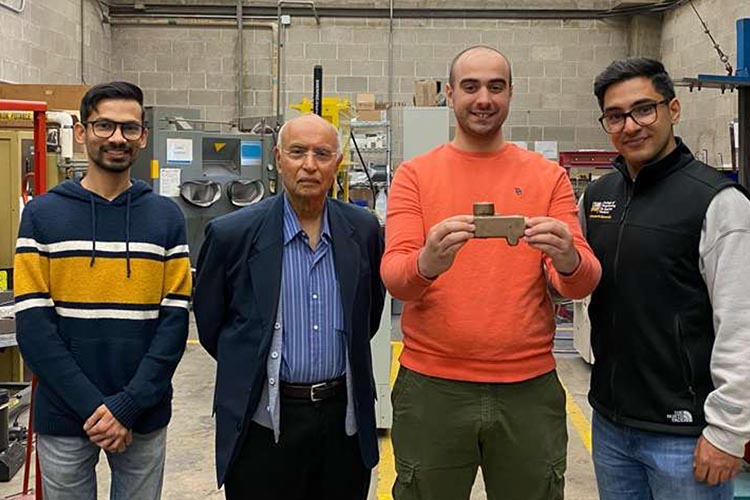
Toma presented the findings on behalf of the UWM research team that included Kaustubh Kishore Rane, Mehran Zare and Swaroop Behera. Associate Professor Benjamin Church, and Pradeep Rohatgi, Distinguished Professor in charge of the UWM Foundry Lab were the advisors.
Senior Design winning teams honored at Order of the Engineer
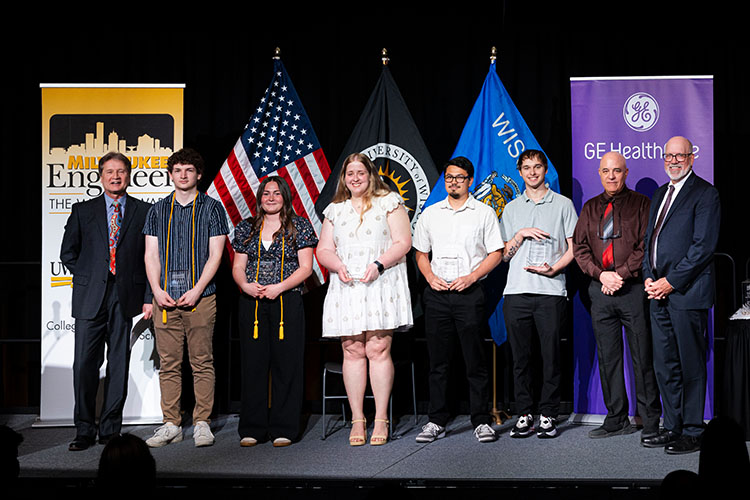
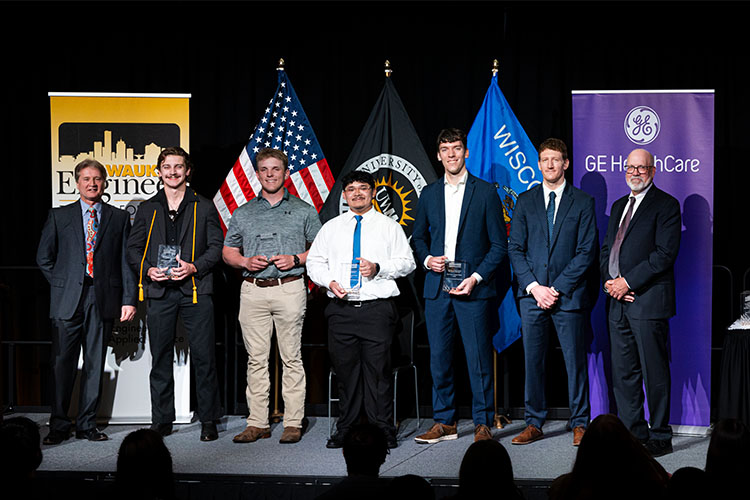
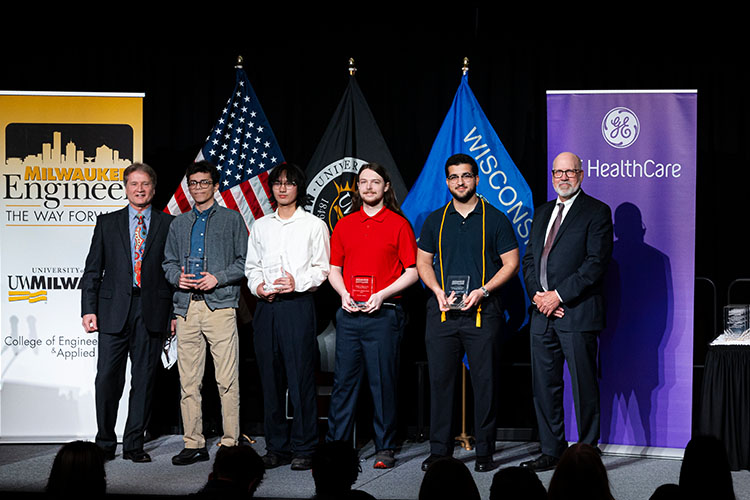
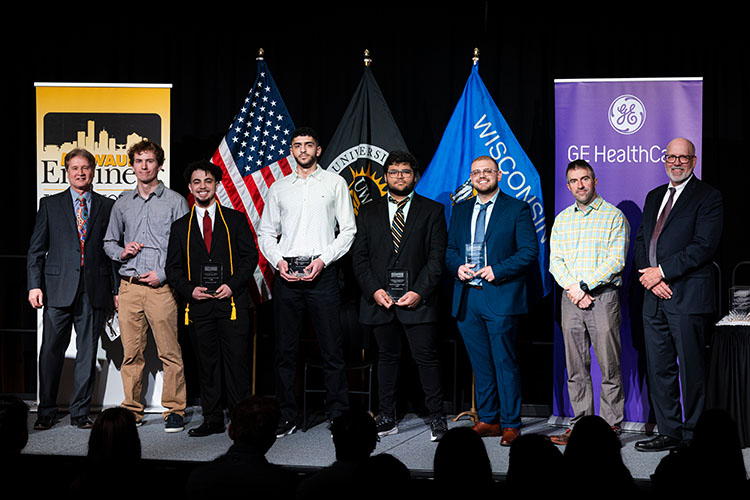
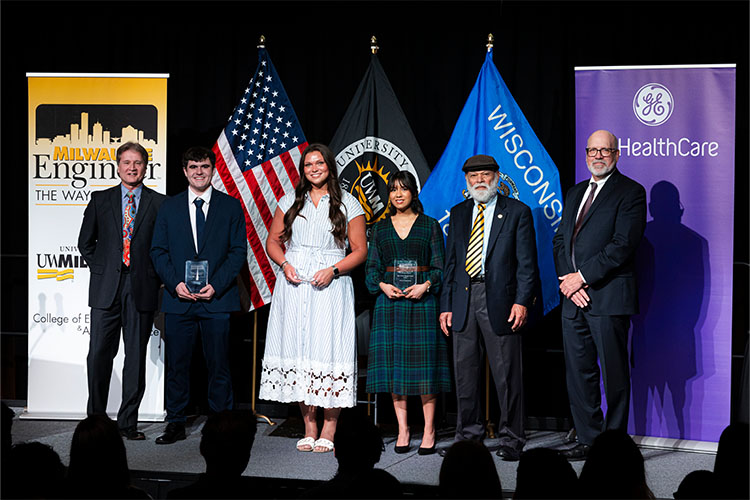
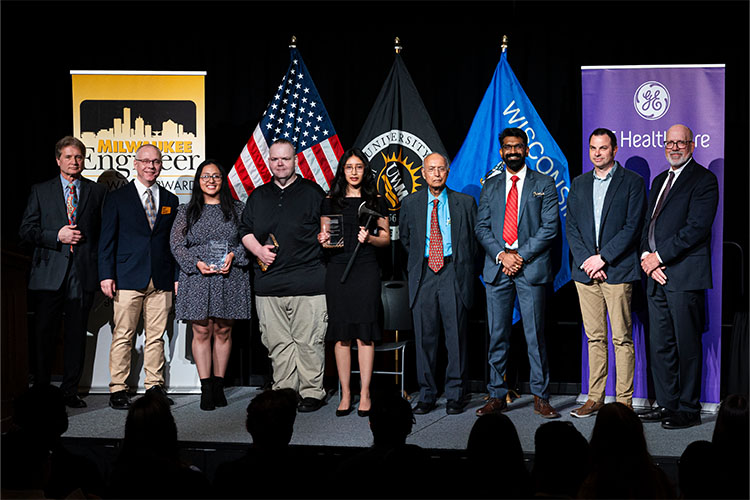
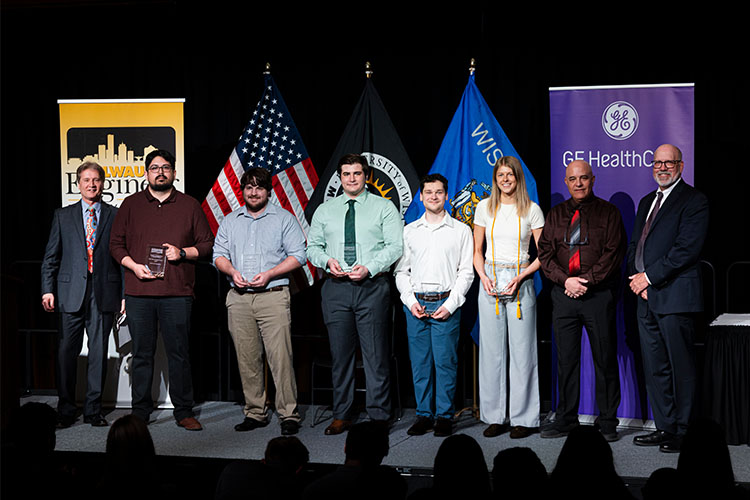
Congratulations to all the senior design teams, and the winning group, by department, honored at the Order of the Engineer ceremony on May 16. Senior Design courses provide experiential learning for students that includes teamwork, communication, and project management.
The number of teams in each department ranged from one, in biomedical engineering, to a whopping 13 from computer science. Teams in departments with more than one team competed in a friendly contest.
The college thanks GE HealthCare, which sponsors the Senior Design competition, and to all the companies who submitted projects. Dive into all the teams.
Biomedical Engineering (only one team) “Air Bubble Detection System.” Objective: Design a cost-effective system to detect, trap, and prevent air bubbles in IV fluid lines. The device must automatically detect bubbles, alert users, stop fluid flow, and safely isolate bubbles to improve patient safety, supported by prototype development and system validation.
Parker Appelbaum
Noelle Helms
Sophee Shell
David Sincere
Cole Wheeler
Advisor: Mohamed Yahiaoui Industry: UMedec
Civil & Environmental Engineering “Titletown Engineering Corp.” Objective: Design an effective parking/traffic solution for the Green Bay Shipyard redevelopment.
Luciano Celis
Brock Jasinski
Evan McGuire
James Ouano
Bryce Woosencraft
Advisors: Sarah Blackowski and Clayton Cloutier Industry: Stantec
Computer Science “Flashcard Roguelike.” Objective: To combine learning and gaming to create a more engaging, effective method for students and learners to study. Traditional flashcard tools and websites are often repetitive and lack interaction. This project aims to solve that by integrating flashcards into gameplay interactions, encouraging players to retain studied information while having fun.
Lawrence Emmer
Ademar Gamero
Mohsin Shah
Nicholas Tassone
Alexander Tong
Logan Watson
Advisor: Ayesha Nipu
Electrical Engineering “Lidar Distance Measurement Tool.” Objective: To create a handheld 905 nm time-of-flight LiDAR device with tilt and logging for quick distance checks and long-term movement monitoring.
Wasin Ghazi Assad
Nathan Krueger
Priyansh Patel
Anas Sabha
Omar Titi
Advisors: Jeff Kautzer and William Dussault
Industrial & Manufacturing Engineering “Digital Visual Management Scoreboard.” Objective: Create a real-time digital visual management scoreboard to better achieve performance goals, promote faster data-driven decisions, and support initiatives aimed at reducing cycle time and increasing throughput for medium and large power core and coil assembly areas at Prolec-GE.
Ryan Bielinski
Avery Longrie
Cynthia Reyes
Advisor: Iftekharuddin Khan Industry: Prolec-GE
Materials Science & Engineering “Milwaukee Molten (Horseman’s Axe).” Objective: To design and cast a horseman’s axe for the Cast in Steel 2026 national competition. Used our background to design the axe, choose the material, choose the heat treatment, and choose what testing is performed on the axe and metal. The team earned the Award for Best Investment Casting at AFS Metalcasting Congress 2026.
Aaron Macek
Carol Martinez
Anna Carolina Salcedo Martinez
Advisors:
Pradeep Rohatgi, Distinguished Professor
Ben Church, Associate Professor,
William Musinski, Assistant Professor
Swaroop Behera, PhD
Industry Mentor: Jim Myers, MetalTek
Mechanical Engineering “Modular Duct Heater for Simplified Manufacturing and Thermal Optimization.” Objective: Design a modular duct heater with interconnectable sections to simplify manufacturing, improve thermal performance, and enable scalable assembly. The design will use simulation and physical testing to validate airflow, efficiency, and manufacturability, with deliverables including CAD models, prototypes, and engineering validation reports.
Brian Anderson
Shannon Herman
Riley Palermo
Valentine Rodriguez
Logan Woodard
Advisor: Mohamed Yahiaoui Industry Mentor: Brett Rogatzki, Zoppas Industries
Order of the Engineer celebrates the college’s student journeys
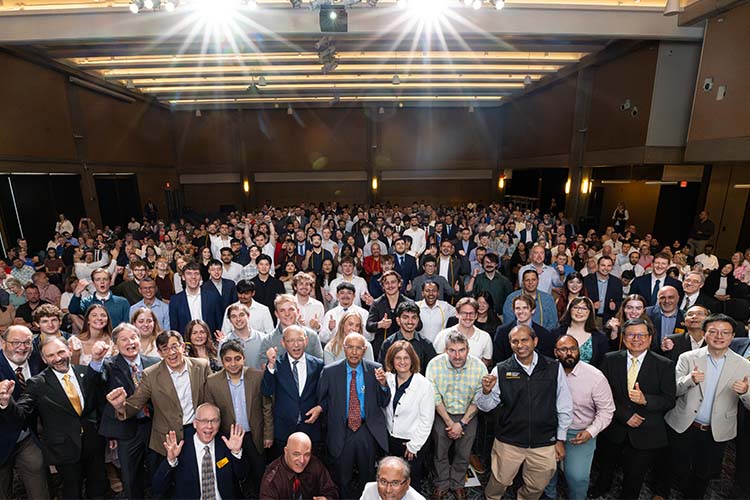
More than 140 students from the college participated in the Spring 2026 Order of the Engineer (OOTE), representing both undergraduates and graduate students in all departments. They were among 273 students from the college who received their diplomas this spring or summer.
As he has since 1996, Bill Selle (’84 BS Mechanical Engineering) served as emcee.
Many students reported their post-graduation plans to join employers such as We Energies, GE HealthCare, Lucas Milhaupt, Graef, Milwaukee Tool, Sargent & Lundy (Chicago), Toshiba America Energy Systems and the U.S. Navy.
Students attending the celebration contributed some of their favorite memories at the college, which were displayed on a PowerPoint reel. Among the memories shared were:
Late-night sessions in the senior design room where I learned the art of hardware-software integration.
Having classes with my friends and my sister.
Group study sessions in the Tutoring Center and computer lab
Using the Makerspace to 3D print and fabricate stuff I designed for projects.
Working with BOTCH Dice Company to build a product that can actually benefit their company.
Two from college included in UWM’s ‘Hired Before Graduation’ slideshow and graduate video
More than 270 students from the college graduated on May 17. Among them were two bachelor’s degree recipients who were featured in UWM’s graduation promotions.
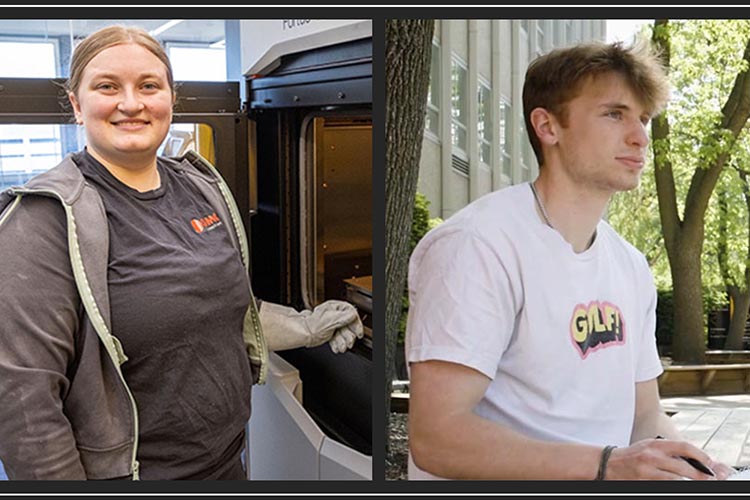
Suzanne Gorman graduated with a bachelor’s in mechanical engineering and is continuing with her accelerated master’s degree at UWM while working in new role as an applications engineer at Lucas Milhaupt. Gorman is taking advantage of the college’s Accelerated Graduate Degree program which offers students the opportunity to earn a bachelor’s and a master’s in as few as five years.
At Lucas Milhaupt, she will develop customized brazing solutions. Brazing involves creating metallic mixtures that are used to join base metals without melting them. Her achievement was showcased in the photo slideshow “Hired Before Graduation” in the UWM REPORT.
Greg Oberbroeckling earned a bachelor’s degree in industrial engineering. He appeared in the campus-producedvideo (at the 1:57 mark) that showcases one graduate from each college and their next steps. Studying to be an engineer while also serving as president of the men’s club soccer team taught him that hard work and commitment are needed for success, Oberbroeckling said.
It’s a family affair for one graduate, Fox 6 News reports
Congratulations to Will Peters who graduated with honors with a bachelor’s degree in computer science and as a commissioned officer in the Wisconsin Army National Guard. WITI-TV News, Fox 6 Milwaukee, featured Will and his mother, Mary Peters, who also crossed the commencement stage on May 17. Mary received her master’s degree in nursing. She is a second-time alumna, having earned her bachelor’s degree in December 2001. Completing the picture is Will Peters’ father, Christopher Peters, who is a UWM assistant professor of nursing.
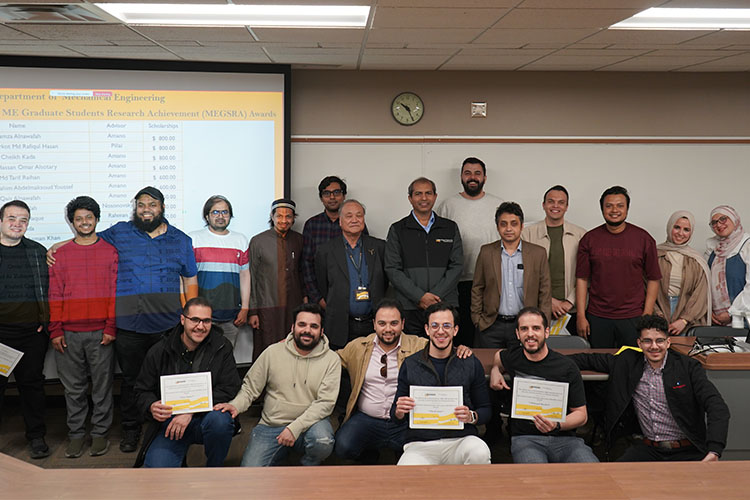
Seventeen receive the Mechanical Engineering Graduate research awards
The Mechanical Engineering Graduate Program Committee has awarded 17 student research achievement awards that recognize scholarly contributions, including publishing research findings in reputable journals and presenting at conferences in the field. “We congratulate each of you on this well-deserved achievement,” said Professor and department chair Habib Rahman. “This award represents your dedication, hard work, and commitment to excellence in graduate research.”
The top five students, based on the number of journal and conference publications over the past year, gave short presentations of their work.
Hamza Alnawafah Development of a photovoltaic-powered PEM electrolyzer integrated with modern power systems to address hydrogen generation efficiency and instability under fluctuating solar conditions, enabling liable and sustainable green hydrogen production.
Abul Borkot Md Rafiqul Hasan Development of data-driven porous media transport models to address coupled heat, liquid, and contaminant transport challenges in engineered and natural porous systems. This will enable improved thermal management, groundwater remediation, and advanced material design.
Kada Kada Optimizing hydropower efficiency by tackling captivation, the formation and violent collapse of vapor bubbles that damage turbine blades. This is done by integrating high-fidelity computational fluid dynamics simulations with physical experimental validation.
Omar Shaker Development of new methodology to design wind turbines that address energy loss due to varying tip speed ratio for small-sized horizontal access wind turbines. This enables a greater amount of energy harnessed at non-optimal wind speeds.
Mohamed Ibrahim Abdelmaksoud Youssef Optimizing helical vertical-axis wind turbine blade aerodynamics to address inefficient urban wind energy harvesting. The goal is to enable rooftop residential turbines to achieve greater power output through winglets tubercles and vortex generators.
Twelve other students in the department also were recognized.
Qais Mikhled Khalaf Alnawafah Development and optimization of sustainable energy and thermal management systems using solar energy, artificial intelligence, nanofluids, and advanced cooling technologies.
Omar Alsotary Development of an optimization tool to address the frosting and defrosting behavior of air-sourced heat pumps and investigate of the potential of a defrosting hybrid system to improve efficiently during winter in cold climates.
Masum Bellah Design of shape-memory-alloy reinforced self-healing metal matrix composites to address structural degradation in critical structures such as aerospace and spacecraft. The work enables autonomous damage recovery, extended component lifespan, improved structural safety and reduced maintenance costs.
Md Enamul Haque Development of a portable and bed-attachable, smart exoskeleton for a lower-limb rehabilitation robot. This addresses the lack of consistent and accessible three-stage therapy for bedridden patients recovering from immobilizing conditions.
Cheikh Kada Optimizing the co-pyrolysis of waste blends to maximize energy recovery and minimize waste volume. Leveraging synergistic thermo-mechanical effects can increase fuel yield and quality, ultimately reducing fossil fuel dependency.
Md Mahafuzur Rahaman Khan Development of an intelligent desktop-mounted neurorehabilitation system integrated with AI-driven, dynamically adaptive games to enhance motor recovery outcomes, while addressing low engagement with conventional upper-limb physical therapy among stroke survivors.
Areej Khalil Optimized helical diverter geometries for passive cooling within gas turbine blade channels. The aim is to improve the cooling efficacy, thereby increasing cycle efficiency and extending the lifespan of critical aerospace components.
Mohamed Maache Optimizing the process of converting waste to energy using the thermochemical conversion process. This will help to reducing greenhouse gas emissions and overcoming the dependency on fossil fuels.
Khaled Qananba Development of a dielectrophoresis-based microfluidic platform to address the lack of rapid, label-free methods for detecting and separating micro- and nanoscale particles for biomedical and environmental applications. This will enable more efficient viral detection and particle characterization.
Md Tarif Raihan Development of intelligent liquid and porous media cooling technologies to address overheating and energy inefficiencies in next-generation data centers. The aim is to enhance thermal performance and reduce energy consumption.
Asif Al Zubayer Swapnil Development of a new sensor-aided, tool changer system for multifunctional assistive and collaborative robots that will help the disabled and those who use powered wheelchairs to operate robotic arms to perform activities of daily living.
Mohamed Abdel-Aziz Sayed Youssef Design of a vascular network to be embedded into materials, allowing for autonomous healing mechanisms to fill in micro-cracks that occur in engineering applications.
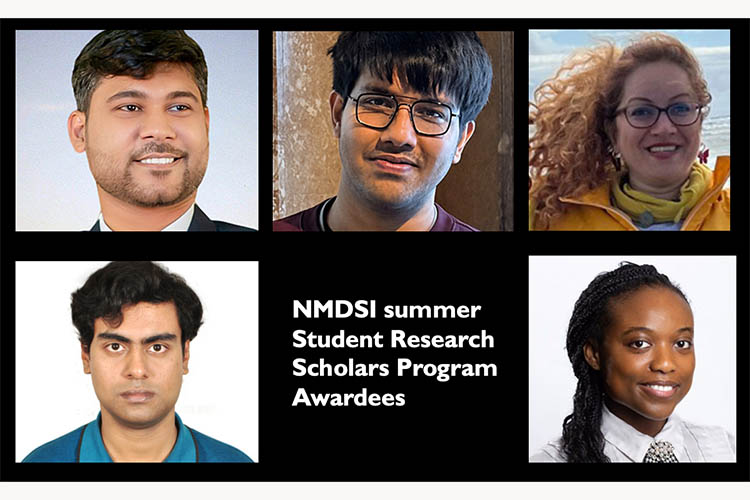
NMDSI funds five through its Student Research Scholars Program
Launched in 2023, the program helps student researchers gain practical experience working on interdisciplinary projects at their home campuses. As part of its eighth cycle, NMDSI received 57 proposals spanning 15 disciplines, highlighting growing cross-campus engagement in student AI and data science research. A partnership among UWM, Marquette University and Northwestern Mutual, NMDSI aims to establish Wisconsin as a national hub for data science and technology.
A committee subject matter experts reviewed the proposals and has awarded $77,500 funding to 24 student researchers for Summer 2026. Five of the 11 awards to UWM students were from the college, including:
Nayan Banik, computer science Faculty Mentor: Mohammad Habib Rahman “Simulation-Grounded Deep Learning for Safe Autonomous Mobile Manipulation in Underserved Community Healthcare Environments.”
Motakabbir Hossain, computer science Faculty Mentor: Susan McRoy “Creating an AI-Enabled Analysis Pipeline for Audio Recordings of Health Coaching to Promote Physical Activity for Patients with Knee Osteoarthritis.”
Sammie Omranian, computer science Faculty Mentor: Susan McRoy “AI Methods to Assess Signs of Professional Burnout in Communication between Health Coaches and their Clients.”
Raisa Nkweteyim, bioinformatics Faculty Mentor: Lu He “Disparities in Receipt and Timing of Initial Medical Nutrition Therapy Among Adults with Type 2 Diabetes in the ‘All of Us’ Research Program.”
Asif Al Zubayer Swapnil, mechanical engineering Faculty Mentor: Mohammad Habib Rahman “Exploring Vision-Language-Action Model Integration for Sensor-Augmented Embodied AI.”
Students in Amano lab talk to Spectrum News about the future of biomass energy
Biomass – such as cork, sawdust, corn stalks, and the never-ending stream of animal waste – can be used to create biofuel by burning it in the absence of oxygen. In fact, it can create super-efficient and clean hydrogen gas and cut down on our reliance on fossil fuels. So why don’t we use biomass more?
Mohamed Maache
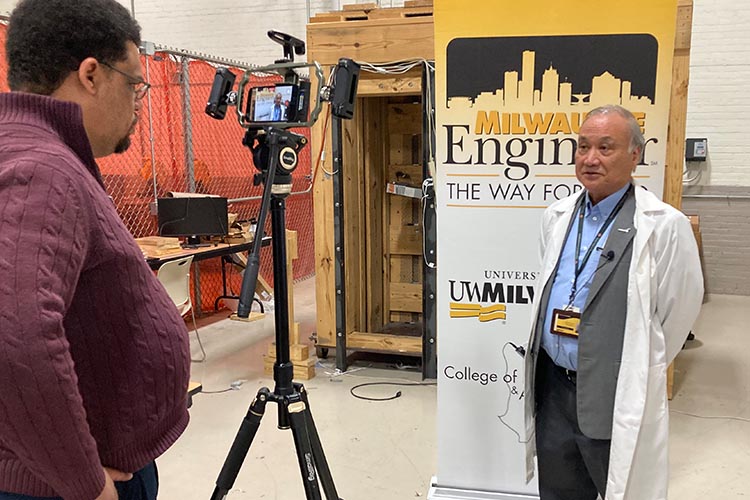
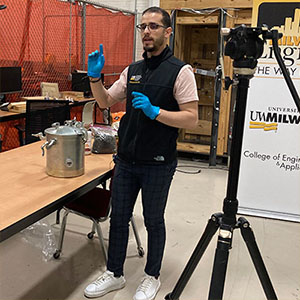
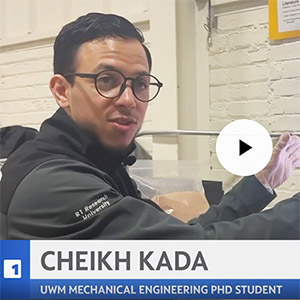
Spectrum News recently looked into the question in Professor Ryo Amano’s lab where PhD students Cheikh Kada and Mohamed Maache are generating data on pyrolysis, the application of extreme heat to a material in the absence of oxygen, which turns it into gas.
Their research looks at which materials create the most energy while also producing useful byproducts like biochar, which can help improve soil for farming. Optimizing the creation of biofuel from biomass, including super-efficient and clean hydrogen, could lead to an increase in its use, Maache said.
“Our end goal is to compare the samples to determine which one produces synthetic gases that could actually be used,” said Maache. “We want to know, for example, which sample gives us hydrogen.”
Kada studies which different blends of biomass materials release the most energy during heating, and cork with wastewater sludge is a promising contender.
Next, the team plans to test larger sample sizes using a specialized pressure system as they work to find better ways to turn waste into clean energy. Amano’s comments appear in the print version of the story. View the segment.
Student group wins an award in national steel-casting competition
What happens when engineering students spend months designing a steel axe, then put it to the test against teams from across the country? For a group of students in the college, it ended with a national award – and plenty of sparks flying along the way.
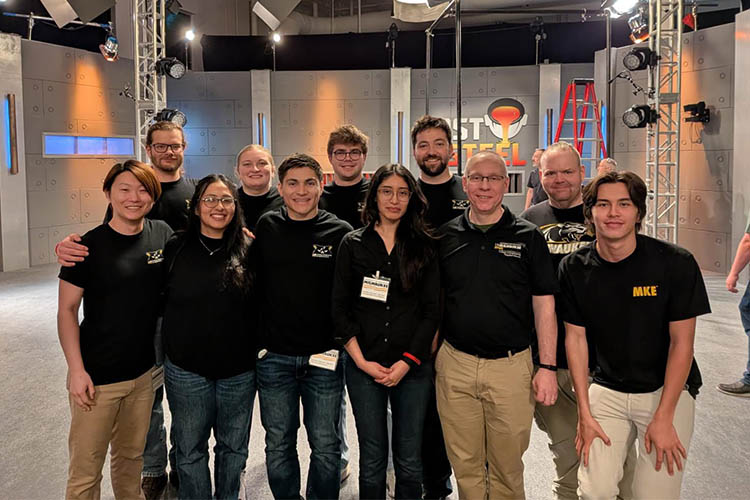
Eleven students forming three teams represented UWM in the Cast in Steel Competition, in Grand Rapids, Mich., where they earned a cash prize in one of the six categories, the award for “Best Investment Casting.”
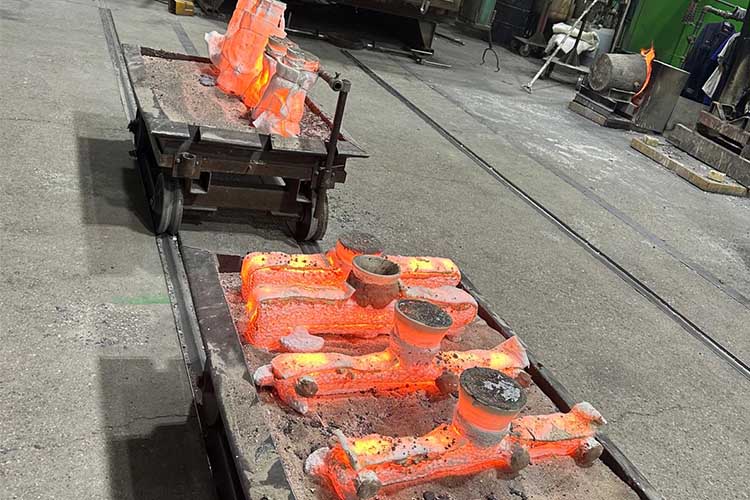
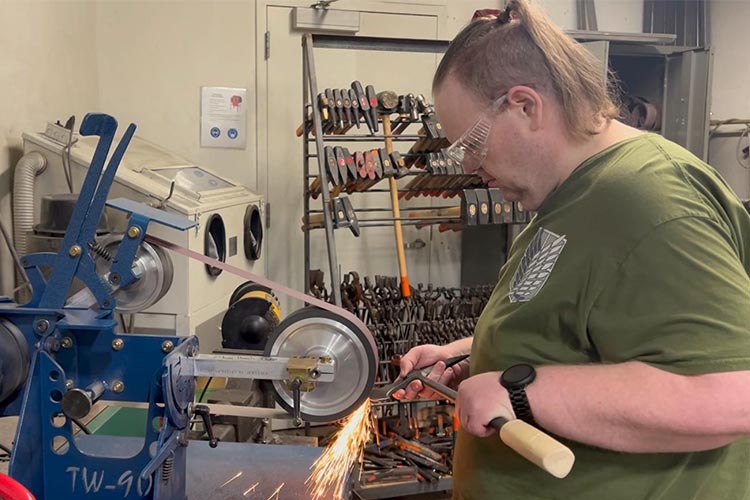
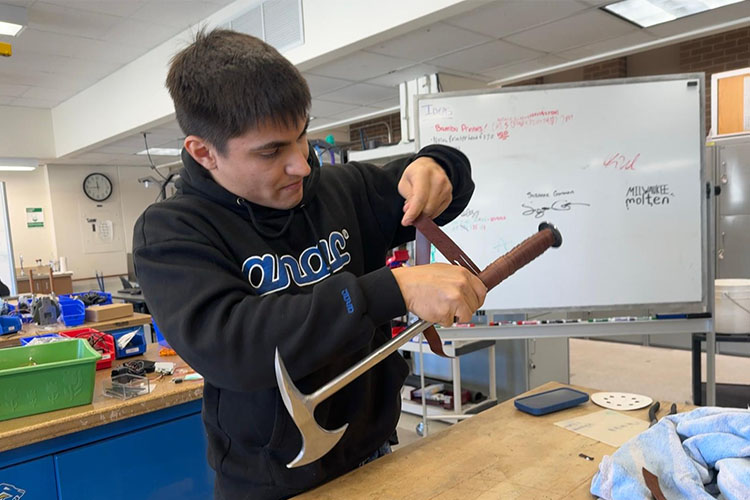
The molds of the design show the red-hot outer coating of a ceramic slurry. Once cooled, the molds were then filled with the molten metal. Aaron Macek sharpens the finished axe blade.Jexel Valentin Perez adds the leather handle to the tool.
The challenge: to design and cast a functional weapon – a horseman’s axe, inspired by those used by Robert the Bruce, medieval king of Scotland.
Organized by the Steel Founders’ Society of America and held during Metalcasting Congress, the competition challenged 58 university teams to design, cast and test their axes. Success depended on more than just making an impressive-looking tool – teams had to create an axe that could withstand demanding mechanical tests while showcasing precise manufacturing techniques.
Preparation for the competition began in September 2025. Over months of work, students from both the Mechanical Engineering and Materials Science & Engineering departments, developed designs and ran simulations. They decided to use investment casting – a highly detailed manufacturing process.
What is investment casting?
In investment casting, a mold of the product is made by first creating the design in wax and then coating the outside several times with a ceramic slurry until you get the right thickness, said team member Carol Martinez, a senior in materials science & engineering.
“In the process, you melt out that the internal wax and then pour in the molten metal into the cavity that’s left,” Martinez said. “It’s called ‘investment’ because it takes a longer time than sand-casting. But we were thinking about the surface finish of our part.”
Sandcasting can give you a rough surface finish that would then have to be smoothed with machining afterward, she said.
Partners with industry
To bring their designs to life, the UWM students partnered with MetalTek International in Watertown, Wis., which has experience with investment casting and helped the team achieve the precision and finish they were aiming for.
At the competition, students not only tested their axes but also networked with industry professionals and observed a wide range of metal casting technologies in action.
“They were showing more than technical skill,” said faculty advisor Ben Church, associate professor, materials science & engineering. “They exhibited teamwork, persistence, and the kind of hands-on experience that allows them to apply classroom concepts.”
The team also thanks the UWM Prototyping Center and ThermTech in Waukesha for supporting the project.