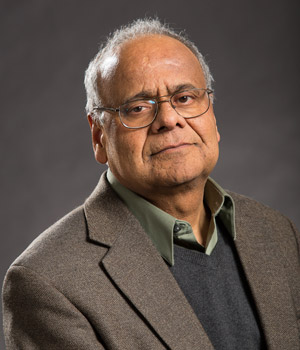
SAE magazine published an interview with Rahman about rehab robotics
Habib Rahman, professor, mechanical engineering, was interviewed for a Q&A that recently appeared in Tech Briefs magazine on his recent research building a platform that would make remote physical therapy available to stroke patients.
Each month, the engineering magazine, put out by the SAE Media Group, features a researcher who has done innovative research.
Rahman developed a portable, assistive robotic arm, called the iTbot, that allows stroke patients to receive physical therapy without leaving their homes.
In the interview, Rahman explains how the assistive arm can adjust the right tension for a patient, which methods the arm employs to measure pain-free range of motion, what information a digital twin can give the therapist, and why a therapist is always a part of the treatment’s platform.
Transforming the electrical grid – and conquering power outages – starts with Cuzner’s ‘building blocks’
Electrical outages have become a common occurrence around the globe – and also in Wisconsin, said Robert Cuzner, professor of electrical engineering. “I’ve kept track at my home and I’ve been without power for at least 100 hours in the last year.”
With a rise in extreme weather, an ever-growing demand for energy, and an aging electrical grid, how can the U.S. fix its infrastructure and boost reliability without starting from scratch?
The answer, said Cuzner, is microgrid technology. Microgrids are power sources for a limited area, such as a military base. They integrate different kinds of energy, such as diesel generators, solar cells, wind turbines, fuel cells and battery banks to supply the necessary electricity storage, whether connected to the main grid or operating as an “island,” serving as backup power for the immediate vicinity it serves.
Cuzner views microgrids as a way to transform the old grid into an automated modern system. Microgrid components “talk” to each other, making them much quicker at detecting defects before they lead to a blackout.
However, because microgrids are smart, they are complex, making them expensive to operate. Cuzner has pioneered an idea that would clear the way to for microgrids to thrive commercially. He proposes breaking them down into “building blocks,” or smaller units of microgrid components, called nanogrids.
The background on microgrids
One reason microgrids aren’t widely used yet involves equipment compatibility, Cuzner said.
“You’re trying to merge the old infrastructure with the new equipment of the microgrid, where no uniform standards exist,” Cuzner said.
Finding the equipment needed to integrate renewables is one example, said Mark Vygoder, a doctoral student and longtime lab member. Cuzner’s lab members have been working with large U.S. military bases in Europe that already use microgrids to address grid insecurity but are grappling with costs related to knitting together unstandardized equipment.
“It’s a bit like the Wild West where you can buy devices from different vendors and all the products are a little bit different,” Vygoder said. “So, it becomes quite costly when you have to hire a service provider to sort that out for you. When the microgrid operates independent of the grid, all those different components need to coordinate and communicate.”
UWM expertise in power distribution
Cuzner, an expert in power controls, conversion and distribution – the areas of vulnerability in microgrid technology – stands at the center of UWM’s reputation as a leader in both energy storage and electric grid technology.
Cuzner’s lab is a lead partner in the GRid-connected Advanced Power Electronic Systems (GRAPES), a national industry/university research center that aims to accelerate insertion of power electronics into the national grid.
Cuzner, Vygoder and Andrew Eggebeen, a recent PhD graduate in computer engineering, who worked in Cuzner’s lab, visited three U.S. bases in Europe in the summer of 2023 to get a first-hand look at how these microgrids are being implemented and their limitations.
“One thing we found was that these bases are very large and spread out, leading to transmission problems,” Cuzner said. “In one case, the solar array is several miles outside of the base.”
To solve the problem, Cuzner and his colleagues at the Naval Post Graduate School in California developed a “zonal distribution concept” – essentially breaking microgrids down into less complex units, called nanogrids.
What is a nanogrid?
Cuzner’s background is in the conversion of Navy shipboard power generation to electrical distribution. Such architecture features damage-control zones: When the power goes out in one part of the ship, the system reroutes itself using smart switchgear and continues to operate with only the affected zone shut down.
Nanogrids can be strung together within the microgrid itself, improving overall smart capabilities. And they can be added one at a time, easing the cost burden of a microgrid.
Cuzner and his team are researching the best ways to standardize components supplied by commercial vendors and ensure “grid-edge inter-compatibility,” which means that even components supplied by different vendors can work and play well together.
“If smart components of a nanogrid are standardized,” Cuzner said, “it can become a ‘plug and play’ building block that can be produced cost-efficiently.”
UWM’s microgrid ‘sandbox’
To work out the details of nanogrids, Cuzner’s lab members have built a fully functional microgrid at the University Services & Research building near UWM’s Kenwood campus. Since 2021, the lab has been building an energy distribution system with smart metering and controls, giving them an experimental sandbox.
Joseph Lentz (’23 MS electrical engineering), left, and doctoral student Mark Vygoder display a portion of UWM’s microgrid, which is housed at the USR building. The lab members are working on the equipment needed to amplify the nanogrid’s smart communication. Routing power through two different AC buses in their system allows them to test with two different nanogrids, either running them independently or connected to the larger system.
The researchers can now observe how a microgrid responds under varying conditions, quantify how commercial components monitor microgrid data, and then simulate in real-time a full-scale system that interacts with real control hardware.
“With our microgrid, we can simulate equipment that is on the grid, test it at scale, quantify the ‘grid-edge’ where everything comes together, and figure out how to improve performance,” Cuzner said. “That’s something no one else has done yet.”
In 2023, they worked with a local company, Badger Technologies, to install, test and integrate a battery energy storage system with the UWM microgrid. In addition, UWM’s microgrid includes a solar array, one wind turbine, two natural gas generators and a smart switch that could connect it to the national grid.
The college is currently exploring ways to secure federal funding to turn the UWM microgrid into an industry-collaborative lab with a 1,000-13,000-volt testing facility. Such a facility would attract industry, quicken the pace of new microgrid technology and would include research on electric ships and aircraft.
Power distribution and controls in focus
Nanogrids also improve control of the flow of electricity if connected to the grid.
Control refers to how the existing grid meets demand. Higher than normal demand for electricity could cause a blackout, but so could a glut of power to the grid from renewables.
Another benefit of nanogrids is that the controls can be built from the “bottom up,” Vygoder said, giving nanogrids the ability to speedily compensate for power disturbances.
Southeast Wisconsin is the perfect place to develop this commercial potential with its cluster of companies related to energy, power and controls. UWM is at the epicenter, with longstanding research partnerships with industry leaders including Eaton, Rockwell Automation, Leonardo DRS, and Johnson Controls.
So far, the U.S. Naval Facilities Engineering and Expeditionary Warfare Center (NAVFAC EXWC) has funded Cuzner’s collaboration with the Naval Post Graduate School.
Most recently, this led to Cuzner receiving funding from Office of Naval Research to develop a “digital twin” approach to study how nanogrid components respond to a wide range of both normal and damaged scenarios.
AI and nanogrid decision-making
Digital twins rely on artificial intelligence to improve communication among the smart components of both micro and nanogrids. It’s the next step in the integration research.
When paired with machine learning, AI could potentially allow microgrids and nanogrids to teach themselves what leads to a breakdown and autonomously decide what to do when they detect trouble brewing.
For this research, Cuzner has consulted with Zhen Zeng, UWM assistant professor of computer science, who is an expert in digital twins and cybersecurity. Zeng is co-advising computer engineering students who are helping in Cuzner’s lab, bringing together power/energy and computer engineering in the college.
“When we feed a lot of information into an AI model, the model can quickly tell you what is going on in the system,” said Zeng. “We try to understand which situations we would need to consider when building cyber-protection into the design,” she said.
UWM’s master’s in data science ranked one of the best
Fortune magazine has ranked UW-Milwaukee’s Master’s in Data Science program as one of the best in the country, landing at No. 25. UWM’s program also was ranked No. 15 among the most affordable programs nationwide. UWM is the only program from Wisconsin on either list.
UWM’s data science master’s degree is a 12- to 16-month program, which can be done full- or part-time, starting with a bachelor’s degree in any major. Courses from business, engineering and computer science are featured prominently.
The program was established with support from the Northwestern Mutual Data Science Institute, a partnership among Northwestern Mutual, UWM and Marquette University which aims to help make southeastern Wisconsin a national hub for technology, research, business and talent development.
A lesson learned while he was pursuing a doctoral degree in electrical engineering at Michigan State has turned out to be a mantra for Devendra Misra’s long academic career and also one that he passes on to faculty just beginning their careers: Be prepared to pivot and apply your knowledge across disciplines.
Misra, a professor of electrical and biomedical engineering, has spent 40 years at the college, providing service to the administration, teaching hundreds of students and contributing to several different lines of scientific inquiry. He retires today.
Dev Misra
“I was in the electromagnetics field, however my PhD professor pushed me to learn other things too,” he said. “So, I took many other courses, including graduate-level courses in physics and mathematics besides in other areas of electrical engineering. Now, I feel that was very good advice. Things don’t work in isolation. Everything is interconnected.”
It certainly primed him for the many different demands of academia.
Misra’s first task as a new UWM professor in 1985 was quite different from his doctoral work at Michigan State, he remembers. “The chair asked me whether I could teach a required course in electromagnetics to EE majors with almost no mathematical background. My answer was ‘yes.’”
It was a course the college had to begin offering for all students or risk losing its accreditation. In addition, he revised the first electronics course for EE majors, adding a lab component even though electronics was outside his area of expertise.
Early research
As a young researcher, he was involved in federally funded research with a collaborator at the University of Pennsylvania and others to build a life-detection device that would find military wounded personnel on the battlefield from a distance of at least 200 feet.
Misra’s contribution was to show how it could be done with microwaves. Leveraging both state and funding industry, Misra’s work evolved into an ultrasonic sensing device he developed that uses sonar to detect structural defects in pipes.
An article in the UWM Graduate Profiles magazine (now defunct) from fall of 1990 highlighted this work.
After that, the department recognized that electromagnetics could bring in research money and the college then recruited a couple of new faculty members in electromagnetics. Misra, meanwhile, had obtained an engineering education grant from the National Science Foundation to set up a lab with a sequence of courses on telecommunications.
Misra working in the biomedical engineering lab
A team player and more
Colleagues, including Chiu Law, associate professor, electrical engineering and computer science, say they were impressed by Misra’s willingness to help junior faculty members. “Since Dr. Misra has a long history and experience in teaching courses in the electromagnetics area, he gave me suggestions and advice when I first started teaching the undergraduate electromagnetics course. Our discussions have continued for teaching other courses in this area throughout my tenure at UWM.”
K. Vairavan, professor emeritus, computer science, got to know Misra well during a time when Vairavan chaired computer science and Misra headed up the electrical engineering half. “Together, the two disciplines comprised the college’s largest department, so I had a great opportunity to work with him and I also served with him on many search committees including those for deans,” Vairavan said.
“He has been a dedicated faculty member and has served the university and the college well in a number of ways,” Vairavan said. “Most recently his contributions have been in the development of the biomedical engineering program. He took much initiative in establishing the program. I know that he organized groups of faculty members to develop the ideas for it.”
Delaying retirement to fill a need
During the 2014-15 school year, Misra said he felt ready to retire. But the college needed someone to help establish the biomedical engineering program that would serve as a department, offering both undergraduate and graduate degrees. Misra had the background to lead the effort and so he agreed to stay on.
The program began accepting students in the spring of 2016. Immediately afterward, Misra began working on the accreditation process which was completed in 2021.
Looking back, he said, he joined the UWM faculty because he was attracted to the climate in the department and the very strong faculty governance at the time. Had he ever considered leaving?
“I thought that, if I moved, I may make more money,” he said. “But if I stayed here, I felt the [quality of] life would be much better.”
January is a prime time to use the college’s Machine Shop
Are you working on research between semesters? The semester break in January affords faculty and students the opportunity to use the college’s Machine Shop during a less hectic time. Shop manager Mike Brown gives the low-down in this Q&A.
What is a particularly unique piece of equipment you have that has many applications?
We have two Proto Trak mills that have the ability to thread-mill male and female parts. Additionally, these mills can perform three-dimensional movements from our CAD software. We also have a Sharp mill, complete with multiple tools along with flood coolant if required. This mill has a 10,000 RPM spindle with a spindle chiller for long-running programs.
What else do you commonly provide?
We can provide manual and CNC machining. Also, we have the ability to mill three-dimensional projects with use of our EZcam software.
What are some of the pieces of equipment that you teach people how to use (as opposed to doing the job for them)? At present we teach milling and engine lathe and CNC milling machines. Next semester will be laser machine and CNC plasma and CNC routers.
Give us an idea of how many people you typically serve.
Students in classes and working with researchers number around 150, mostly in the spring semester. There were about 25 faculty at the end of the semester.
What do students say about their experience in the Machine Shop? They enjoy it and want more time on the machines.
What is the cost to the faculty member or CEAS client?
The charge for labor is $45 per hour. The material is an additional cost. In most cases, we are able to acquire the material to decrease the cost of shipping.
What is the process for someone wanting help on a project? For example, do they contact you to discuss before setting up a time?
Email a request (contact information below) and then come to the machine shop with a drawing. This helps in supplying an accurate quote. If the request is simple, then the individual can email or stop in at the machine shop.
Can a task be done same day?
The projects can be done in one day, depending on the job requirement and jobs in the queue.
Is there paperwork for the faculty member to fill out?
We have a lab charge sheet that requires a grant number and name of the requestor for a quote.
Recent grad featured as one of the students who had job offers before graduation
Kudos to Sydney Block, who just finished her BS in civil & environmental engineering, was among the multitude of UWM students who had job offers before graduation. She also was one of 190 degrees conferred by the college this semester.
While earning her undergraduate degree, Block served as president of the UWM chapter of the Society of Women Engineers and also as a design lead with UWM chapter of Engineers Without Borders.
In the summer of 2024, she began an internship with Stantec’s Community Development Group and is now continuing as a full-time employee.
Members of the college named by students as international student advocates
Among the 37 faculty and staff receiving 2024 International Advocate Awards from the UWM Center for International Education are six from the College of Engineering & Applied Science. All were nominated by students. Congratulations to:
College leads the university in research awards so far this fiscal year
Research awards are surging at the College of Engineering & Applied Science from levels during the COVID pandemic and have also increased greatly from this time a year ago. In fact, the college is leading all other UWM colleges’ research funding at the mid-point of the 2025 fiscal year.
The college’s research awards total just over $10.5 million ($9.5 from federal sources) with six months to go in the cycle. While the amount of external funding is elevated nearly campuswide, compared to this time last year, the amount in engineering and computer science research represents a peak over the last decade.
External awards to the college by year, with 2025 at halfway.
Leveraging the college’s expertise in energy auditing
One of the largest grants in recent years was awarded by the U.S. Department of Energy in June. The $5.7 million grant is designated to set up Industrial Training Assessment Centers (ITACs) around the Midwest to help small- and medium-sized companies remain competitive in the face of climate change.
“We were selected because of our longstanding DOE-supported program that trains UWM engineering students to conduct energy audits through our Industrial Assessment Center, the only one in Wisconsin,” said Ryo Amano, professor, mechanical engineering, who is directing the new initiative. “So now we are ‘training the trainers’ at ITACs at nine communities in four states.”
Douglas Hamm is vice president of teaching and learning at Moraine Park Technical College, with has campuses in Fond du Lac, Beaver Dam and West Bend.
“An attractive aspect of this grant opportunity, in addition to collaborating with UW-Milwaukee who certainly is a recognized leader in the space, is our ability to add energy auditing and conservation into the programs we offer where they can provide the most benefit,” Hamm said. “For our students, this added skill set could distinguish them from other job seekers who don’t have it.”
Other notable research funding this year
An Early Career Development (CAREER) award from the National Science Foundation was one of five awarded in Wisconsin this year, in NSF Directorate “Computer and Information Science and Engineering.” The CAREER grant is the NSF’s most prestigious award for early-career researchers. (Mahsa Dabagh, biomedical engineering)
The NSF also funded a third Industry University Cooperative Research Center (IUCRC) at the college. The Concrete Advancement Network, with industry members across the industry, is devoted to making concrete more durable and sustainable. (Konstantin Sobolev, civil & environmental engineering)
Research in energy storage technologies, and also in cost-effective uninterruptible power supply solutions. The work includes microgrids and all-electric ships. (Robert Cuzner, electrical engineering)
Funding in biomedical engineering spanned several topics, from nuclear imaging to use of quantum dots as detectors of pathogens. (Qingsu Cheng, biomedical engineering)
Multiple awards supported the refinement of rehabilitation robotics, specifically for a robotic assistive arm for use with physical therapy patients. (Habib Rahman, mechanical engineering)
Continued work on traffic and pedestrian safety solutions. (Xiao Qin, civil & environmental engineering)
Continued work in battery technology (Deyang Qu)
Spectrum News features the foundry’s research on self-lubricating metal materials
Spectrum News visited the foundry to observe students in materials science & engineering produce blended metal alloys with superpowers, such as high-temperature tolerance, strength and self-lubrication.
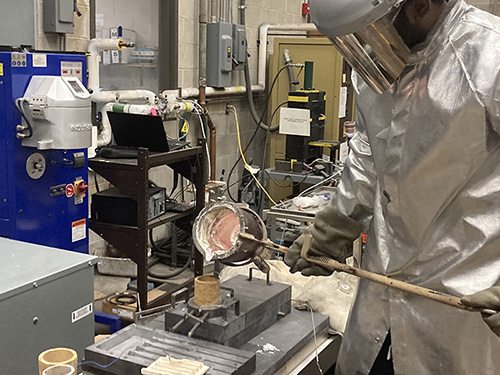
A lab member pours the molten material – called a metal matrix composite – into a vessel to cool in the foundry.
The report featured Professor Pradeep Rohatgi, director of the Centers for Composite and Advanced Materials Manufacturing; his private industry research partner David Weiss, CEO of Visions Materials LLC; and graduate student Kaustubh Rane.
Making these advanced materials could help the state’s foundries thrive, said Rohatgi, and that is the reason why he and Weiss have labored to reach out to local industries.
Rane is trying to create an aluminum alloy that is self-lubricating and also can withstand higher temperatures. That would mean less friction between parts of an engine, boosting the engine’s efficiency and saving gas.
Alums from Milwaukee Tool, Rockwell, and GE HealthCare hosted events for current students
Engineering and computer science students found out what it’s like to work at three of Milwaukee’s largest companies with events hosted by people who had been in their shoes – the college’s alumni. Milwaukee Tool, Rockwell Automation and GE HealthCare all hosted events this fall, giving students the chance to meet in a relaxed, one-on-one atmosphere.
Current students got an up-close look at some of the newest products made by Milwaukee Tool at Milwaukee Tool Demo Day held Sept. 18 on the EMS Plaza.
Both UWM engineering and business students attended the tour at Rockwell Automation in September. Megan Waterworth led the planning effort, Punita Miller, Andrew Hastert and Amanda Martin helped with logistics, and Patrick Hollenbach presented on the company’s early career Integrated Supply Chain group opportunities.
More than 60 students checked in for the event in advance of the career fair hosted by the UWM Center for Student Experience & Talent (SET).
UWM alums hosted similar events this fall with Rockwell Automation, inviting both engineering, computer science and business students to meet and tour the company’s headquarters on Sept. 20. GE HealthCare employees came to campus for a day on Sept. 10.
The chance to visit Rockwell Automation, recognized globally for its innovation and sustainability efforts, was invaluable, said Tristan Jarvey, Innovation intern at the Lubar Entrepreneurship Center.
CEAS alums Kailee Ottman (from left) and Klarissa Boisvert visited the college with other GE HealthCare representatives Daisy Cueto and Cecilia Cortez.
“During the Rockwell tour and lunch event, I engaged with professionals in my field, gained insights into the application and interview process, and observed various ongoing projects at Rockwell,” said Jarvey, a computer science undergraduate. “It played a crucial role in my career journey, as I was recently offered an internship at Rockwell for summer 2025.”
“SET doesn’t just host campus career fairs, said Juli Pickering, SET director of employer relations, partnerships, & events. “We also bring together students with industry in more casual settings, such as site visits with alumni that give our students a taste of the real world of engineering and computer science work.”
If you’d like to host a demonstration on campus or welcome students to your workplace, please contact Pickering at jlpicker@uwm.edu.