Fall Welcome Fest delivered on its promise of fun and community building
Engineering and computer science students got a chance to mingle, meet faculty and enjoy lunch at the annual Fall Welcome Fest held on the EMS plaza Sept. 18.
Thank you to all the faculty and staff who showed up to greet students and represent their departments. The event is an invigorating way to start a new semester and introduce students to the college.
Pounce is showing this student how to show their Panther Pride!A member of the student chapter of Society of Automotive Engineers (SAE) demonstrates the cozy driver’s seat in the group’s Baja car. Teaching faculty Bill Dussault, electrical engineering, explains how the Tesla coil works.Professor Susan McRoy, computer science (seated), discusses the field with an interested student. A member of the Prototyping Club shows off the group’s portable 3D printer.Associate Professor Jaejin Jang, industrial & manufacturing engineering, explains the course options in his department to two students.Members of the American Foundry Society, student chapter, man the Foundry-in-a-Box activity. The two on the right are Associate Professor Ben Church and Professor Pradeep Rohatgi, both materials science & engineering. The whole group of Milwaukee Engineers and Computer Scientists celebrates the new school year. A student talks to another about joining the National Society of Black Engineers, student chapter.Professor Hani Titi, civil & environmental engineering (right), meets new students attending the festivities.
The highlights include attendance by Pounce and campus police’s comfort dog, Ezmae, giveaways, and a free lunch! Many student organizations and individual departments hosted demonstrations of work or equipment.
Engineering topics were on display, including a Tesla coil demonstration.
Student organizations hosted their own show-and-tell. To name a few: The foundry group showed what you can do with molten tin; the Prototyping Club brought its portable 3D printer, the Biomedical Engineering Society chapter exhibited some of its creations, and, of course, American Society of Mechanical Engineers chapter brought its current Baja car.
Spectrum News asks the Shen lab how to reduce energy used by data centers
Researchers at UWM are looking for ways to reduce the amount of data that is processed at data centers while still getting good computing results and saving energy.
Shuaiqi Roger Shen, assistant professor of electrical engineering, said this research, powered by a tiny GPU processor, also called an edge-of-network AI device. He pairs efficient algorithms with edge processing by these small devices right at the source of the data. This kind of processing keeps the data private and out of the cloud and out of data centers.
It’s one strategy that improves efficiency both for data centers and industries using AI, like manufacturing. Shen’s doctoral student, Monika Gawande also was interviewed. She said the device works like a mini data center, enabling AI to comb through a lot of information very quickly.
She described how the GPU technology allows her to “prune” the processing — reducing the data that needs to be stored and keeping only the essential information required by AI to do the job. Watch the report.
Dedicated space for senior design studios funded entirely by private donors
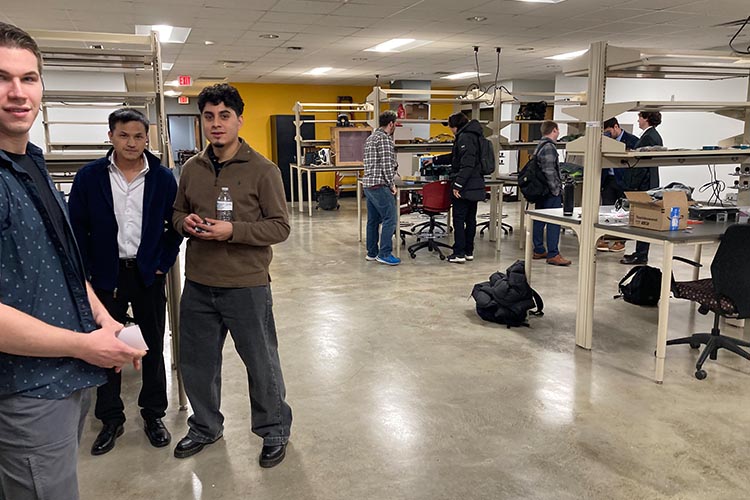
The new EMS Senior Design & Capstone Studios in EMS 371 have been renovated and will open for use later this month. These spaces are entirely funded by private philanthropy and offer a permanent collaborative workspace for student/industry capstone projects.
Donors whose gifts have supported the new space include:
Alan D. Kulwicki Legacy Fund
Paul McNally Fund, and
Donors to the CEAS General Fund
The capstone projects are critical to prepare students for the workforce, said Mohamed Yahiaoui, teaching faculty, mechanical engineering. Previously, seniors working on their capstone projects had to share room with all engineering students in the Makerspace and its adjacent study area.
That space crunch prompted Yahiaoui to propose a dedicated studio, reserved exclusively for senior design students, with 24/7 access.
“The new senior design studio will bring together students from all engineering disciplines in one permanent space,” he said. “It fosters cross-disciplinary collaboration that mirrors industry, a crucial soft skill students would not otherwise have the opportunity to develop.”
Donors were enthusiastic about the idea.
“This is a worthy project that the Alan Kulwicki Legacy fund is honored to be a part of,” said Jan Beatty-Hendley, chair of the fund’s advisory committee.
If you haven’t already signed up to use the studios, contact lab manager Avie Judes at judes@uwm.edu.
Joint degree programs provide global opportunities for CYCU students
Welcome to 35 new and returning students from Chung Yuan Christian University (CYCU) in Taiwan who are participating in joint academic programs with UWM’s College of Engineering & Applied Science.
A group of returning students and staff are supporting the new cohort. Yu-Ping (Peter) Teng, PhD student in physics (clockwise from left) joins CYCU staff member Jiaxian Freya Lin; CYCU Associate Professor Dung-Sheng Tsai; doctoral candidate Li-Chih Tsai, bioinformatics; Te-En (Danny) Liu, PhD student, mechanical engineering and president of the Taiwanese Student Association at UWM; Ting-Rui (Ray) Chang, industrial & manufacturing engineering; Chi-Ping Chiu, senior, EE; Yu-An Su, senior, EE; Chi-Yueh Tai, senior, EE; and Chen Chang, senior, computer science.Dung-Sheng Tsai (back row, from left), CYCU associate professor, electronic engineering, and director of the CYCU-UWM undergraduate dual degree program, takes a moment with Te-En (Danny) Liu, current president of the Taiwanese Student Association at UWM, and Jiaxian Freya Lin, secretary of the CYCU-UWM undergraduate dual degree program. Yi-Chen (Kelly) Chen (foreground), a returning master’s student, electrical engineering, offers positive vibes for the new school year.Susan McRoy, UWM professor, computer science (with microphone), speaks to the new cohort of CYCU students at a gathering at the Lubar Entrepreneurship Center. In the background are Dah-Chuan Gong, teaching faculty, industrial & manufacturing engineering (left) and Deyang Qu, professor, mechanical engineering (center).Te-En (Danny) Liu, returning PhD student, mechanical engineering, (left) and CYCU Professor Dung-Sheng Tsai welcome the gathering. Chen Chang, senior, computer science, takes his turn as students introduce themselves around the room. Dean Brett Peters makes welcoming remarks at the gathering at the start of the semester. Have a great school year!
This is the continuation of a successful partnership: the college and CYCU have operated a dual master’s degree program since fall of 2017. In 2023, the partnership expanded to include CYCU undergraduates, who attend UWM for their final two undergraduate years.
In both programs, the credits students earn are transferrable to their home institution and students receive their degrees from both universities.
This year’s cohort includes 11 juniors in the “2+2 program” in three departments: computer science, computer engineering and electrical engineering.
There also are four new dual master’s students in the electrical engineering and industrial & manufacturing engineering departments.
These students join the 18 CYCU undergraduates who are beginning their senior year and two master’s students who are continuing their studies at UWM.
The Taiwanese Student Association at UWM recently hosted a welcome event for these students. Te-En (Danny) Liu, mechanical engineering doctoral student, and college leadership, including Dean Brett Peters, faculty and academic staff organized the event.
In addition to the students, CYCU guests included Dung-Sheng Tsai, associate professor in the department of electronic engineering and director of the CYCU-UWM undergraduate dual degree program, and Jiaxian Freya Lin, secretary of the CYCU-UWM undergraduate dual degree program.
Professional magazine highlights Amano lab in research on animal waste as energy
Ryo Amano, professor, mechanical engineering, and his doctoral students, Mohamed Maache and Cheikh Kada, were featured in a story in The American Society of Mechanical Engineers’ magazine about their research into optimizing animal waste for maximum energy output.
The story, which ran as the cover of the online magazine, elaborated on an academic paper Amano’s research team recently published in the ASME Journal of Energy Resources Technology.
The technology already is being tested at multiple sites across Milwaukee. Other lab members involved in the work were PhD students Kada Kada and Abdallah Benelmadjat.
The study looked at the thermochemical properties of horse manure – and suggests that biowaste can provide an efficient means of energy generation in oxygen-free environments.
Researchers tested mixing sewage sludge with cow or chicken manure to see if it could produce more energy when heated. Then they used experimental and mathematical modeling and found that the right mix matters: about 30% sludge with 70% cow manure more than doubled the energy output.
The ASME is the second-largest professional organization in the field, subscribed to by 85,000 members in 135 countries.
Faculty recognized with named professorships, fellowships
Congratulations to the following faculty members, each of whom was honored with a named professorship or named fellowship for this academic year. The awards are backed by two donor funds – Richard and Joanne Grigg and Alan D. Kulwicki.
Through these gifts, the college is providing a fourth year of philanthropic support to faculty.
Named professorships and fellowships support the growth of some of the college’s key research areas and honor recipients’ research, teaching and scholarship. Named professorships, which are for a three-year period, provide a salary supplement, in addition to the funding award. Named fellowship awards are for one year.
Richard and Joanne Grigg Professors
Rob Cuzner, electrical engineering (renewed) Roshan D’Souza, mechanical engineering (renewed) Xiao Qin, civil & environmental engineering Md Habib Rahman, mechanical and biomedical engineering (renewed) Brooke Slavens, mechanical and biomedical engineering (renewed) Konstantin Sobolev, civil & environmental engineering
Richard and Joanne Grigg After earning his degrees, the late Richard Grigg (’04, ’75, ’70 engineering) went on to become the president and CEO of We Generation, the electric-generation arm of We Energies. In 2004, he joined FirstEnergy Corp., in Ohio, and retired as executive vice president and president of FirstEnergy Utilities in 2010.
Alan D. Kulwicki Kulwicki (’77, BS mechanical engineering) applied his degree to his skill in racecar driving to achieve success on the track. Despite his death in a plane crash in 1993, Kulwicki’s name and legacy live on. He was inducted into the NASCAR Hall of Fame in 2019.
George Davida, professor emerit and pioneer in computer science, passed away in August
George Davida, professor emerit, electrical engineering & computer science, passed away in August. Davida, a pioneer in the field of cybersecurity, was on the faculty at the college from 1970 until his retirement in 2010.
The field of computer science essentially did not exist when Davida began his career. He served on several national committees that established the field and created accreditation standards for university programs.
Davida was among the first faculty members hired for the newly created UWM College of Engineering & Applied Science. He delved into unbreakable codes that can hide information, quickly becoming one of the foremost leaders in the field and creating UWM’s Center for Cryptography, Computer and Network Security.
His groundbreaking work in data encryption helped the college’s computer science program establish an international reputation, attracting students, including Satya Nadella, (MS ’90) who went on to become Chairman and CEO of Microsoft.
“He diligently fought for citizens’ rights to privacy and personal data encryption by raising public awareness of the importance of cryptography,” said Edward Beimborn, UWM professor emerit of civil & environmental engineering. “His win ushered in our everyday ability to use online banking, send private emails, phone calls, or messages, and other uses of electronic security and online applications.”
Davida was one of the first on campus to use the internet and also brought the Unix operating system to UWM to facilitate research in computer science.
“I remember his friendship for many years,” said K. Vairavan, professor emerit, electrical engineering & computer science. “I also value his major contributions to the development of our computer science program.”
Early years
Davida grew up in Baghdad, Iraq, during a difficult political and social time. At the age 17, he received a Fulbright Scholarship to come to the U.S. and attend the University of Iowa, where he earned his undergraduate and graduate degrees.
At Iowa, he worked for Professor James Van Allen during the time high energy belts surrounding the earth were investigated (the Van Allen radiation belts). Davida participated in NASA-related research projects with Allen.
His funeral is Friday, Aug. 29 at Saint Peter & Paul, 2490 N. Cramer St. near campus. Visitation is at 11 a.m. and the Catholic service begins at noon. The burial is at 2:30 p.m. at Resurrection Cemetery, 9400 W. Donges Bay Road, Mequon, Wis.
MPS high school seniors test-drive engineering at UWM
When Salman Ibrahim, a senior at Ronald Reagan High School, heard he could take a real college engineering class while still in high school — and for free — he didn’t hesitate.
“This way, I can try it out and see if I like it,” he said. “Since it’s free, I don’t have to spend money if I change my mind later.”
Ibrahim is one of 19 Milwaukee Public Schools seniors spending Fridays this year at UWM, earning three credits for taking Introduction to Engineering.
The opportunity comes through the M3 College Connections Pathways Program, a partnership between UWM, MPS, and MATC that allows high school students to take college-level classes in fields like nursing, psychology, education, and architecture. This year, engineering joined the list for the first time.
How it works
Through College Connections, seniors take English and math courses at MATC for most of the week. On Fridays, they take their chosen elective course. The engineering course, taught by faculty member Madiha Ahmed, gives students an early look at what the field is really like. It’s also a chance to ease into the college environment, said Chris Beimborn, UWM’s STEM outreach manager.
“This class gives students a chance to explore their interests and get familiar with the college experience,” Beimborn said. “MPS’s career and college readiness mentors will provide support services. But students also will have access to campus resources like tutoring, so they’ll be set up for success.”
Jayla Harris took some time out from UWM’s summer “Design & Build” camp to talk about why she joined the M3 College Connections pathway in engineering. Through the program, she will be taking an engineering course at UWM on Fridays during her senior year.
Other students weigh in
For Jayla Harris of Golda Meir High School, the addition of the engineering class is more than an experiment — it’s a launchpad. “I want to be an engineer, and this helps me get a head start,” she said. “And if I’m already acclimated here [at UWM], and if I like the program, then why not stay?”
Abeedah Adebayo, a senior at Rufus King High School, is attracted to engineering because it combines her favorite things. “I decided I wanted to be an engineer because I love working hands-on and with computers,” she said. “This major lets me do both.”
She said she was already leaning toward UWM for college so the free course is just icing on the cake.
New cohort of Nadella Scholars announced
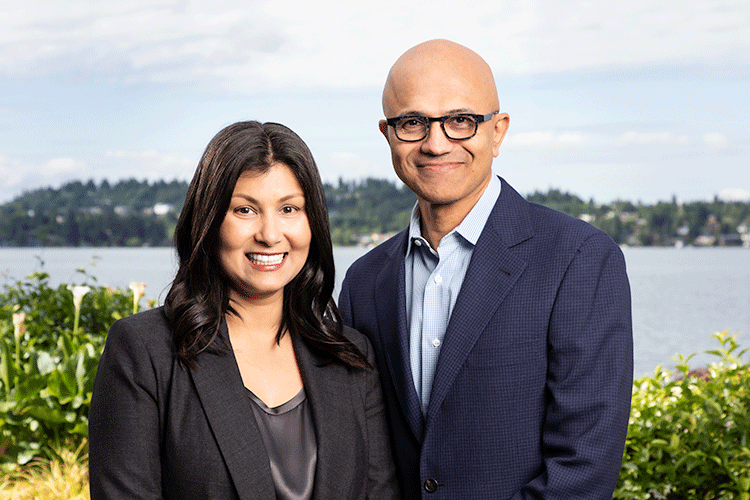
UWM has named its fourth cohort of full-ride Nadella Scholarship in Tech Education winners, funded through a gift from UWM alumnus and Microsoft Chairman and CEO Satya Nadella (’90 MS) and his wife, Anu Nadella.
Fourteen graduates of Milwaukee high schools, 11 of them pursuing computer science or computer engineering, were awarded the scholarship for 2025-26.
Recipient Owen Hirthe, a graduate of Ronald Reagan College Preparatory High School, is planning to study computer science. He said the scholarship is life-changing for his family.
“Receiving this award is incredibly important to me. When I start in the fall, I will be one of three of my siblings in college at the same time, so not burdening my parents with the cost of it means a lot to me.”
The original cohort of scholarship winners, which began in fall 2022, are seniors this fall. To date, 44 Nadella Scholars have been named; 37 are studying computer science or computer engineering.
The Anu and Satya Nadella Scholarship is specifically for students who graduate from Milwaukee high schools and intend to study computer science, computer engineering, data science or information technology. Each scholarship provides financial and academic support and room and board for up to five years.
The Nadellas have donated $4 million to support tech education. In addition to providing funding for scholarships, their gift also provides funding for academic support to help students remain successful in pursuing their degrees.
College scores half of new Catalyst Grants from the UWM Research Foundation
Four researchers in the college recently have been awarded funding from the UWM Research Foundation to further projects that aim to better facilitate renewable energy sources, find circulating cancer cells, and provide robotic physical therapy to patients confined to a bed.
The Catalyst Grants are supported by the Lynde and Harry Bradley Foundation and Invenergy through the UWM Research Foundation and are designed to support research in areas where UWM has the greatest potential to impact the regional economy through commercialization.
Each team is using the funding to advance early-stage solutions that address urgent societal needs and position their innovations for real-world deployment. The CEAS projects include:
Next-generation power conversion for energy storage Feng Guo, electrical engineering
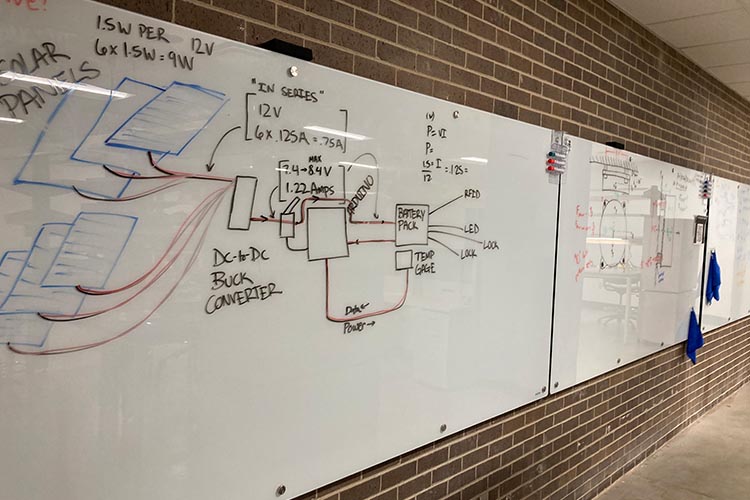
Guo is prototyping a novel power converter to improve the efficiency and cost-effectiveness of battery storage systems, enabling better integration of renewable energy.
Precision cancer diagnostics Ashwin Narasimhan and Priya Premnath, biomedical engineering
The researchers are developing a liquid biopsy platform to isolate rare circulating tumor cells with greater accuracy, improving early cancer detection and personalized treatment planning.
Rehabilitation robotics for bedridden patients Habib Rahman, mechanical engineering
Rahman is creating a portable, bed-attachable robotic exoskeleton to deliver early-stage lower-limb therapy, reducing caregiver burden and improving recovery outcomes.