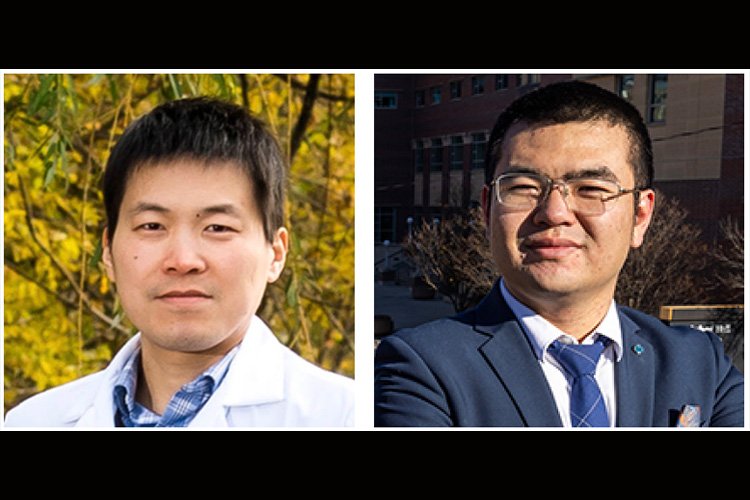
Two research projects from the Civil & Environmental Engineering Department have received funding from the UWM Discovery and Innovation Grant (DIG) program. This yearlong, internal seed funding prioritizes new lines of research that have high external funding potential. These grants were among six awards given for this academic year.
A more efficient way to extract minerals from water
Xiaoli Ma, associate professor
Rare earth elements are essential ingredients in electric vehicles, electronics, and other modern technologies. But recovering these valuable minerals from industrial wastewater is difficult, expensive and often requires large amounts of energy and chemicals.
Associate Professor Xiaoli Ma is working on a better method: specially designed membranes that act as sophisticated filters, separating valuable minerals from wastewater.
The research targets rare earth elements such as neodymium and dysprosium, used in powerful magnets for electric vehicles and wind turbines, and lanthanum, used in batteries and industrial processes.
The challenge is that these minerals often occur in tiny concentrations, mixed with much larger amounts of common minerals such as sodium and calcium.
Ma’s team will use artificial intelligence and computer simulations to design membranes with nanoscale channels that selectively separate valuable minerals from other dissolved substances in wastewater.
Rather than creating and testing countless materials through trial and error, researchers will use computer models to predict which membrane designs are most promising. They’ll then manufacture and test those materials in the laboratory.
“The advanced membrane technologies we develop will also have the potential to be used in extracting other critical metals from these complex waste streams,” Ma said.
Using connected cars to spot trouble on the road
Tom Shi, assistant professor
Imagine a crash on I-94 during the morning commute. Before a 911 call comes in or a traffic camera operator spots the wreck, something else is already happening: Drivers approaching the scene are braking, changing lanes and slowing down.
Assistant Professor Tom Shi wants to teach computers to recognize those patterns – and use them to spot trouble on the road in near-real time.
With DIG support, Shi will use information already generated by many newer vehicles, including GPS location, speed, direction and acceleration – anonymized data available from vehicle manufacturers.
Even though only about 8% of vehicles on I-94 report this kind of information, preliminary analysis suggests that is enough to reveal traffic trends.
The researchers will combine those data with historical crash and incident records from the Wisconsin Department of Transportation. AI models will learn what normal traffic looks like and identify unusual patterns that could signal a crash, wrong-way driver, stalled vehicle or debris in the roadway.
The end product is a real-time traffic event detection system that transportation agencies like WisDOT can pilot.