Best Senior Design Projects
Senior Design is an opportunity for students to work as a team to apply what they have learned within their major over their undergraduate years to real-world project that demonstrates their knowledge of essential skills and concepts.
One winning team from each department will be recognized at the Order of the Engineer ceremony on Saturday, May 16, 2026.
Click on each project below to see objective, team members, advisor(s), and presentation dates/times.

Program Sponsor

Biomedical Engineering
Presentations: TBD



Air Bubble Detection System
Objective: Design a cost-effective system to detect, trap, and prevent air bubbles in IV fluid lines. The device must automatically detect bubbles, alert users, stop fluid flow, and safely isolate bubbles to improve patient safety, supported by prototype development and system validation.
Team Members:
- Parker Appelbaum
- Noelle Helms
- Sophee Shell
- David Sincere
- Cole Wheeler
Advisor:
- Mohamed Yahiaoui, Senior Lecturer, Mechanical Engineering
Presentation: TBD
Project Findings:
TBD
Civil & Environmental Engineering
Presentations: Friday, May 8 from 9 am – 12 pm in EMS E180

BB MKE
Objective: To design a public amphitheater for a new park in Green Bay, WI as part of the Green Bay Shipyard redevelopment, an industrial park that is no longer in use. A large part of this challenge is taking a dilapidated part of land and transforming it into a green space that can be enjoyed safely by the public.
Team Members:
- Braden Dickas
- Brianna Holmgren
- Emily Lusso
- Kaden Norby
- Marinelys Pachuca
Advisors: Sarah Blackowski and Clayton Cloutier, Civil & Environmental Engineering
Transportation Group
Objective: Design an effective parking/traffic solution for the Green Bay Shipyard redevelopment.
Team Members:
- Luciano Celis
- Brock Jasinski
- Evan McGuire
- James Ouano
- Bryce Woosencraft
Advisors: Sarah Blackowski and Clayton Cloutier, Civil & Environmental Engineering
Environmental Team
Objective: Design a functional space for the community that provides sufficient drainage around public areas, sidewalks, and parking lots. The design will also ensure the rehabilitation of the existing site conditions including soil conditions and slope erosion. The site will revitalize the city’s economy, improve individual citizen’s lives, and create a welcoming outdoor space.
Team Members:
- Taylor Albrecht
- Leo Debruler
- Avery Durnen
- Jenna Hoger
- Xochitl Mayoral
Advisors: Sarah Blackowski and Clayton Cloutier, Civil & Environmental Engineering
JAMOA Structural Engineers
Objective: The goal of this Senior Design Project is to develop a safe and practical structural design for a proposed recreational center. The team will evaluate how the building can be supported using beams, columns, and foundations while also considering construction materials, cost, and feasibility. This project applies engineering knowledge to a realistic building design scenario.
Team Members:
- Joseph Karcher
- Michael Lynch
- Anthony Mason
- Anjay Nair
- Ovu Nwankwo Jr.
Advisors: Sarah Blackowski and Clayton Cloutier, Civil & Environmental Engineering
Computer Science
Presentations: TBD
AI-Powered Vulnerability Scanning Tool
Objective: Our project aims to make cybersecurity easier to understand and apply. We’re building a tool that helps developers check their code for security risks. Users can upload their code, and the system will review it and generate a clear report explaining any potential vulnerabilities and how to fix them. This helps teams catch problems early and build safer, more reliable software.
Team Members:
- Ting En Chang
- Nathan Edwards
- Sofia Kaye
- Jacob Lind
- Sid Midha
Instructor: Ayesha Nipu, Computer Science
Campus Connect
Objective: Our project aims to create a web-based platform that connects college students who have practical and technical skills with clients who need help with jobs and short-term projects.
The goal is to make it easier for students to showcase their abilities, build experience, receive reviews, and get paid, while giving clients a simple way to find and hire student talent.
Team Members:
- Aryan Ahlawat
- Rory-Michael Christlieb
- Izzie Mort
- Logan Phillips
- Jagger Vincente
Instructor: Ayesha Nipu, Computer Science
Campus Resource Navigator
Objective: Students often struggle to discover and access campus resources because information is fragmented across different websites, offices, and flyers. This leads to under utilization of support services that could improve academic success, well being, and retention.
Our goal is to provide a direct and easy to use mobile application to aid fellow students in getting what they need.
Team Members:
- Thomas Dang
- Jack Harmer
- Tristan Jarvey
- Logan Lapierre
- Connor Leberg
- Adam Polak
Instructor: Ayesha Nipu, Computer Science
Decentralized Networking & Messaging App
Objective: Our goal is to create a decentralized networking app that doesn’t require a wifi connection to deploy. Our app will allow people to see nearby events hosted using the app, being able to join the events and view presentations being held by vendors or other event attendees. Users will also be able to message others connected to the network, along with sending files or documents.
Team Members:
- Labib Alam
- Landon Faris
- Angelo Giampetroni
- Victor Hernandez
- Matthew Storm
- Chiao Yi Tsai
Instructor: Ayesha Nipu, Computer Science
Flashcard Roguelike
Objective: Flashcard Roguelike is a game that aims to combine learning and gaming to create a more engaging, effective method for students and learners to study.
Traditional flashcard tools and websites are often repetitive and lack interaction. This project aims to solve that by integrating flashcards into gameplay interactions, encouraging players to retain studied information and make it rewarding.
Team Members:
- Lawrence Emmer
- Ademar Gamero
- Mohsin Shah
- Nicholas Tassone
- Alexander Tong
- Logan Watson
Instructor: Ayesha Nipu, Computer Science
Habit-lio
Objective: Habit-lio is habit tracker application that is integrated into a Chrome browser extension that enables a seamless experience where users can track their habits and remain focused on their current assignments and tasks.
Habit-lio is focused on affirming goals and habits. This is done through streaks, milestones, default affirmations, and a friending system to encourage friends on their journeys.
Team Members:
- Alrayan Amer
- Brennan Arfstrom
- Nathan Jenson
- Elgin Raguero
- Cole Tauscher
- Joshua Thaisananikone
Instructor: Ayesha Nipu, Computer Science
Helping Connections
Objective: To create a centralized platform where unhoused individuals can easily access whatever resources they may need. From sending requests to volunteers for essential items like blankets, to finding the nearest food bank, we want to make it as easy as possible for unhoused individuals to get the help they need.
Team Members:
- Shend Berbatovci
- Connor Gregorius
- Jacob Huang
- Michael Perez
- Jack Pontow
- Kareem Salem
Instructor: Ayesha Nipu, Computer Science
Ice Breakers
Objective: To create an app that brings strangers together by making their first interactions easier. We want to provide a platform that lets people who are in close proximity to each other chat anonymously until they decide if they are ready to meet, and facilitate their meeting if they do. We also want to help them with their initial conversation by providing icebreakers and other basic information that makes it easy for them.
Team Members:
- Jersemy De Jesus
- Trevor Fuhrer
- Samuel Gaudet
- Lauren Knutson
- Ignacio Vega Rivera
- Solomon Yang
Instructor: Ayesha Nipu, Computer Science
PantherFind
Objective: Our goal is to build a centralized, user-friendly platform where lost and found items can be reported, tracked, and searched by anyone in the campus community. By doing this, we will save students time and stress when recovering belongings, as well as increase the likelihood that valuable items are returned to their correct owners.
Team Members:
- Majd Farah
- Evan Jamison
- Marcus Karrels
- Jacky Lin
- Alex Markoutsis
- Michael Yatckoske
Instructor: Ayesha Nipu, Computer Science
Peer-to-Peer Book Exchange
Objective: Our goal is to be able to resell books back to college students that need them. Very often, textbooks go unused after college and are often disposed of or forced to sit on a shelf. With our project, we seek to create a community by allowing students to sell or trade their books and notes for classes.
Team Members:
- Connell Adams
- Kyle McCluskie
- Nicholas Murawski
- Daniel Ricci
- Aden Sengsouvanh
- Parker Tetting
Instructor: Ayesha Nipu, Computer Science
SkillSwap App
Objective: Our Senior Design Project, SkillSwap, is a platform that helps people connect to exchange skills and knowledge.
Users can create profiles, list skills they can teach, and find others who want to learn. The goal is to make learning more accessible by allowing people to help each other grow through skill sharing and collaboration.
Team Members:
- Nancy De Jesus
- Eric Hall
- Nathan Lynch
- Abdul Malik
- Ismael Ovalle-Castorena
- Austin Van Den Plas
Instructor: Ayesha Nipu, Computer Science
Smart Music App
Objective: To create a web application that generates personalized playlists for users using AI, based on their Spotify listening history, current mood, and weather conditions.
Rather than manually curating music, users receive playlists that are automatically tailored to their context in the moment, creating a music experience that feels relevant and effortless
Team Members:
- Mustapha Alhajari
- Alex Plyer
- Joseph Selner
- Gurleen Singh
- Aidan Sosnowski
- Jacob Ullrick
Instructor: Ayesha Nipu, Computer Science
UWM Roommate Finder
Objective: Our goal is to create a UW-Milwaukee roommate finder that helps students find compatible roommates instead of being randomly assigned, or having to search for one on social media. The app will allow students to set preferences, connect with other UWM students, message each other, and plan dorm setup together. We aim to reduce roommate conflict and make the transition to college life smoother.
Team Members:
- Maxwell Krug
- Christian Lopez-Hernandez
- Andrew Meder
- Will Peters
- Carter Piepenburg
- Fernando Rodriguez
Instructor: Ayesha Nipu, Computer Science
Electrical Engineering
Presentations: TBD
Electronic Instrument Tuner
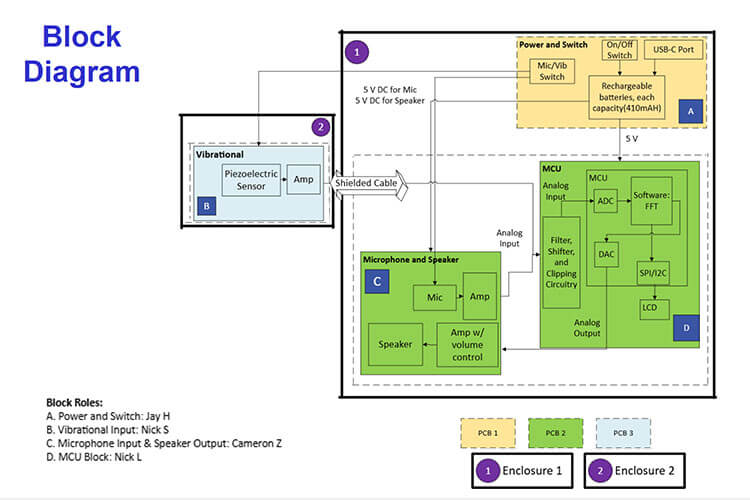
Objective: To create a device that allows a musician to tune their instrument. When the musician plays a given pitch, it will show the corresponding note to that pitch (using the western scale), their frequency, and the frequency they need to adjust to (whether they’re “flat” or “sharp”).
Team Members:
- Jay Huang
- Nick Laufenberg
- Nick Schott
- Cameron Zins
Advisor: Jeff Kautzer and William Dussault, UWM CEAS Electrical Engineering


Presentation: TBD
Key Features and/or Operating Modes:
- Rechargeable battery through USB-A
- Microphone for acoustical tuning
- Speaker for playing reference note to player after player plays their note
- Vibration “clip-on” tuning
- ON/OFF Switch, Input toggle switch,
- LCD for displaying note, user frequency, frequency to tune to, and whether they’re “sharp” or “flat”
- Frequency Range: C1 – B5 (32 Hz – 987 Hz)
Key Differentiating Performance:
- Supports both acoustical and vibrational tuning with toggle of a switch
Cost:
- Sales Price: $66, Component Cost: $21.97, Assembly & Test Costs: $10
Environment:
- Indoor, Outdoor, Stationary
- Operating Temp Range: 0 to 85° C
- Humidity Range: 0 to 100%
Power Input:
- Battery Power: 2 Lithium Polymer Batteries, each 3.7 V nominal, normal 2.5A, Max 5 Amps
Major Functions:
- Range: 32 to 987Hz, Accuracy: +/- 0.1Hz, Resolution: 0.05 Hz
- Functions: On, Off, Acoustical Mode, Vibrational Mode, Speaker mute toggle
- Quantities: Musical Frequency (Hertz)
Lidar Distance Measurement Tool
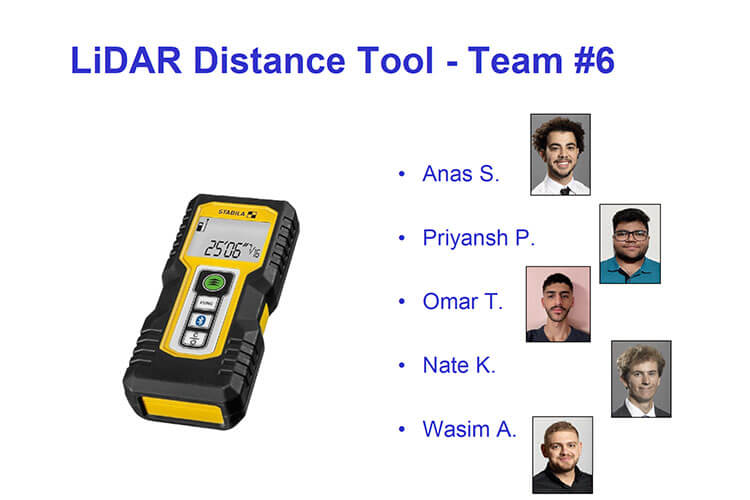
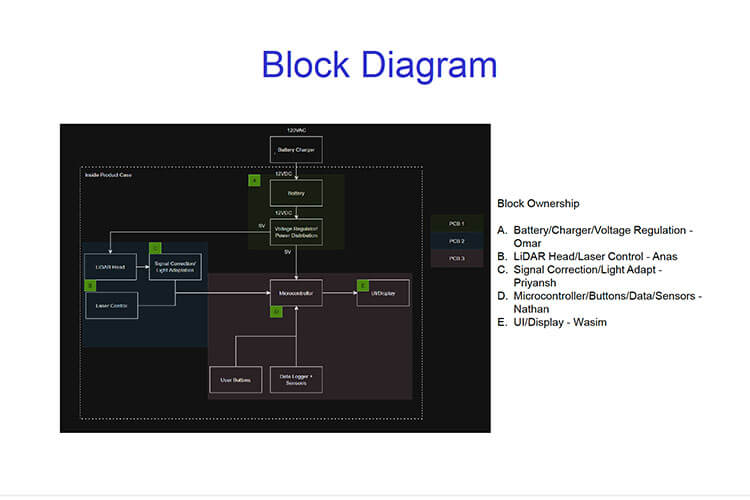
Objective: To create a handheld 905 nm time-of-flight LiDAR device with tilt and logging for quick distance checks and long-term movement monitoring.
Team Members:
- Anas S.
- Priyansh P.
- Omar T.
- Nate K.
- Wasim A.
Advisor: Jeff Kautzer and William Dussault, UWM CEAS Electrical Engineering
Presentation: TBD
Major Features:
- Live Measure – real-time distance (m/ft) with tilt reading.
- Long-Term Monitor- duty-cycled data logging for change detection.
- Adaptive-Light- ambient-aware sampling rules for outdoor sunlight.
- Visible aiming laser, microSD logging and USB export
Intended Market:
- Construction, facilities, utilities, infrastructure maintenance, field research, campus labs.
Cost:
- Sales Price: $400, Component Cost: $320, Assembly & Test Costs: $20
Environment:
- Indoor, Outdoor, Stationary
- Operating Temp Range: -10 to +50° C
- Humidity Range: 10 to 90% RH non-condensing
Power Input:
- Battery- 1× Li-ion to rails 5V (LiDAR) and 3.3V (logic), USB-C 5V for charging/run-while-charging
Major Functions:
- Live Measure; Long-Term Monitor (duty-cycled logging); Sleep
- Distance- Range: 0.2–100m, Accuracy: ±5cm (<500 Hz) or ±10cm (≥500 Hz), Resolution: 1cm
- Angle (tilt)- Range: ±180°, Accuracy: ±1° (target), Resolution: 0.1°
- Displayed: Live Distance, Live Angle, Battery %
Rechargeable Emergency Lamp
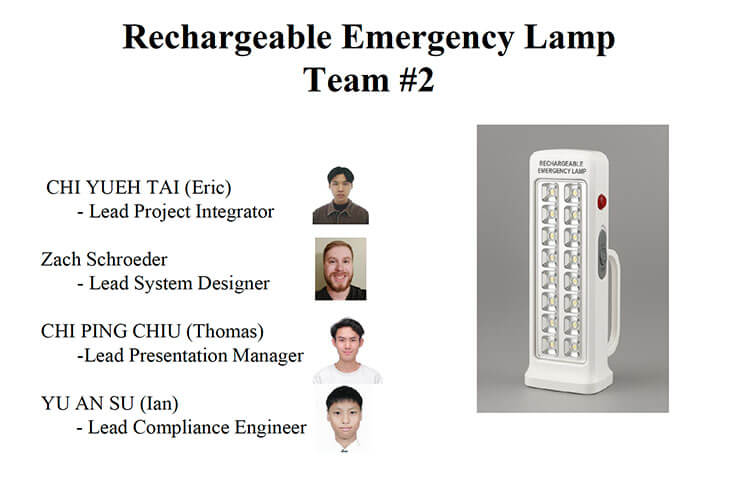
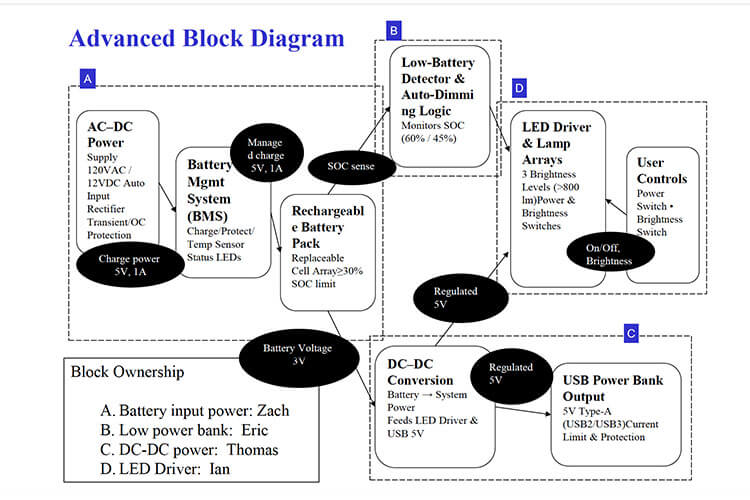
Objective: To design and implement a rechargeable emergency lamp with BMS, LED control, and USB power output
Team Members:
- Chi Yueh Tai (Eric)
- Zach Schroeder
- Chi Ping Chiu (Thomas)
- Yu An Su (Ian)
Advisor: Jeff Kautzer and William Dussault, UWM CEAS Electrical Engineering
Presentation: TBD
Major Features:
- Three brightness levels with auto-dimming on low battery
- Works as emergency light and 5V USB power bank
- Built-in battery management for safe charging and reliable runtime
Intended Markets:
- Rural areas with poor electricity (e.g., Sub-Saharan Africa)
- Households in disaster-prone regions (Japan, Indonesia, Philippines)
- Outdoor enthusiasts (camping, hiking, night use)
- Humanitarian aid and disaster relief
Key Requirements:
- Brightness Output: larger than 800 lumens, 3 selectable levels (High/Med/Low).
- Battery Capacity: 5× Li-ion cells, 3.7 V nominal, 10.8–12 Wh, 2200–3000 mAh.
- USB Output: 5 V regulated, 500 mA (USB 2.0) / 1.5 A (USB 3.0).
- Input Power: 100–240 VAC (0.5 A) or 12 V DC (1 A max).
- Target Sales Price: < $25 per unit; Total Cost: ~ $17–20 including assembly.
- Operating Temperature: –10 °C to +45 °C; Humidity: 10–90% RH (non-condensing).
- Smart Control: Automatic dimming at 60% / 45% SOC, over-charge / over-discharge / over-temp protection.
- Form Factor: Portable / stationary lamp, lightweight for indoor/outdoor/disaster use.
- Charging Efficiency: ≥ 85%; full charge < 5 hours from AC input.
- Standards Compliance: Meets IEC 60086-4 safety for Li-ion packs.
Safe Shutdown DC Power Supply
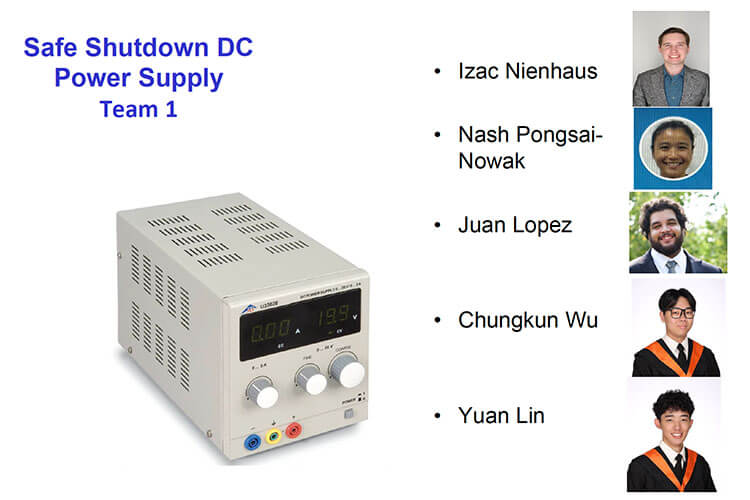
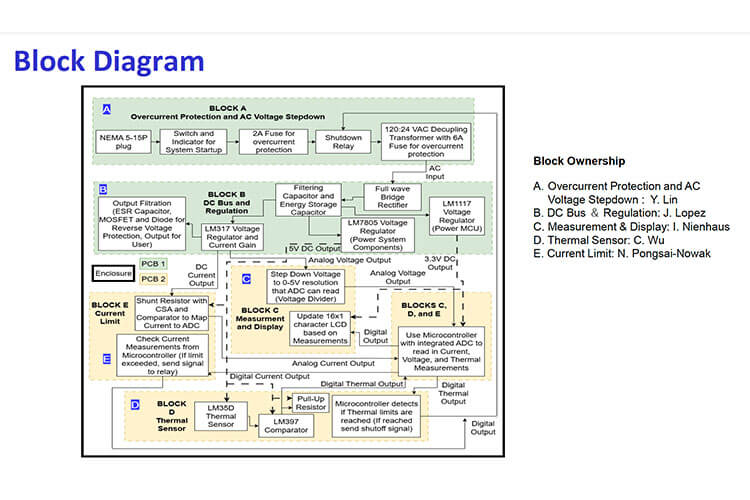
Objective: To convert residential AC to adjustable safe DC power supply for laboratory use with protection and monitoring features.
Team Members:
- Izac Nienhaus
- Nash Pongsai-Nowak
- Juan Lopez
- Chungkun Wu
- Yuan Lin
Advisor: Jeff Kautzer and William Dussault, UWM CEAS Electrical Engineering
Presentation: TBD
Major Features:
- Automatic thermal shutdown for safe operation
- Automatic current overload shutdown for safe operation
- Variable 1–20 V DC output with up to 5 A current
- Research and prototyping environments in US academic institutions
Intended Market:
- Laboratories
Cost:
- Sales Price: $250, Component Cost: $166, Assembly & Test Costs: $15
Environment:
- Indoor, dry environment
- Operating Temp Range: 15 to 120° F
- Humidity Range: 5 to 96%
Power Input:
- Residential AC Power: 60Hz 102 – 132 VAC @1.5 Amps Max
Major Functions:
- On : Measure
- Range1 – 20 Vdc, Accuracy: 1%, Resolution: 0.1 Vdc
- Range 0.6 – 5 Amps, Accuracy: 1%, Resolution: 0.1 Amps
- Off (No power to system)
Smart AC Energy Monitor
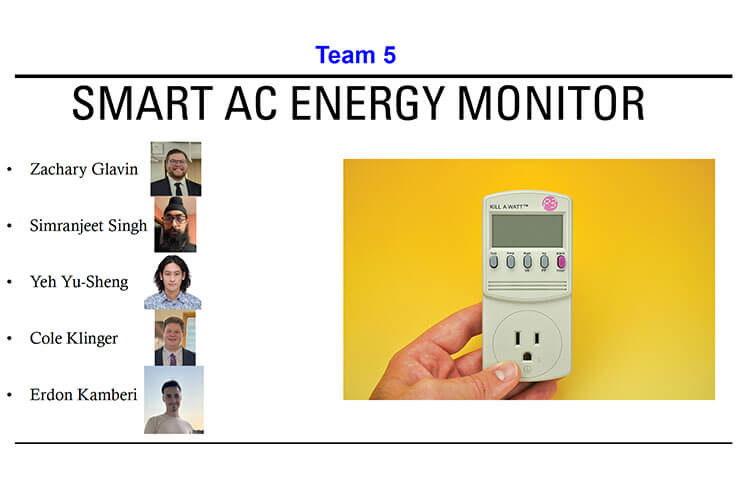
Objective: To accurately measure the energy consumed (in kWh) by appliances or devices plugged into it.
Team Members:
- Zachary Glavin
- Simranjeet Singh
- Yeh Yu-Sheng
- Cole Klinger
- Erdon Kamberi
Advisor: Jeff Kautzer and William Dussault, UWM CEAS Electrical Engineering
Presentation: TBD
Major Features:
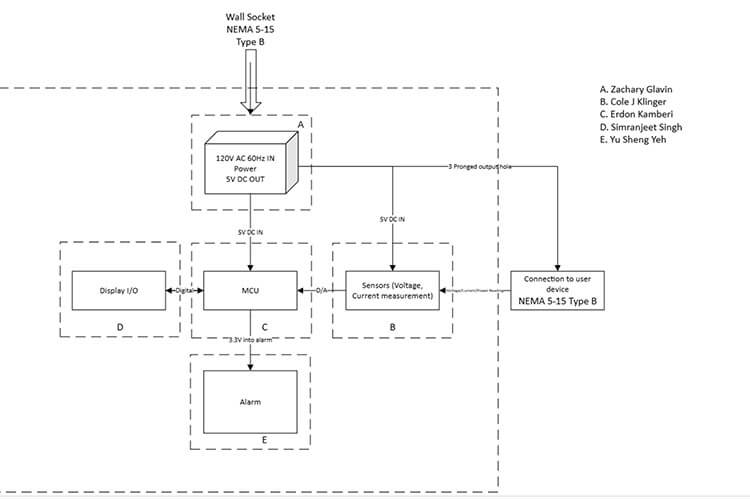
- Monitor voltage and current display real-time voltage (V) and current (A) of connected appliances.
- Display power usage, show power consumption in watts (W) to help users understand how much power each device uses.
- Track daily/total energy use keep a running total of energy used over time.
- Estimate electricity costs help users calculate electricity costs manually using displayed kWh values and their utility rate.
- Alarm to notify user when the energy consumption is over a set amount in kWh
Intended Market:
- Intended for use in North America (120 V, 60 Hz)
Cost:
- Sales Price: $25, Component Cost: $15, Assembly & Test Costs: $5
Environment:
- Indoor
- Operating Temp Range: 0 to 37° C
- Humidity Range: 30 to 80% Rh
Power Input:
- Residential AC power: 120 VAC at 15 A, 60 Hz
- Battery power: not applicable
- Other power input: not applicable
Major Functions:
- TBD
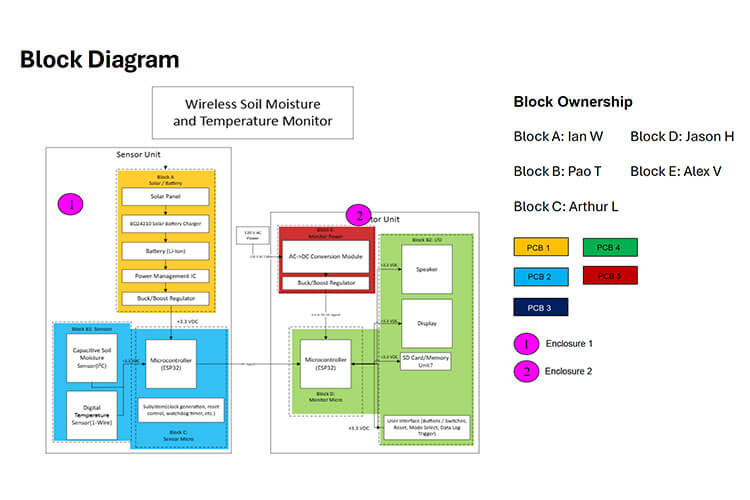
Wireless Soil Moisture & Temperature Monitor
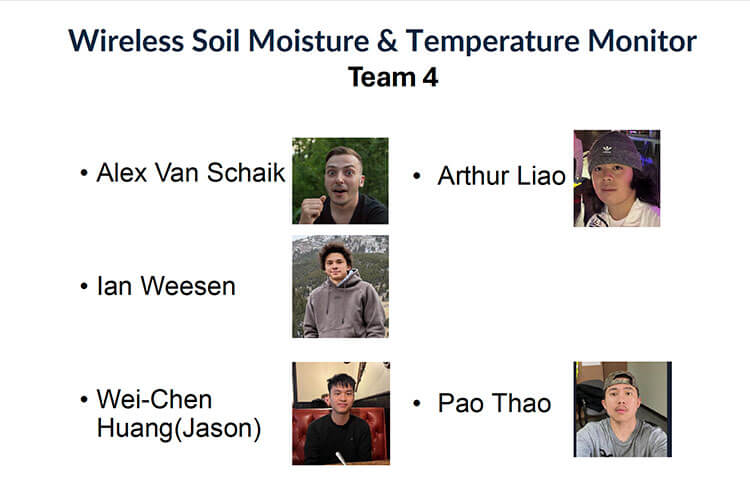
Objective: To create aA= wireless sensor/monitor system for farmers, gardeners, and plant enthusiasts which periodically polls soil moisture level and temperature.
Team Members:
- Alex Van Shaik
- Ian Weesen
- Wei-Chen Huang (Jason)
- Arthur Liao
- Pao Thao
Advisor: Jeff Kautzer and William Dussault, UWM CEAS Electrical Engineering
Presentation: TBD
Key Features and/or Operating Modes:
- Sealed, waterproof, solar powered, rechargeable outdoor sensing unit
- AC powered indoor base station with display and user controls
- Configurable soil dryness/wetness alarms
- Multi-depth sensing capability (e.g., surface, mid-level, root zone)
Key Differentiating Performances:
- Minimum 200 meter line-of-sight communication range
- Soil moisture accuracy ±5%, temperature accuracy ±2°C
- Configurable sampling rate (e.g., every 15 minutes to 2 hours)
- Can operate at least 7 days without sunlight using battery storage
- Battery charge from min to max capacity within 6 hours of full sun
Intended Market:
- USA
Cost:
- Sales Price: $40, Component Cost: $20, Assembly & Test Costs: $4
Environment:
- Indoor monitor unit and Outdoor sensor unit.
- Operating Temp Range: Indoor: 10-30° C ; Outdoor: 0-45° C
- Operating Humidity Range: Indoor: 0-90%, Outdoor: 0-100%
Power Input:
- Residential AC Power: 102-132 VAC
- Battery Power:1 Li-Ion
- Other Power Input: Solar Technology
Major Functions:
- Range: 200 M Line of Sight, Batt.: 168 Hr Without Charge, Humidity
- Accuracy:±5%, Temp Accuracy:±2° C, Resolution: 8 bit per sensor
- Functions:On, Off, Manual Measure,Set Polling Interval, Alarm
Industrial Engineering
Presentations: TBD
Contractor Route & Fleet Optimization
Objective: The goal of this project is to develop a methodology to get the optimum number of routes for FedEx Ground contractors, and use this routing methodology to determine the optimal truck fleet makeup (truck types) and employee requirements.
Team Members:
- Bandar Alharbi
- Mohammad Altuwaijri
- Wyatt Graczkowski
- Raul Medina Castello
Project Advisor:
- Matthew Petering, Industrial Engineering
Industry Mentor:
- Jugal Pandya, FedEx


Project Presentation:
TBD
Connected Systems Institute
(East of Golda Meir Library)
Materials Science & Engineering
Presentations: Tuesday, May 12, 2026 at 1 pm in EMS 170

“Axe Me Later” cast horseman’s axe
Objective: To design and cast a horseman’s axe for the Cast in Steel 2026 competition.
Use our background to design the axe, choose the material, choose the heat treatment, and choose what testing is performed on the axe and metal.
Team Members:
- Aaron Macek
- Carol Martinez
- Anna Carolina Salcedo Martinez
Faculty Advisors:
- Pradeep Rohatgi, Professor, Materials Science & Engineering
- Dr. Ben Church, Associate Professor, Materials Science and Engineering
Industry Mentor: Jim Myers, MetalTek
Presentation: Thursday, May 9 from 11 am – ~12:30 pm in EMS W119
Mechanical Engineering
Presentations: TBD






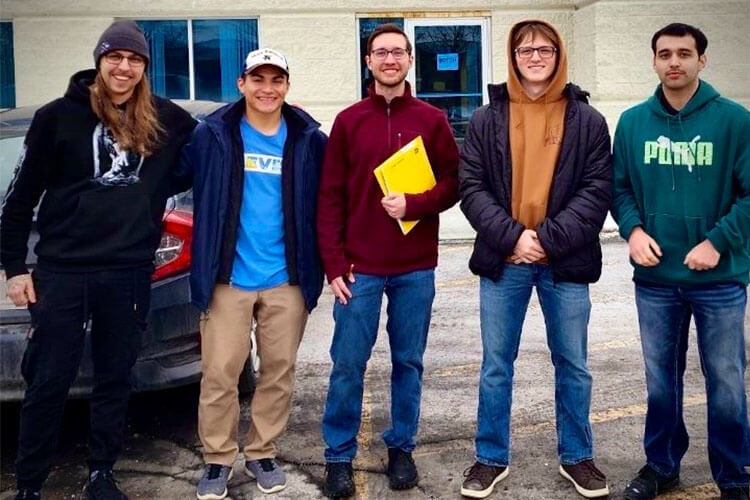
Automated Dice Rotation
Objective: Design an automated system to rotate dice in a printing fixture, replacing the current manual process.
The system must precisely rotate batches of dice through required angles, starting with 6-sided dice, using reliable, scalable, and cost-effective concepts built primarily from off-the-shelf components.
Team Members:
- Marco Aguilar
- Owen Cass
- Ethan Nienhaus
- Logan Olson
- Jexel Valentin Perez
Project Advisor: Mohamed Yahiaoui, Senior Lecturer Mechanical Engineering and Kyle Jansson,
Industry Mentor: Bob Spircoff, BOTCH
Project Presentation: TBD
Project Findings: TBD
Cable Tie Tool Modeling and Mechanism Improvement
Objective: Analyze and model the mechanism of the HellermannTyton EVO9 HT cable tie tool to understand the relationship between user input force and output tension force in order to improve performance.
The goal is to develop an optimized design that reduces required force and ergonomic strain, supported by mathematical modeling, CAD design, and a functional prototype.
Team Members:
- Wynne Grame
- Ben Kruger
- Matthew Paulson
- Avery Reimer
- Nick Straka
Project Advisor: Mohamed Yahiaoui, Senior Lecturer Mechanical Engineering
Industry Mentor: Ryley Walter, Hellermann Tyton
Project Presentation: TBD
Project Findings: TBD
DeltaHawk II
Objective: Redesign an aircraft electrical enclosure for Delta Hawk’s engine PCB to improve manufacturability, reduce weight and cost, and meet RTCA DO-160 environmental and structural requirements.
Deliverables include a CAD model, functional prototype, compliance plan, and production cost and manufacturability analysis.
Team Members:
- Al Azhar Al Badri
- Joshua Lee
- Anthony McArthur
- Zaid Taha
- Lucas Thibert
Project Advisor: Mohamed Yahiaoui, Senior Lecturer Mechanical Engineering
Industry Mentor: Niklas Barrett, DeltaHawk
Project Presentation: TBD
Project Findings: TBD
Lightweight Aircraft Diesel Muffler with Integrated Vibration Isolation
Objective: Design a lightweight aircraft diesel exhaust muffler with integrated vibration isolation to reduce airframe vibration and meet FAA requirements.
The system must weigh under 11.5 lbs., optimize exhaust performance, and remain cost effective. Deliverables include CAD design, prototype, and testing validation.
Team Members:
- Harley Gehrand
- Sawyer Jones
- Ryan Schlais
- Vincent Sparacino
- Flavio Toma
Project Advisor: Mohamed Yahiaoui, Senior Lecturer Mechanical Engineering
Industry Mentor: Niklas Barrett, DeltaHawk
Project Presentation: TBD
Project Findings: TBD
Multi-Line IV Connector System
Objective: Design a compact, lightweight, purely mechanical multi-line IV connector that simplifies fluid selection and reduces user error.
The system will improve safety, usability, and efficiency in clinical environments through intuitive operation, reliable isolation of lines, and a validated functional prototype.
Team Members:
- Mahmoud Ahmad
- Aaron Franklin
- Aditya Kennedy
- Isaac Lomibao
- Samier Saleh
Project Advisor: Mohamed Yahiaoui, Senior Lecturer Mechanical Engineering
Industry Mentor: Dr Mohammed Djelmami-Hani, UMEDEC, LLC
Project Presentation: TBD
Project Findings: TBD
Neonatal Warmer Side Wall Design Improvement
Objective: Improve the neonatal warmer side wall design to prevent accidental opening and enhance safety, usability, and reliability in NICU environments. Optimize the latching and opening system, develop a prototype, and validate performance while ensuring compatibility, cleanability, and compliance with GE HealthCare standards.
Team Members:
- Grant Abrahamson
- Adam Kovacs
- Baker Malik
- Brady Schmidt
- Elliot School
Project Advisor: Mohamed Yahiaoui, Senior Lecturer Mechanical Engineering
Industry Mentor: Ramune Auzelyte, GE HealthCare
Project Presentation: TBD
Project Findings: TBD
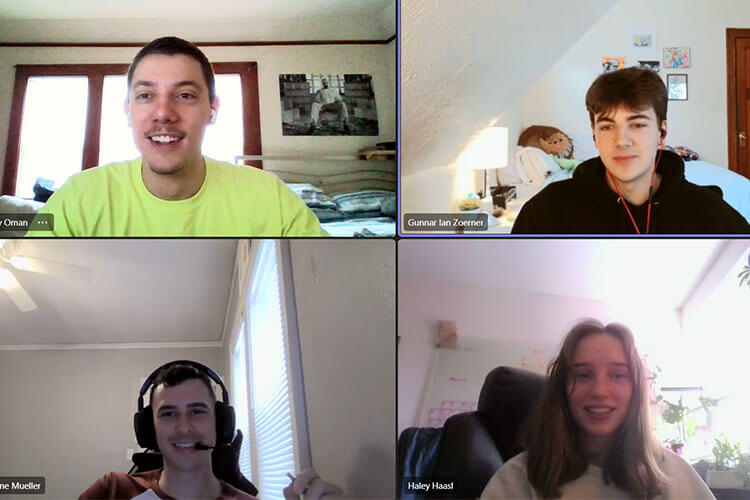
NiceRink
Objective: Design a hanger system to secure NiceRink kick plates to exterior rink walls to protect the liner. The new system must replace the current screw-based method, and allow for faster, simpler installation and improved repeatable use. It must withstand sub-zero temperatures, be cost-effective, work with existing materials and processes, and be validated through CAD, material selection, and prototyping
Team Members:
- Haley Haasl
- Joseph Mueller
- Tyler Oman
- Gunnar Zoerner
Project Advisor: Mohamed Yahiaoui, Senior Lecturer Mechanical Engineering
Industry Mentor: Jim Stoller, NiceRink
Project Presentation: TBD
Project Findings: TBD
Vertical Bin Storage
Objective: Design a vertical bin storage system to reduce floor space in a welding area while safely storing and providing access to heavy part bins. The system must improve space efficiency, ensure operator safety, support forklift loading, and include a complete 3D design, drawings, and cost estimate.
Team Members:
- Elijah Albrecht
- Brady Basile
- Brendan Eggert
- Jacob Horvat
- George Waples
Project Advisor: Mohamed Yahiaoui, Senior Lecturer Mechanical Engineering
Industry Mentor: Systems LLC
Project Presentation: TBD
Project Findings: TBD
Vulture
Objective: Design a next-generation ozone decomposer for corona treatment systems that reduces size and cost by 20 to 30 percent, improves manufacturability through modular design, and maintains or
exceeds ozone destruction efficiency and safety standards.
Deliverables include mechanical
design, airflow analysis, cost targets, and assembly instructions.
Team Members:
- Lucas Baiel
- Suzanne Gorman
- Justin Pflanzer
- Martin Roberts
- Nolan Woehrer
Project Advisor: Mohamed Yahiaoui, Senior Lecturer Mechanical Engineering
Industry Mentor: Ross Blomgren, Enercon
Project Presentation: TBD
Project Findings: TBD
Zoppas
Objective: Design a modular duct heater with interconnectable sections to simplify manufacturing, improve
thermal performance, and enable scalable assembly. The design will use simulation and physical
testing to validate airflow, efficiency, and manufacturability, with deliverables including CAD
models, prototypes, and engineering validation reports.
Team Members:
- Brian Anderson
- Shannon Herman
- Riley Palermo
- Valentine Rodriguez
- Logan Woodard
Project Advisor: Mohamed Yahiaoui, Senior Lecturer Mechanical Engineering
Industry Mentor: Brett Rogatzki, Zappos Industries
Project Presentation: TBD
Project Findings: TBD
3D Parts Cleaner
Objective: The goal of the project is the make a device that washes and cleans the resin off of the 3D parts that are built in the ‘figure 4 modular 3D printing system’.
Team Members:
- Jacob Ford
- Josh Olson
- Chayank Pawar
- Parker Stelter
- Ian Sobojinski
Project Advisor: Mohamed Yahiaoui, Senior Lecturer Mechanical Engineering
Industry Mentor: Jordan Nowak, Engman-Taylor

Project Presentation: Wednesday, May 1 from 8:15 am – 2:00 pm in EMS E250
Project Findings:
The team was supposed to make a prototype that cleans resin from 3D printed parts from a figure 4 modular printer. We were successful in creating a prototype with CAD files and all the supplemental documents needed to prove our findings.
Become a Senior Design Project Sponsor
Contact: Mark Meier, College of Engineering & Applied Science Office of Research: meiermd@uwm.edu