Kieyarrah Dennis can wear a lot of hats. In fact, versatility has shaped her personal and academic pursuits.
Her adaptability blossomed during her elementary years at a community-focused bilingual school in Milwaukee. Later, it drove her to earn a bachelor’s degree in biochemistry and history as an undergraduate student at the College of Saint Benedict in Minnesota.
“I knew that biochemistry was a broad enough scientific track that I could use it as a foundation to do anything,” she said. “And I want to do it all.”
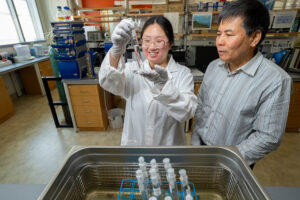
In 2021, Dennis joined the University of Wisconsin-Milwaukee’s School of Freshwater Sciences as a PhD student — propelled by a love of water and bugs.
She now specializes in expanding our understanding of antibiotic-resistant organisms so that the field of medicine can better equip people to survive bacterial infections. Her research advocates for more diverse treatments against the pathogens we are exposed to in our water systems and other public spaces.
“I’ve taken antibiotics,” Dennis said, “but I didn’t think about the fact that treatments could or could not work based on what organism you’re sick with and whatever resistance mechanisms they pick up.”
Following ‘creepy crawlers’
Dennis’ biochemistry studies for her bachelor’s degree planted the seeds for her work as a grad student today. “I was just thinking about parasites,” she said. “I’ve always been interested in creepy crawlers.”
Charged with writing a mock proposal for research, her capstone explored the development of a vaccine against a disease spread by freshwater parasites. The process introduced Dennis to disease transmission routes, dynamic food chains and freshwater environments, including public parks and green spaces.
Dennis was fascinated and hooked, and she started as a freshwater sciences grad student at UWM less than a month after graduation. “I drove home, rested for maybe eight days, then started here,” she said.
Probing antibiotic resistance
Over the past four years, Dennis has plunged into the complexities of how certain pathogens — such as E. coli, which is prevalent in bodies of freshwater and beyond — evolve and adapt to resist antibiotic treatment.
The issues of antibiotic resistance and multidrug-resistant organisms have grown significantly since the 1980s, which has prompted concern and significant funding to prevent a future where antibiotics no longer work.
For Dennis, some days her research looks like microscopic sequencing of gene families in the lab. Other days, it requires donning her history hat, while contemplating anthropology, sociology and other disciplines.
“You can’t solve this issue when you only look at a slice of where it occurs,” she said. “It’s out in the community. It’s in the hospitals. It’s in our food chain. It’s in the water.”
Bridging science and neighborhoods
With her lab hat on, Dennis immerses herself in the detailed genetics and mutation patterns of these microorganisms, as well as the freshwater environments that drive the evolution of the pathogens. Her findings will help develop new solutions to protect us from them.
Recently, though, she also discovered a love for public health. She hopes to educate communities about these issues in our world, bringing the science to everyday people.
“There’s usually a disconnect between the people doing the actual research and the people doing advocacy or the application of research,” she said. “I would like to do both.”