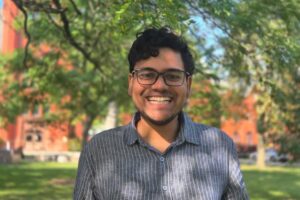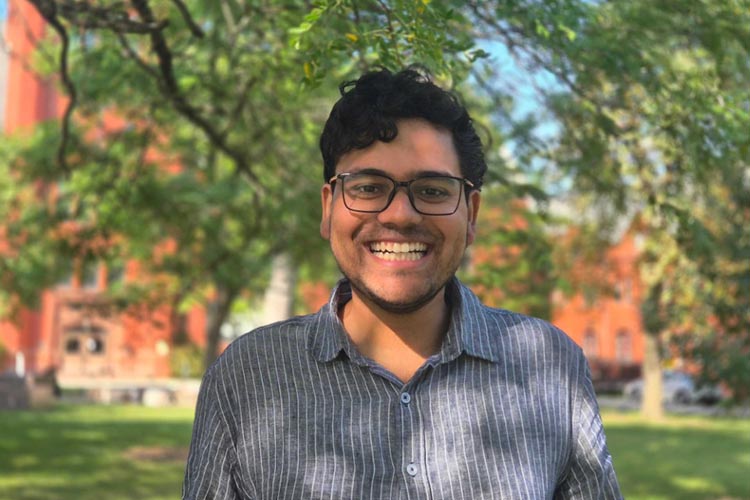
Why would a young astronomer from India travel some 8,000 miles around the world to pursue his Ph.D. in physics? Simple. Pratyusava Baral wanted to study with the UW-Milwaukee physicists who deciphered the data for the first-ever detection of gravitational waves.
Baral came to UWM in 2021 after earning his bachelor’s and master’s degrees in physics at Presidency University in Kolkata, India. His journey has been well worth it, and he’s earned the Physics and Astronomy Department’s Nicholas J. Papastamatiou Award, which recognizes an outstanding graduate student.
“This award is a tremendous honor,” says Baral, whose work on algorithms helped detect gravitational waves in the recently concluded fourth observational run of the LIGO (Laser Interferometer Gravitational-Wave Observatory) Scientific Collaboration, an international consortium of dozens of institutions and hundreds of researchers. “I am humbled and proud to be selected for this award by my faculty mentors.”
Baral will complete his doctorate in June and begin a postdoctoral fellowship in September at NASA’s Jet Propulsion Laboratory.
UWM’s Leonard E. Parker Center for Gravitation, Cosmology and Astrophysics has attracted top graduate students for decades. The center’s reputation grew after its significant role in the first-ever detection of gravitational waves by the LIGO Scientific Collaboration in 2015.
The discovery was celebrated by scientists around the world, and it confirmed a prediction made a century prior by none other than Albert Einstein. UWM’s LIGO team provided data interpretation expertise that was crucial to the discovery, which earned the 2017 Nobel Prize in Physics.
Supporting students like Baral, who dream of building upon Einstein’s work, is the goal of 414 for UWM Giving Days. And on April 13-14, when 15 donors make a gift to the Nicolas Papastamatiou Award or the Physics General Fund, an additional $3,000 in challenge funding will be unlocked. It’s one more way to help UWM students keep reaching for the stars.