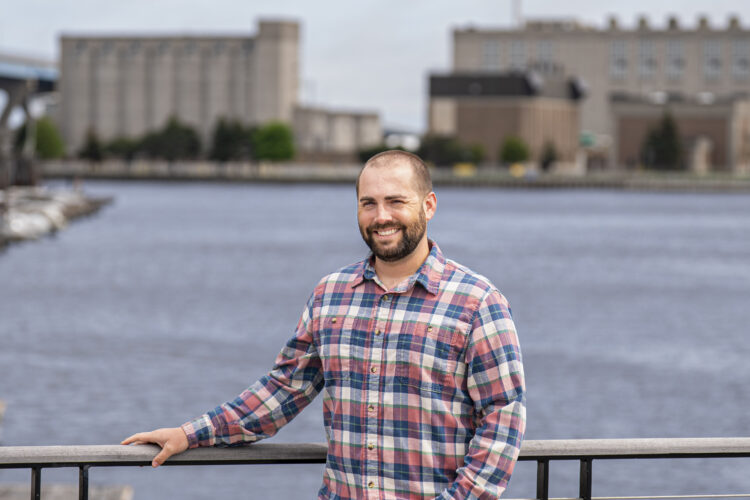
Growing up in Wisconsin, Brennan Dow spent his childhood exploring wooded nooks in public parks and splashing through streams and lakes near Stevens Point.
His coming-of-age unfolded just before cell phones became ubiquitous, said Dow, who earned his master’s in freshwater sciences at the University of Wisconsin-Milwaukee and now works for the Wisconsin Department of Natural Resources. Sometimes he misses those days when his only obligation was to make it home before dinner.
“I was doing my own investigations of everything that was out in green spaces,” Dow said. “But I didn’t look at a tree and think it’s a different species, or look at a bird or animal and think whether it’s good or bad for the ecosystem.”
Today, Dow coordinates a human ecosystem, consisting of scientists at different local, county, state and federal agencies, environmental leaders and conservation groups — all dedicated to cleaning up Milwaukee-area rivers and Lake Michigan.
His role as the Milwaukee Estuary and Sheboygan River Area of Concern coordinator is part of nearly $500 million in clean-water funding efforts, aimed at fixing decades of water contamination and environmental degradation.
Applying research to real-world issues
Thinking critically and strategically about nature began at UW-Eau Claire, where Dow majored in biology, specializing in bugs and aquatic life.
“When you start to piece the whole thing together, like food webs and how everything interacts with everything else, it’s a cascading effect,” he said.
When he graduated in 2013 with his bachelor’s degree, Dow landed a seasonal job with the Wisconsin DNR, where he would interview anglers about fishing on Lake Michigan. That process sparked endless questions about the state of the lake and its fish. He enrolled in UWM’s School of Freshwater Sciences in 2015 to dive deeper.
Dow’s graduate work in freshwater science and technology grew into an ambitious thesis, mapping the conditions across the bottom of the Milwaukee Harbor and the area’s tributaries. The undertaking landed nearly $250,000 in state and conservation grant money.
His thesis also identified 30 key waterway improvement projects in the Milwaukee area. That work eventually led to a full-time position with the DNR, overseeing cleanup and restoration efforts in Milwaukee’s contaminated and degraded waterways.
A history of contaminated water
During the 1900s, industries dumped heavy metals from machine shops, coal tar from gas plants and other toxic materials into Milwaukee’s three principal rivers. This stopped after Congress passed the Clean Water Act in 1972, but the damage was already done.
Many of the worst compounds, including heavy metals and human-made chemicals like PCBs, settled into the river bottoms and banks or flowed into the Milwaukee Harbor, where they continue to affect bugs, fish and people who consume fish today.
“The biggest effort is to clean up the bottom of our rivers and the harbor,” Dow said.
Change underway
This major effort, funded by the Great Lakes Restoration Initiative, involves a project agreement between the Environmental Protection Agency and five non-federal sponsors, including the DNR. The team is working to determine how much of the contaminated river bottom sediment can be removed and designing the project’s execution.
Dow is also coordinating with the Milwaukee Metropolitan Sewerage District on the construction of a facility to safely contain all the contaminated waste dredged out over the course of the cleanup.
“I’m kind of the glue that holds it all together,” Dow said of his position with the DNR.
Ultimately, that position involves working with local, county, state and federal agencies — as well as nonprofits, research groups and other parties — to ensure that our lakes and green spaces are healthy and thriving.