John Grunhagen emigrated from Germany to the United States in the early 1800s, settled in Milwaukee and bought five acres of land. In 1849, he began selling burial plots on his property in conjunction with a cemetery association. The area became known as Grunhagen’s Cemetery, a final resting place for the city’s German Lutherans.
But in 1871, the cemetery association defaulted on its mortgage, and the City of Milwaukee, eager to develop the area, ordered the burial ground closed and its occupants moved. Houses, churches, and businesses sprang up. Grunhagen’s Cemetery faded from memory, leaving behind only a few photos archived in the Milwaukee Public Library.
An excavation begins
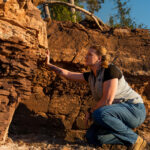
Roughly 144 years later, Patricia Richards, associate director of UWM’s Cultural Resource Management program, wore a neon construction vest and white hard hat as she looks over a dusty lot on North 13th Street. In an L-shaped pit before her, UWM graduate students and professional archaeologists sat in the dirt, carefully brushing grit away from skeletons half-embedded in the ground.

As it turns out, photos were not all that remained of Grunhagen’s Cemetery. At least 55 bodies were left behind in graves that weren’t removed when the city gave the order.
Richards is in charge of the cemetery’s excavation. She and the Cultural Resource Management program were hired by Guest House of Milwaukee, a homeless shelter that wants to expand and asked CRM to be on hand as a precaution when it broke ground on the lot next door.
“They were pretty sure that there wasn’t going to be anything here, because, as you can see, we’re standing in the basement of a house,” Richards said, pointing out the dimensions. “But we ran into burials in the wall, burials underneath here. They poured a cement foundation here over burials that were intact.”
CRM was founded in 1974 as a contractual arm of UWM’s Anthropology Department. It helps public and private agencies comply state and federal laws protecting historic sites and local resources. Usually, this means taking care of long-forgotten burial sites. CRM was on hand in 2006 to excavate the Old Catholic Cemetery on 22nd Street in Milwaukee and in 2013, when Froedtert Hospital broke ground for a new building and found an unmarked cemetery below.
In fact, Richards said, there are about 70 “forgotten cemeteries” in Milwaukee County alone. Now, it’s Grunhagen’s time to be remembered.
A delicate process
The archaeologists and graduate students wielded shovels, sifting through dirt and gently uncovering old bones. Most of the bones belonged to adults, but the crew found six juvenile graves in a separate section of the cemetery.
“What we aim to do is expose the remains in place and to do so without damaging them,” Richards said. “There are a variety of things that we learn about orientation related to burial program. … Did you cross the hands over the chest or by the side? Does the person have something in their hands? Can you tell if they were put in a coffin that was actually made for them, or were they put in a coffin that was too big or too small?”
Marcus Schulenburg, a doctoral candidate in anthropology, used wooden tools to chip away dirt from a femur. You can learn a lot from bones, he said, gesturing to the ones laid out before him.
“We know they were a young-ish adult, but had some dental problems. There’s a very large cavity. They would have had toothaches during their life,” he said. “This looks like a suspender clip that we’ve got, which is pretty neat to find. … They were buried with their arms crossed. It was a traditional Christian burial. The head is oriented to the west.”
After the dig
Once uncovered and photographed, the bones will go to UWM’s anthropology lab for cleaning and analysis by students and professors.
“The analysis involves determining the age of the individual at death, the sex of the individual, anything more that we can say about life ways. Did they have any trauma? Was there any disease that we can see that reflects itself in the osteology of the individual?” Richards said.
The anthropologists prepare a report for the Wisconsin Historical Society, which determines the bones’ fate. Some may be reburied elsewhere. Others may stay at UWM for curation in the Anthropology Lab.
Either way, Richards said, the scientists will try to identify the remains as best they can. There are no surviving cemetery records or gravestones, so the process will be difficult. The goal is respect.
“The people who do this kind of work don’t do it because they’re going to get rich or famous,” Richards said “They do it because they have a need to honor folks in cemeteries like this. Each of these people was buried by a family member and loved by a family member. We really feel strongly that that’s what we’re trying to somehow honor and protect.”