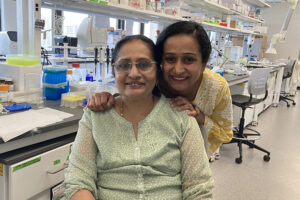
Callie Ylvisaker did something no one else has ever done: She completed all three study abroad programs offered by the Helen Bader School of Social Welfare at UWM. What’s more, Ylvisaker departed on all three trips in 2024, before her graduation in December.
“It was an eye-opening experience,” Ylvisaker said.
Each country Ylvisaker visited – South Africa, Austria and Costa Rica – offers its own unique study options and experiences. In Costa Rica, where Ylvisaker travelled in January of last year, she was put up by a host family, sharing early morning and evening meals. But in the morning and afternoon, Ylvisaker attended intensive Spanish-language learning courses designed to help social workers interact with non-native English speakers throughout their careers.
After finishing daytime coursework, Ylvisaker frequented various cultural events in the central plaza of Grecia, the town she stayed in outside of Costa Rica’s capital, San Jose. The Costa Rica study abroad with the Helen Bader School was developed in consultation with the California chapter of the National Association of Social Workers.
Learning from each other
Cultural intermingling was not the focus of Callie’s trip to Austria in June 2024. Instead, Ylvisaker spent most of her time in a conference-like setting, learning about the comparative public policy differences among Austria, the United States and various other countries.
Ylvisaker was impressed by the broad reach of the event. “The conference we attended attracted many international students. There were people from all over Europe, Turkey and other places in attendance. We were all able to learn from one another, to discover what issues we shared and how each country addressed them.”
The University of Applied Sciences Upper Austria hosts the UWM study abroad students and may be of interest to students studying not just social welfare degrees, but also history, psychology and other majors.
But Ylvisaker called her trip to South Africa the most unique of all.
“It was a little more personal of an experience. We had a smaller group, and the professor who took us, Melinda Kavanaugh, was exceptionally well connected,” Ylvisaker said.
A sense of community
On her previous two trips, Ylvisaker was accompanied by about a dozen students. But for the South Africa trip in July and August 2024, there were only about half as many students.
“We spent all our time together – we got to know each other,” she says. “Our colleagues regularly made us braai (South African barbeque). We played games together. You felt a sense of community.”
The course evolved over its existence, said Kavanaugh, a social work professor at UW-Milwaukee and the faculty host of the South Africa study abroad trip.
“We worked to create a more intimate, hands-on experience for our students.” Kavanaugh leveraged her network with colleagues at Stellenbosch University so that students could interact with residents and observe the issues facing South African communities.
This trip is meant to focus on public health, particularly around Cape Town, the nation’s legislative capital, and Stellenbosch. Ylvisaker and the other students were hosted by Stellenbosch University. Both Cape Town and Stellenbosch are in South Africa’s Western Cape province.
Focus on mental health
The particular focus of the public health study abroad was mental health and substance abuse, according to Ylvisaker.
“Rather than focusing on punitive measures, in South Africa, their focus is on prevention and reintegration. That’s a little bit different than what we do in the States.”
She also considered herself a lucky student – the summer 2024 study abroad to South Africa is the last time the program will be offered for the foreseeable future.
Ylvisaker saw both ends of the spectrum while in South Africa. While she and her cohort spent most of their time in Stellenbosch and the university, they did go into the countryside and visit some poorer communities. “They opened our eyes to what we take for granted every day.”
Ylvisaker recalled a story of a family who, despite having the means to leave the shantytown and live a better life elsewhere, decided to stay in the poverty-stricken area to continue to be part of the community.
“The need for community was one of the biggest takeaways from the whole trip,” Ylvisaker said. “That came as a little bit of a shock – I always studied where I was going, but you can’t really know a place until you are there. Community is a big part of who you are.”
Eye opening experience
In all, Ylvisaker, an Evansville, Wisconsin native, found travelling very rewarding. “These study abroad trips were amazing. At no other time in my life have I seen the things I did while overseas. Getting to see how other people live and then coming home to our luxuries and first-world problems was striking.”
Mark Twain is often quoted as saying “travel is fatal to prejudice.” Ylvisaker felt that was an accurate description. Since graduating with her pre-law degree, Ylvisaker has worked as a behavioral therapist at MKE Behavioral. But come the summer, she will embark on a new cross-country adventure: as an English teacher for Teach for America. She will be stationed in Las Vegas, teaching elementary school, for the foreseeable future.
“I would highly recommend people do a study abroad experience, if they are able,” Ylvisaker said. “It opens your world and lets you see things you never would have otherwise.”