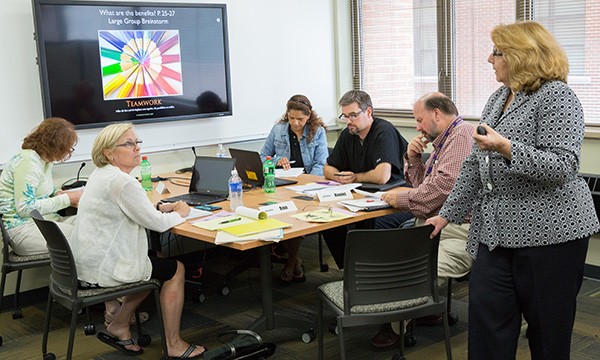
Tyler Gillen’s mathematics literacy class is not your traditional classroom. Six rectangular tables surrounded by swivel chairs are connected to a flat screen monitor, laptops are distributed for every three people, and large white boards are painted on the walls to surround the room with additional portable boards available to each “station.”
This is one of UWM’s new active learning classrooms.
“We know that engaging students actively helps all students achieve deeper understanding, retain it, and retrieve it later, particularly for at-risk students.”
– Connie Schroeder
Center for Excellence in
Teaching and Learning
Gillen teaches in one of five, retrofitted active learning classrooms with 24 to 54 seats in the former Columbia St. Mary’s Hospital (now the Northwest Quadrant). Opened in January 2015, the five rooms are available to all departments on campus.
In this classroom, a projector dropped from the center of the room displays information on a large screen. Each group can send their laptop work to their monitor, to other team monitors, or to the large class screen. The instructor may manipulate images to and from the various “stations” from the instructor console using a document camera or projector. Multiple methods are used across each discipline throughout the class period and students work in individual, pair, and group learning.
UWM’s new Kenwood Interdisciplinary Research Complex will have a somewhat similar but even larger, 72-seat facility as a general classroom. The College of Nursing is redesigning curriculum around a 130-seat facility with a different set of technology, said Connie Schroeder, senior consultant for Instructional and Organizational Development in the Center for Excellence in Teaching and Learning. Schroeder leads the initiative and campus committees on active learning classrooms and provides workshops and a certificate in active and small-group learning for faculty and academic staff members.
The research on active learning is impressive, Schroeder said. “We know that engaging students actively helps all students achieve deeper understanding, retain it, and retrieve it later, particularly for at-risk students. The spaces and technology allow us to redesign courses for active learners and collaboration and get students thinking, applying and making sense of knew knowledge.”
An active learning classroom assessment team is analyzing data from the spring 2015 semester and Schroeder is analyzing data from a grant-funded study on the classrooms and critical thinking.
Gillen, an adjunct professor, agreed that the classrooms enhance instruction. “The two big differences are the focus on group work and self-learning,” he said. Dividing students into groups of four, he told them to look at a five-page math problem that appeared on each of the monitors. It involved five people who were supposed to share 50 pounds of rice equitably, based on their widely varied weights, each getting at least a pound. The groups started by making ballpark guesses. Gillen guided each group by asking them questions to solve the problem, comparing two approaches to problem solving. Laughter rang out from one of the tables as the group figured it out.
Josie Gemignani, a freshman from Cedarburg, said, “In this class, everyone has to do the work. No one can slack off. Everyone’s learning.”
UWM is not alone in providing active learning classrooms. There are clusters of such classrooms and buildings devoted to them around the country.
The institutional investment is big, but so is the potential to improve student learning and retention, Schroeder said. The Massachusetts Institute of Technology adopted a similar active learning approach for a freshman physics class after seeing 40 percent of the students drop the class and another 10 percent fail. Tests given to students in both active learning and standard classes found students in the active learning classes did twice as well as their counterparts.