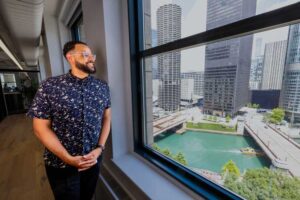
Every two years, the School of Architecture & Urban Planning awards the Marcus Prize, a top prize in international architecture, to an up-and-coming architect. Joshua Prince-Ramus, this year’s winner, is founding principal and president of REX in New York. The Huffington Post called him “one of the five greatest architects under 50,” and he was listed among “The 20 Essential Young Architects” by “ICON” magazine.
Part of the prize, which is funded by the Marcus Corp., provides an architectural design studio involving the architect, UWM students and faculty members.
This semester, Prince-Ramus and UWM students have been working to reimagine the installation of a new hybrid function for the downtown Milwaukee post office, 341 W. St. Paul Ave., which is scheduled for eventual redevelopment.
Matt Jarosz, adjunct professor and director of the Historic Preservation Institute, and Gil Snyder, associate professor of architecture, discuss Prince-Ramus and this year’s project.
Q. What is going on in the studio and how is Joshua Prince-Ramus involved?
A. Jarosz: We wanted to choose a Marcus Award winner who would not hesitate at the idea of working with an existing building or structure. We wanted someone who felt that adaptive reuse of midcentury modern buildings can form an important part of an architect’s portfolio of work and can also play an important part of educating architects. In the last century, the norm was to take buildings away and start over. Now we are saying that sustainability and sensitivity to the environment are not just a passing fad. People like old buildings that offer a sense of history and texture.
Q. Why choose the post office?
A. Jarosz: Joshua asked to work on an iconic Milwaukee building that was not much loved. The old post office couldn’t have been a better candidate. It’s enormous. The students had the opportunity to dig into the history of the place and why it looks the way it does. Another happy occurrence was that Kendall Breunig offered us first-floor space at the Pritzlaff Building (near the post office), a convenient location for scouting the site and for enhancing our interaction with professionals.
Q. How does the size of the building affect plans?
A. Jarosz: In some ways its bigness has been the problem. Developers wanted to buy it 20 or 30 years ago and demolish it, but it can’t be demolished because of subsoil problems and other issues. Now we have a developer out of Chicago (R2 Companies and Poskly Holdings, which bought the building in October 2015), and they are definitely going down the path of adaptive re-use.
Q. Will the ideas that the students come up with in the design studio actually happen? The developer and the city have mentioned in the media what they are thinking about.
A. Jarosz: We’ve been communicating with the current owners and they obviously have an interest in what we’re doing. They have not sponsored the studio in any way, but they’ve been generous in letting us use it as a study model and wander around inside. They’re planning to come in May to see our presentation.
Snyder: While it’s speculative, it’s really the intention of the studio to present an entirely plausible scenario. Look at all the other studies the school has done through Community Design Solutions and on the rapid transit connection (a bus route between downtown Milwaukee and the Milwaukee Regional Medical Center). The studio is trying to be a leader in the community in exploring the idea of adaptive reuse of historic buildings. We have a history of engaging with the community and examining possibilities.
Q. How are Prince-Ramus and the students reimagining the building?
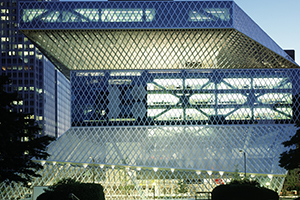
A. Snyder: One of the things Prince-Ramus is really interested in is having a complete and total understanding of the client’s functional program and using that to integrate the organization of the building’s internal spaces, and in turn, to motivate design invention. He has challenged the students to design a “Strategostructure.” The idea is to make a civic cultural center out of the post office – one that includes a performance theater, museum, library and multiplex, all sharing the newly adapted armature of the existing building. It can easily become an iconic, mixed-use destination at the heart of the city.
Jarosz: Rather than being a passive receiver of urban decisions from developers, architects need to get ahead of the discussion so we can end up with places and spaces that are more meaningful. That’s at the heart of this studio. The students are having a fabulous experience. Joshua has been generous with his time. It’s just been a great opportunity for them.