The morning stillness has enveloped the Cedarburg Bog, just as it has for thousands of years. The quiet is gently broken as graduate student Amberleigh Henschen whistles for the common yellowthroat birds she is researching. When one quickly returns her call, she smiles the way a mother smiles at hearing her children’s laughter — excited, happy, energized. Like her fellow researchers and others who hike the narrow boardwalks through UWM’s acreage of this diverse wetland, she is drawn by curiosity and a desire to learn in nature’s classroom.
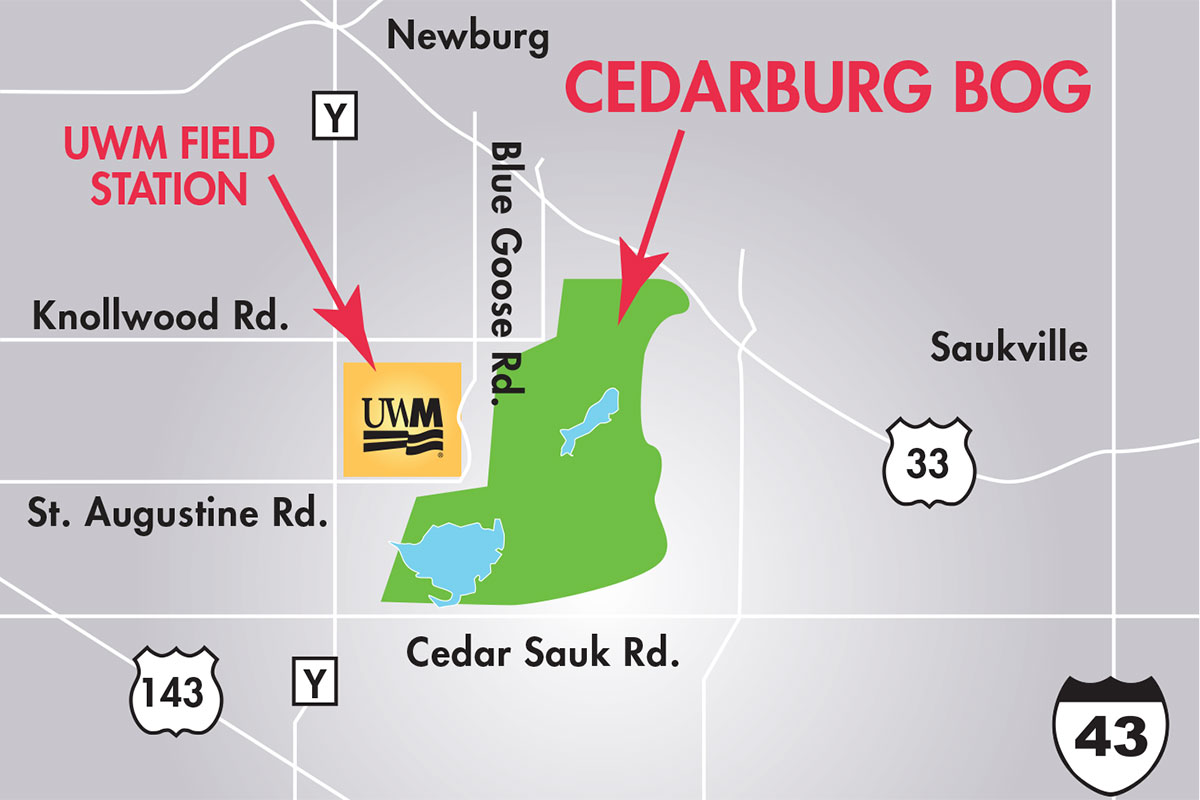 Just 30 miles north of campus, the Cedarburg Bog spans 2,200 acres and is owned primarily by the Wisconsin Department of Natural Resources and UWM. It was designated a National Natural Landmark by the National Park Service in 1973, and as an Experimental Ecological Reserve, is part of the National EER network. Anchored by the UWM Field Station, this outdoor laboratory frequently hosts students from UWM’s numerous scientific disciplines who explore its forests, swamps, meadows, marshes and lakes.
Local residents are correct when they humorously refer to the area as the “Saukville Swamp.” With its neutral pH, this wetland is technically a swamp; bogs have a more acidic pH. Its name is also somewhat of a misnomer as geographically it is in Saukville.
James Reinartz, a senior scientist at the University, presides over the area as the director of the Field Station, but his connection to the environment is deeper and noticeably profound. A fatherly ambassador and curator,
he speaks with the calm, measured cadence of a man who has learned patience waiting for nature to do things in its own time.
“The Cedarburg Bog is an exceptional asset and an important source of biodiversity,” Reinartz says. “Even though UWM is an urban campus, many students are interested in careers in environmental conservation. These areas provide a balance, a hands-on opportunity, and a way to broaden their education.”
For students like Henschen, the bog has been a place of boundless discovery.
“The Cedarburg Bog and UWM Field Station have provided me with an area to conduct almost all my field research while staying close to home,” Henschen says. She is examining why female common yellowthroats seem to prefer to mate with males with larger black, Zorro-type facial masks, which she hypothesizes may indicate a better immune system and healthier male.
“I hope to unravel what benefits females gain by being choosy about their mate,” she explains.
Home to carnivorous plants, a beech tree forest, about 35 plants at the southern-most reach of their growing range, and an ecosystem that thrives just beneath the water’s surface, the area’s importance, will only increase as climate change,
habitat fragmentation, and invasion by exotic species continue to influence natural areas around Wisconsin and the world. Carved into a quiet, rural expanse in southeastern Wisconsin, these unique wetlands play a vital role in preserving water quality and species diversity, and serve to enhance understanding of our environment.