When Jena Choi moved from Los Angeles to Whitefish Bay in middle school, she swapped ocean beaches for freshwater ecosystems. Lake Michigan and the area’s abundant rivers fostered a love of kayaking and deepened her appreciation for aquatic systems.
But it wasn’t until she enrolled in UW-Milwaukee’s School of Freshwater Sciences that Choi realized the possibilities of lifelong work in water. At UWM, she has already made meaningful contributions to lab work, snagging multiple awards for her research analyzing water dynamics and quality.
“There’s a whole career for science communication, outreach and helping people find resources,” Choi said. “I see myself teaching communities about water quality and water safety.”
Analyzing water dynamics
Choi’s contributions began even before her first freshman class at UWM, thanks to the university’s summer research program for incoming students.
In that program, Choi worked alongside UWM assistant professor and hydrologist Charles Paradis, who charged her with investigating how uranium behaves in soil during a flood.
That work could lead to new ways to clean and protect groundwater in polluted areas. Paradis applies similar research to understand the impacts of road salt on the natural environment.
For Choi, the unique experience revealed how scientific inquiry unfolds in real-time.
“It really taught me what research looks like,” she said. “Everybody doesn’t know exactly what will happen and it’s up to us as a team to figure it out. And even with no experience coming in, I made a contribution to it.”
Other professors and faculty have helped diversify her experience and success.
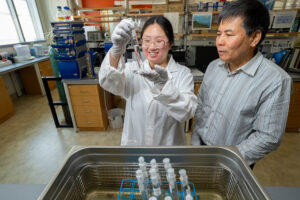
A freshwater science class with Laodong Guo immersed Choi in lab work, where she analyzed the chemical properties of wastewater that collects in oil fields during the extraction processes. As part of that work, she ran water samples through a spectrometer and learned how to use programming software to carry out the tests.
The aim of that research, in part, was to determine whether contaminated water in oil fields can be reclaimed for other uses, such as recycling produced water or recovering important metals.
Earning accolades
Choi’s cross-disciplinary studies have already earned attention from researchers in the field through presentations at the UWM Research Symposium and the National Conference of Undergraduate Research.
In 2023, she received a UWM Outstanding Performance in Introductory Chemistry Award. More recently, she entered the accelerated master’s program for high-achieving students in School of Freshwater Sciences. This means she can begin her graduate degree while finishing final requirements for her bachelor’s degree.
In 2025, Choi received an Outstanding Presentation award at the UWM Research Symposium for a research project supported by Gina Seegers Szablewski, a senior teaching faculty member in UWM’s geosciences department.
That work involved redesigning established geological diagrams in textbooks to be more visually appealing and engaging. And it helped Choi envision potential real-world work she’d like to do in the Milwaukee community.
Teaching the value of water
Choi imagines taking a multidisciplinary approach to her career, including collecting water samples, analyzing them (thanks to her chemistry minor) and teaching the public about water quality, health and safety. For example, she wants to make report cards that inform people when and where water is safe to swim in or consume.
Milwaukee Riverkeeper is one area nonprofit already doing this type of work; the organization has inspired Choi to volunteer in water cleanup events.
Her evolving expertise as a freshwater sciences student will allow her to dive even deeper into this passion. “I just want to teach people why water is valuable.”