It’s the largest long-term study of brain development and child health ever done, and faculty and students in the University of Wisconsin-Milwaukee’s Psychological & Brain Sciences Department are playing a crucial role.
A decade ago, the Adolescent Brain Cognitive Development study began following more than 11,000 children and their parents, with the goal of generating detailed data about how young brains mature. It’s already provided crucial information about the best predictors for positive mental health outcomes, including the benefits of physical activity and good sleep habits, as well as the detrimental effects of drugs, alcohol and excessive screen time. And it’s a great example of how supporting psychology during 414 for UWM Giving Days can make a widespread impact.
National impact
UWM is one of more than 20 ABCD Study sites and has followed more than 300 adolescents, with Professors Krista Lisdahl and Christine Larson serving as UWM’s principal investigators. Such research is one of the many ways a strong UWM Psychological & Brain Sciences Department benefits the broader community, as is preparing today’s students to become tomorrow’s mental health practitioners.

And children and parents aren’t the only ones benefiting from this important work. Projects like ABCD provide invaluable opportunities for developing UWM students into the next generation of mental health researchers.
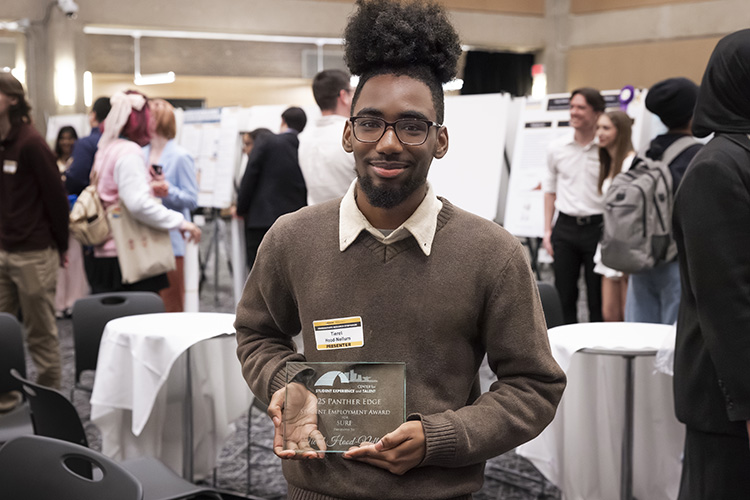
Like Tierel Hood-Nellum, who started out as a volunteer undergraduate researcher on the project before he advanced to research assistant, became a Student Undergraduate Research Fellow, and earned the Panther Edge Award for his outstanding work. Now, after graduating from UWM with a bachelor’s degree in psychology in 2025, he’ll be in Marquette University’s clinical psychology doctoral program in 2026.
“It impacted my life drastically, and it’s kind of directed my life into this field of research,” Hood-Nellum said. “I very much want to do research, and if it wasn’t for the lab and these opportunities, I never would have known that.”
Undergraduate researchers are important
Lisdahl says that undergraduate researchers are a critical part of the ABCD team, helping with data collection and research sessions while also being mentored on their own research questions. The project attracts a diverse array of students, whose study areas go beyond psychology into fields like social work, nursing, public health, neuroscience and engineering.
“It really crosses so many disciplines, and students not only get exposure to myself and Professor Larson, but they’re also encouraged to engage with the national network,” Lisdahl said. “We also have professional development opportunities and work groups that students can join.”
Understanding a complicated world
And the results will pay dividends for countless people who’ll benefit from better mental health.
“I think the modern world is complicated,” Lisdahl said. “So I think it’s really important, now more than ever, to continue to understand the factors, using state-of-the-science methods, to learn what really creates resilient, hardy and healthy teenagers going into the next decades.”
You can provide valuable support to UWM’s Psychological & Brain Sciences Department with a gift during 414 for UWM Giving Days. When 15 donors give to psychology, two anonymous donors will unlock an additional $1,000 for it. And your gift is not only an investment in the future of UWM’s students and faculty, but also in the parents and children throughout the community who benefit from their work, now and for years to come.