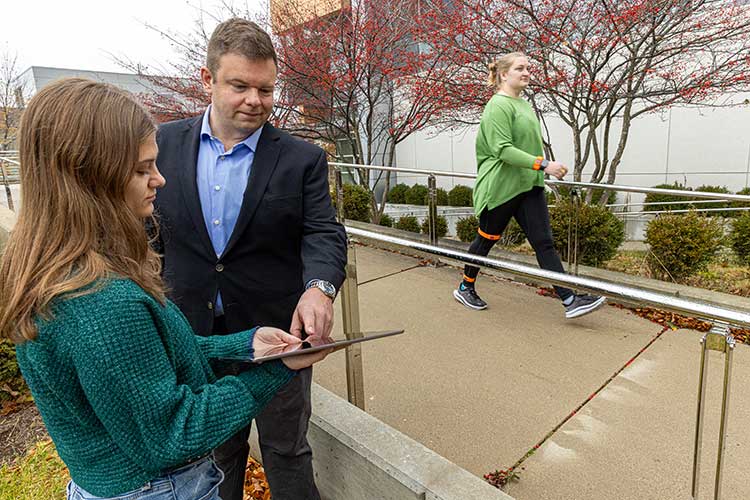
While Jacob Rammer was still a PhD student, he and his advisor built a human motion analysis lab on a shoestring budget – using off-the-shelf parts instead of expensive commercial systems. Their goal? To provide functional, affordable technology to hospitals in countries where standard labs like those in the U.S. are out of reach.
That scrappy effort eventually blossomed into a powerful partnership. Thanks to a connection with a post-doctoral researcher from the Philippines, Rammer and his advisor formed ties with clinicians at the University of the Philippines-Manila and the Philippine General Hospital. The impact has been significant.
Helping children in the Philippines
The Philippines stretches across 2,000 inhabited islands. Philippine General in Manila is the only place in the nation where children with mobility issues – caused by conditions like cerebral palsy, brittle bone disease, and cancer – can receive specialized orthopedic care.
What is human motion analysis? “Think of a room fitted with cameras around the perimeter,” explained Rammer, now an assistant professor of biomedical engineering. “We place reflective markers on the patient’s body, and a computer translates their movement into precise data that shows us how they walk or move.”
What began as a low-cost lab experiment has now helped 4,000 children Beyond that, the lab offers a rare chance to study lesser-researched conditions.
“Most of our patients have cerebral palsy, a disease that can vary significantly from child to child,” Rammer said. “This kind of technology really helps clinicians figure out what’s working, and what’s not.”
The detailed data the lab provides is vital for pediatric patients, especially those going into or recovering from surgery. Many use braces, orthotics, or wheelchairs and it’s crucial for doctors to know how they’re progressing after they go home.
“After surgery, parents naturally want to be protective,” Rammer said. “But for bones to heal and grow properly, kids need physical stress. The challenge is striking a balance – encouraging safe activity without putting them at risk.”
Providing learning opportunities for students
To help maintain that balance, Rammer and his students developed a smartphone app that tracks patients’ movement and activity levels. It allows clinicians to stay connected between visits – and gives them insight into how recovery is going at home.
The app supports comprehensive gait analysis and collects daily movement data – offering a fuller picture of long-term mobility during rehabilitation. Eventually, Rammer hopes to automate the system using AI, giving doctors a dashboard view of any issues in real time.
“Right now, we’re pulling the data manually and recording it on Excel sheets,” he said. “But soon, clinicians could get immediate updates and alerts about mobility problems without having to dig through files.”
In 2026, Rammer will lead a class in which students will have the option of journeying to the Philippines to help conduct movement analyses of children with disabilities, shadow clinics and observe surgeries prescribed because of their analyses. The class is open to students in any UWM major.
Undergraduate students who work in Rammer’s lab already help process the data and learn how to draw conclusions. They’re also collaborating with master’s students in bioinformatics to develop the app’s backend and data tools.
Because the work often requires custom solutions, students are involved in building both software and physical devices. “Every research project leads us to invent something,” Ramer said. “Whether it’s a tool, a sensor, or a program.”


