Todd Miller has always loved Wisconsin waters. He has fond memories of swimming in Lake Michigan, visiting his grandparents’ lake house and going on family fishing trips. It was those early experiences that drew him back to the Milwaukee area after earning his PhD and completing postdoctoral research on harmful algae on the East Coast.
“Water is such an important part of our daily lives and our culture,” said Miller, an associate professor of environmental health sciences at the University of Wisconsin-Milwaukee’s Joseph J. Zilber College of Public Health. “I felt a strong sense of wanting to go back to where I was from and study water quality and toxins in lakes.”
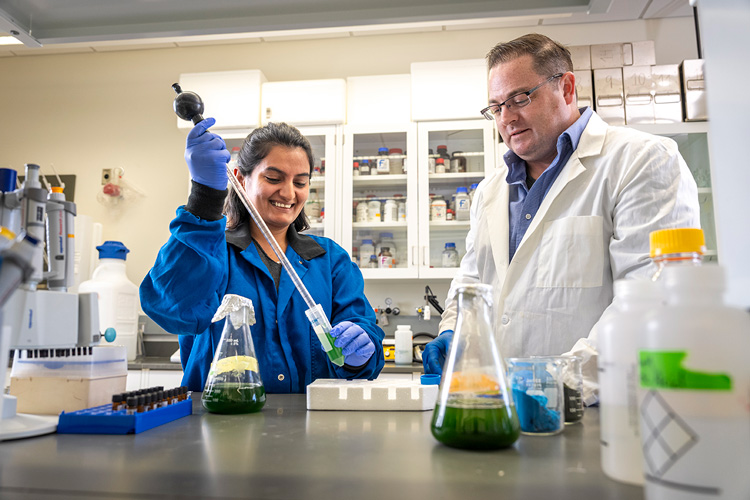
Now, as the principal investigator at the Laboratory for Aquatic Microbiology and Chemistry, Miller is working to develop a deeper understanding of toxins in Wisconsin’s waterways and the Great Lakes region. Specifically, he’s exploring the formation of harmful algal blooms and ways to prevent them.
“Almost 70% of the water that comes into American homes comes from a lake or a river,” Miller said, “and about 70% of our lakes and rivers now have this problem to different degrees.”
Harmful algal blooms: A growing problem
Miller’s primary focus is on blue-green algae, an aquatic life form most often found in freshwater, where they can grow quickly into concentrated blooms. While most blue-green algae are not harmful, some algal blooms produce toxins that cause skin irritation, gastrointestinal issues and even neurological damage in humans and animals.
These harmful algal blooms have increased in recent decades. Plus, they’ve become more frequent and toxic due to intensifying issues like climate change and nutrient pollution from agricultural production. The blooms can have major consequences for public health and the economy, like contaminating drinking water and spreading serious illness, Miller says.
But while harmful algal blooms are becoming a pressing concern, their study is relatively new. That’s why Miller calls his research, which has attracted attention and funding, “challenging and intriguing.” It has the potential to impact public health, improve environmental protection and inform policy decisions related to water quality and agricultural practices.
In some cases, it already has — for example, in northern Wisconsin, where a community leveraged Miller’s work to establish the Tug Lake District to protect and rehabilitate the lake and its ecosystem for the benefit of residents, property owners, and the public.
Keeping Wisconsin waters safe and clean
Miller views water-rich Wisconsin as a model for studying and addressing harmful algal blooms in the Great Lakes region and beyond. But his work has other impacts. Miller’s lab examines the growth of emerging contaminants in wastewater, including household chemicals and drugs like opiates, to see what they reveal about human behavior and public health.
Additionally, Miller’s team developed the innovative Panther Buoy, an autonomous monitoring buoy that can track the presence of algal blooms in real time. Panther Buoys have been deployed in bodies of water around the state, feeding continuous data to his lab and helping the team conduct more accurate, efficient research at lower cost.
Miller’s work is at once local and global. It improves public health in Wisconsin by ensuring cleaner water. And it may contribute to better environmental understanding and conservation more broadly — now and in the future.
“First, it’s about training the next generation of scientists,” he said. “We also have an opportunity to design new technologies that can detect toxins in water. And I’m hoping that our research will lead to more affordable and effective ways of monitoring waterways for potentially harmful substances.”