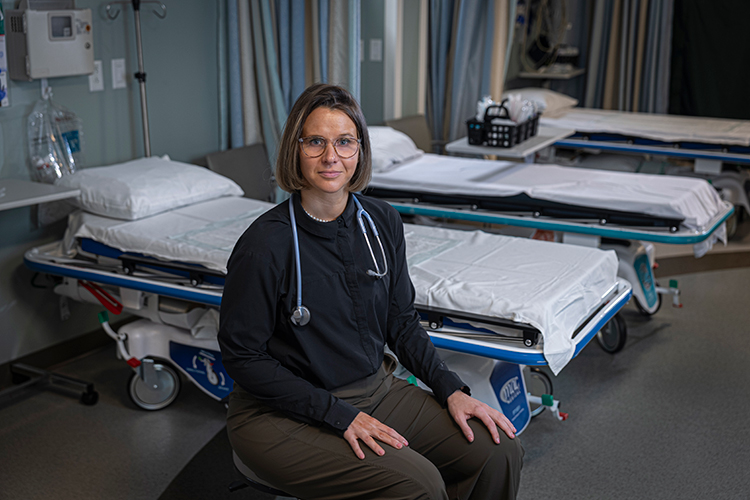
After war broke out in the Gaza Strip in 2023, Laura Swoboda watched from the other side of the globe as humanitarian conditions deteriorated. As a nurse practitioner, Swoboda was tapped into a global network of medical professionals, many of whom shared urgent calls for volunteers to travel to the conflict zone and provide medical care to Gazans in need.
Swoboda, who uses they/them pronouns, is no stranger to going abroad on medical missions. They also specialize in wound care – an especially relevant skill for treating patients in war zones. So, when an opportunity arose to volunteer with surgical nonprofit FAJR Scientific, they jumped at the chance. In 2024, Swoboda traveled to Gaza European Hospital and worked alongside an international team of surgeons.
“I was the only nurse practitioner and wound care specialist (on the team),” said Swoboda, who graduated with a doctorate of nursing practice (DNP) from UWM in 2018. For three weeks, they did what they could to treat Gazans’ devastating injuries and psychological trauma in an environment Swoboda calls “chaos.” Teams had limited supplies and worked in dire conditions, even sleeping in the hospital after their safe house was threatened by nearby bombings.
“My main job was just to help people and let them know that there were people abroad that still cared,” Swoboda said.
Swoboda’s trip to Gaza was guided by their conviction that health care is a fundamental human right. “I’m a humanitarian,” Swoboda said. “I don’t see national borders, socioeconomic status, sex, religion — those things shouldn’t impact your ability to be healthy.” To Swoboda, healing individual patients is as important as addressing the political and socioeconomic barriers to health.
A holistic approach to care
Swoboda’s journey to wound care expert and equity advocate started a decade ago while working as a home care nurse in Scottsdale, Arizona, in “a very ritzy area.” But a short drive away, “people don’t have doors (and) they have dirt floors — so (there’s) quite a disparity.”
At the same time, Swoboda could find little information about how to create lasting wound healing. “Wounds are (often) a symptom of a disease,” Swoboda said. For example, conditions like diabetes and peripheral artery disease can cause recurring lesions. These chronic illnesses, and their resulting wounds, can worsen with lack of access to proper treatments — a barrier that primarily affects low-income patients.
That’s where Swoboda’s interest in health equity and wound care intersect. As a certified wound, ostomy and continence nurse, they’re as interested in cutting-edge wound treatments as they are breaking down barriers to health care access.
Advocating for change
Today, Swoboda is focused on developing treatments that involve regenerative medicine, which boosts the body’s natural ability to heal by re-creating or repairing tissue. This field encompasses a variety of techniques like stem cell therapies, skin transplants and tissue engineering. But Swoboda also makes note of the social issues their patients face and uses that information to advocate for better health care policy.
“When I’m going and bothering my congressperson about something, I see that as part of my professional work, too,” Swoboda says. Seeing the effects of bad policy leads them to show support for safer environmental conditions and better health care access. For example, Swoboda recalls that while living in Shorewood, Wisconsin, they were a vocal advocate for removing lead pipes from the city’s water system. “If you’re able to advocate in any way, you feel less despair just doing something.”


