The State of Wisconsin and the University of Wisconsin–Milwaukee are dedicated to saving the environment. One of the easiest ways to contribute to the health of our planet is through recycling! University Housing has developed a recycling program that allows for the collection and easy separation of recyclables from the general waste stream. UWM uses single-stream recycling, where the “core four” recyclables do not need to be sorted into different bins. We do, however, separate cardboard and thin plastics (grocery and delivery bags).
More questions about recycling on campus? Contact the UWM Office of Sustainability at ask-sustainability@uwm.edu.
What to Recycle
UWM currently recycles the Core Four along with thin plastics (grocery and delivery bags).
Empty Cans
- Tin
- Soup
- Aluminum
- Soda
Empty Bottles & Jars
- Glass
- Plastic
Flattened Cardboard
- Cardboard Boxes
- Packages
- Paperboard
- Cereal Boxes
Paper
- Mixed Paper
- Junk Mail
- Paper Envelopes
- Homework
- Flyers
- Magazines
- Catalogs
Level Up Your Recycling
Help keep our recycling streams clean! The following items either belong in the trash or need a few more steps before they can be recycled. You can also choose a more sustainable option, such as reusable water bottles, shampoo bars, or detergent sheets.
These items are trash, unless you Level Up!
- (Grind) Coffee cups
Learn why. The paper cups used for coffee are lined with plastic and usually contain coffee, lattes, and other liquids which contaminate the rest of our recycling.
Level up! Remove and recycle the cardboard sleeve. The cup and lid are still trash. - Cold beverage cups
Learn why. The liquid and ice in beverage cups contaminate other recyclables. The straw and lid are not recyclable.
Level up! Empty your beverage containers out into a sink and give them a rinse in order to recycle the plastic cup. The lid and straw are still trash. - Pizza boxes
Learn why. Pizza boxes are trash because the cardboard is contaminated with grease, cheese, and food.
Level up! If the top of the pizza box is clean and does not have any grease, cheese, or food residue, you can rip off the top of the box to recycle. The rest of the box is still trash! - Food and to-go containers with food
Learn why. Food is not recyclable because it contaminates the rest of our recycling.
Level up! Look into our in-house composting program, Panther Pails, if you want to reduce your food waste. - Liquids
Learn why. Liquids are not recyclable because they contaminate the rest of our good recycling. Never recycle any containers that have liquids in them and never dump liquid into a recycling bin. - Plastic grocery bags, zip bags, mailing sleeves, and packaging
Learn why. Thin plastics like plastic bags are difficult to separate in the recycling process as they wrap around sorting equipment or tangle with other recyclables. Make sure to place these in the designated receptacles!
Level up! Choose paper packaging and/or consolidated shipping for fewer boxes and shipping materials when the option is available. - Laundry detergent
Learn why. Rinse out your laundry detergent jug thoroughly before recycling to prevent a foamy or sticky mess that can contaminate other recyclables.
Level up! Switch to buying and using laundry sheets to cut down on plastic packaging. - Damaged clothing, ceramic cups/plates/bowls, holiday decorations
Level up! Donate items that are in good condition. - Plastic utensils (forks, knives, spoons, and straws)
Level up! If possible, try to use plastic utensils more than once. - Styrofoam and packing peanuts (polystyrene)
Level up! Opt for companies that use more sustainable packaging.
How to Recycle in University Housing
Now that you know what you can recycle, you can learn how to recycle. Students living in University Housing use the Paw 2 Paw method shown in the video below.
Recycling Tips & Tricks
Here are some helpful tips and tricks highlighted from the video to keep in mind!
- Clean your recyclables
- Prevent mess, odor, contamination and attraction of unwanted critters.
- Pizza boxes
- While pizza boxes are trash, prevent trash chute clogs by bringing them to your building’s designated recycling center.
- Level Up! If the lid is free of grease, cheese and food; rip it off and recycle the clean top. (Trash the greasy bottom.)
- Different recycling receptacles
- Suite recycling bins are a great way to carry a lot of recyclables to the recycling centers.
- If you are on your way to class, or to meet some friends, use a paper bag to gather your recyclables. You won’t need to return to your room, just recycle the paper bag as well!
- Clean your suite/apartment recycling bin
- Be sure to clean your suite/apartment recycling bin regularly to prevent mess, odor and contamination of future recyclables.
- Use a wipe or rinse out the bin in your shower for deep cleans.
- Line your bin with a paper bag to help keep your bin clean.
Where to Recycling in University Housing
Learn where the main resident Recycling Centers are located! University Housing has Recycling Centers with tall blue bins for paper, bottles, and cans; larger blue or black rolling bins for flattened cardboard; and cardboard receptacles for thin plastics.
Why Recycle?
Recycling is important for the environment, economy, and people!
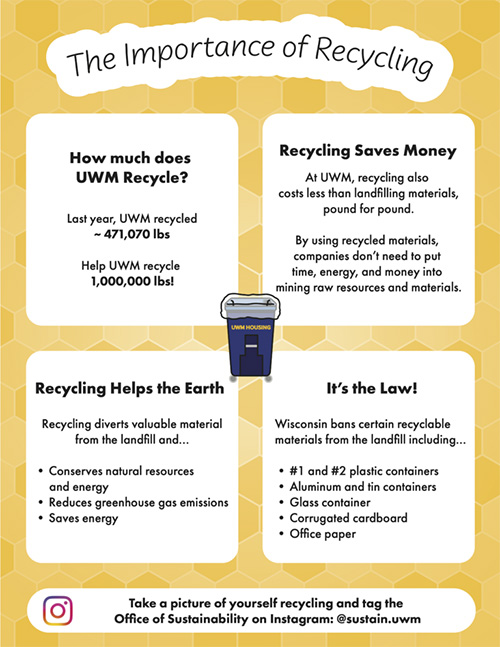
The Importance of Recycling
- How much does UWM Recycle?
- Last year, UWM recycled 471,070 lbs
- Help UWM recycle 1,000,000 lbs!
- Recycling Saves Money
- At UWM, recycling also costs less than landfilling materials, pound for pound.
- By using recycled materials, companies don’t need to put time, energy, and money into mining raw resources and materials.
- Recycling Helps the Earth
- Recycling diverts valuable material from the landfill and…
- Conserves natural resources and energy
- Reduces greenhouse gas emissions
- Saves energy
- It’s the Law!
- Wisconsin bans certain recyclable materials from the landfill including…
- #1 and #2 plastic containers
- Aluminum and tin containers
- Glass container
- Corrugated cardboard
- Office paper
Take a picture of yourself recycling and tag the Office of Sustainability on lnstagram: @sustain.uwm
Adventure of a Plastic Bottle
Ever wonder where your recycling goes after you place it in a blue recycling bin on campus? Follow the journey of a plastic bottle in the video below, as it travels from shelf to end-product.