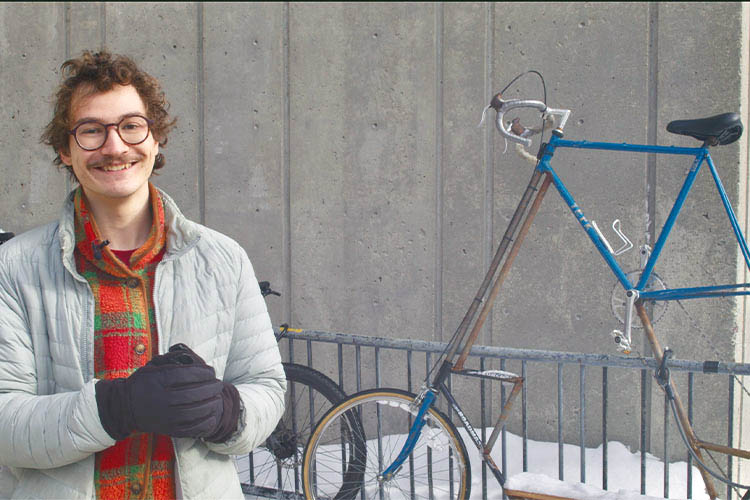
On any given school day, you might spot something unusual rolling across the EMS quad: a bicycle that looks like it missed a memo about gravity.
Perched high above everyone else, mechanical engineering senior Wynn Grame pedals to class on a homemade double-decker bike—two frames stacked into one towering ride that stops people mid-step and mid-scroll.
Getting onto the top seat is part mountaineer, part engineer, and all confidence. Grame starts by walking the bike forward, then steps onto a low wooden slat, grabs hold, and climbs the frame as the bike slowly moves forward.
Like most good engineering projects, the bike started as an idea that refused to go away.
“I saw an image of a double-decker bike like this and it just stuck in my head,” Grame said. And after friends donated one bike and then another, he said, “Then, I just had to do it.”
Just jumping in
Inspiration was the easy part. Execution is where things got interesting. Before this project, Grame had never welded. Not once.
“I used a friend’s borrowed welder to learn a new skill and make some mistakes,” he said.
He worked on the bike over the summer, squeezing in shop time after returning from his internship at HellermannTyton and on weekends. From cutting up the bikes to riding the finished product, the whole build took less than six weeks.
At HellermannTyton, a cable tie manufacturer, Grame worked on customer drawings and some design work with parts. Outside of class and work, he’s also an avid rock climber (surprised?) and a program assistant at Outdoor Pursuits for their bike shop.
His curiosity-driven mindset is what pulled him into engineering in the first place.
More than a conversation-starter
The bike-creation is a rolling example of UWM’s hands-on approach to engineering education—where students don’t just learn problem-solving in theory, they put it into practice.
Grame applied concepts straight from his mechanical engineering coursework, including bending analysis to determine the right tubing thickness. He analyzed bending and deflection, then ran finite element analysis on the frame design to verify that it was sound.
The frame is made entirely of mild steel. While modern bike frames often use aluminum–which is lighter but much harder to weld. Steel is common in older bikes and much more forgiving for someone learning the craft. It’s heavier, sure, but also strong, durable, and reliable.
And there are benefits to riding a bike like this, beyond pure cool factor, he added.
“It also offers excellent visibility on the road,” he said, “because cars can see you immediately and so they are very cautious around you.”
Grame knows of at least four other tall bikes in Milwaukee, but this one is the only one cruising UWM’s campus.
For Grame, the bike isn’t just transportation. It’s proof of concept – for learning by doing. Sometimes, experiential learning looks like a lab or an internship. But sometimes, it looks like a double-decker bike.