Grad student awarded AEE scholarship for top female U.S. student pursuing energy career
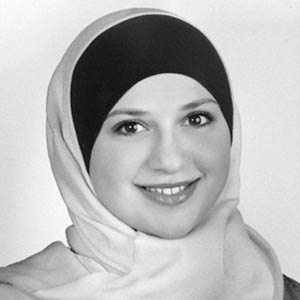
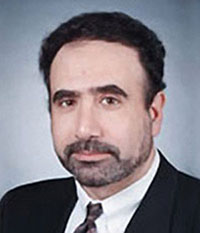
Congratulations to Asma Khasawneh, who was awarded the Ruth Whitlock CWEEL Scholarship by the Council of Women in Energy & Environmental Leadership, a division of the Association of Energy Engineers.
The award honors the top U.S. female student pursuing a career in the energy or environmental fields. Khasawneh’s advisor is Professor Ryo Amano, mechanical engineering.
The $2,500 scholarship recognizes academic excellence, leadership potential, and a commitment to advancing women’s careers in energy.
The scholarship is named after Ruth Whitlock, a notable advocate for women in the sector and former executive administrator for AEE members.
AEE will present the winners of its four scholarships at the AEE World Conference on Sept. 25-27 in Nashville, Tenn.
Cuzner awarded grants to improve energy delivery systems for EVs and the electrical grid
With support from two research grants, totaling $774,000, Robert Cuzner, a UWM professor of electrical engineering, is advancing two arms of research that will help electrify transportation and modernize the national electrical grid.
Data-driven modeling for EVs
Building complex power/energy delivery networks is time intensive. To speed the process, Cuzner, an expert in power conversion and distribution, is developing novel modeling techniques.
Backed by a $274,000 grant from Eaton Corp., Cuzner is participating in a U.S. Department of Defense initiative to create machine learning-based design tools for power electronics-based systems.
Power electronics are devices that regulate and control the flow and conversion of electrical power. They are fundamental to energy delivery.
Ultimately, Eaton Corp., with UWM and the University of Arkansas, aim to develop design tools in open-source software to so that more people can use them. The initial design application is electromagnetically compatible motor drives for electric vehicles.
Breaking down microgrids
Cuzner also has a two-year, $500,000 grant from the Office of Naval Research to develop a “building-block” approach to design and integration of microgrids on U.S. military installations.
Microgrids hold the potential to modernize the aging electrical grid and incorporate sustainable energy sources, like solar. They are power sources for a limited area, such as a military base, that can be connected to the main grid or operated disconnected. But the components of microgrids that operate over large service areas need to communicate better.
A microgrid can be built into smaller “building blocks” – or nanogrids – that can be installed as need arises and ultimately networked together as the full microgrid installation develops.
Cuzner’s lab is developing field-deployable artificial intelligence that will allow these nanogrids to work together autonomously or to operate independently of each other to ensure that energy is delivered where and when it is needed, even under damage scenarios.
This improves the microgrid’s ability to recover quickly to minimize power outages.
This project is in collaboration with Naval Post Graduate School in Monterey, Calif., and the Naval Facilities Engineering Expeditionary Warfare Center in Port Hueneme, Calif.
UW Board of Regents approved six faculty promotions
Congratulations to the following faculty members in the college whose promotions were recently approved by the UW Board of Regents. Five attained the rank of full professor and one was promoted to associate professor.
Promoted to the rank of Professor include:
Nidal Abu-Zahra, materials science & engineering
Ilya Avdeev, mechanical engineering
Robert Cuzner, electrical engineering
Junjie Niu, materials science & engineering
Mohammad Habib Rahman, mechanical engineering
Xiaoli Ma, materials science & engineering, was promoted to the rank of Associate Professor.
Sobolev discusses high-performance concrete on Wisconsin Public Radio
Professor Konstantin Sobolev, civil & environmental engineering, was a guest on the show, “Wisconsin Today,” on Wisconsin Public Radio on Aug. 8. He discussed the new NSF-supported Concrete Advancement Network, an academic-industry research collaborative focusing on sustainable and high-performance concrete.
He discussed how to improve concrete’s sustainability and described two research projects his lab is working on: a protective coating that lengthens concrete’s service life, and “smart” concrete that can remotely signal when deterioration is occurring.
Wisconsin Space Grant Consortium funds out-of-this-world UWM engineering research
Imagine a robotic arm that could one day allow scientists to hold and “touch” objects on other planets without leaving Earth. Or a model that will give scientists a full picture of how a new, 3D-printed metal super-alloy will behave in the harsh conditions of air and space travel.
UWM engineering students are working on both projects this summer with research funding from the Wisconsin Space Grant Consortium (WSGC).
Researchers from a variety of disciplines are presenting at the WSGC’s annual conference, hosted this year by UWM’s College of Engineering & Applied Science on Aug. 9 at the Student Union.
In the last year, the WSGC has awarded $86,000 in grant money for student fellowships and faculty research at UWM in engineering, geosciences and physics.
The college garnered more than half of that amount, including $15,000 to Nathan Salowitz, associate professor, mechanical engineering, who is coordinator of the conference. Two faculty members, Qingsu Cheng and Priyatha Premnath, both assistant professors, biomedical engineering, each received $10,000 in research grants.
Also, Aaron Brandner, junior, biomedical engineering, was awarded the 2024 WSG Undergraduate Scholarship of $3,000.
Here, we take a closer look at two student research projects.
Rocole has always been interested in robots and he began building robotic arms with Legos while he was still in grade school. While most kids that age don’t know what prosthetics are, Rocole was introduced to the idea because his dad was a Marine Corps sergeant during the Iraq War.
He is interested in creating prosthetics with robot features to help lower-arm amputees. But, because he is focused on reducing the cost and making the devices easier to use, he felt the project fit the grant’s space-related requirement.
“A robotic arm could be very useful in remotely exploring an environment in space with data collection from it happening back on Earth,” he said. “For example, by picking up a rock, the arm could tell you things like weight and texture.”
Rocole’s design uses flexible tubing to connect components of the arm, providing comfort to the wearer. Other unique aspects include “five-finger” control and a sensory feedback method called “mechanotactile” – it ties the intensity of the arm’s grip to different levels of pressure to the remaining limb.
Of course, that would be different from person to person, so his next step is to recruit and work with actual patients to calibrate the levels of pressure. Already, Rocole has taken the National Science Foundation’s I-Corps entrepreneurial training at UWM to assess his prototype’s commercial prospects.
“I’m really grateful to be working with Dr. Rahman here and have access to all of his resources,” Rocole said. “I feel like I’m definitely putting my college tuition to good use.”
Harry Smith, doctoral student, Mechanical Engineering Advisor: William Musinski
About two years ago, NASA scientists created a 3D-printed metal “super alloy,” designed for superior strength in extremely high temperatures. Called GRX-810, the alloy is primarily a combination of nickel, cobalt and chromium that can withstand the temperature extremes of space travel.
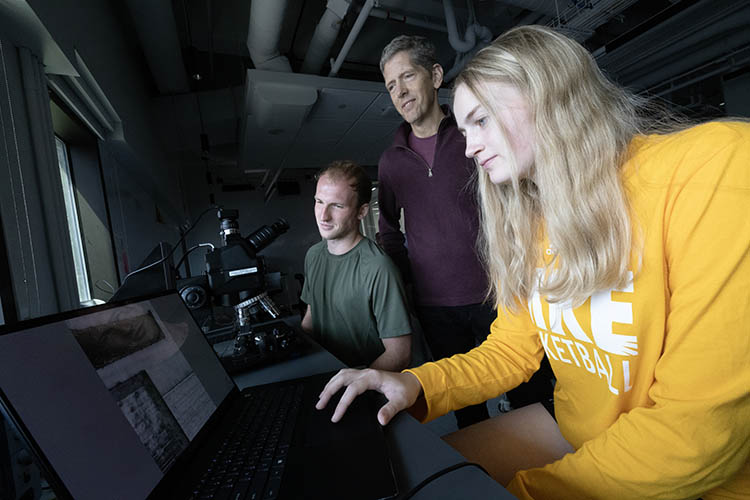
Harry Smith, a doctoral student in mechanical engineering, is developing a model that will reveal more information on GRX-810, a new “super alloy” designed for strength at high temperatures. (UWM Photo/Troye Fox)
More testing is needed, however, to further understand and enable the use of GRX-810 by NASA and other original equipment manufacturers for aerospace applications. The process of making the 3D-printed alloy often results in changes to its microstructure and may introduce defects that affect the material’s strength and crack development.
Existing models that predict a material’s mechanical properties in various testing conditions do not take into account the potential changes in the microstructure that may occur in GRX-810.
With WSGC funding Smith will devise a computational model that can predict at what temperature the material’s strength is affected.
Metals are crystalline materials at the microscale, meaning the alloy will behave differently if their internal crystals are arranged differently, Smith said.
“I’m using what are called constitutive equations to define how the crystals will react under load,” he said. “Then I can simulate how a chunk of this material behaves at different temperatures.”
Once the simulations are completed, he will calibrate them to the experimental data, so that the two match, he said.
Smith is working on his PhD with the goal of teaching one day in an area of computational science.
“I wasn’t super passionate about material science specifically, but I do really like computational science,” he said. “So, Dr. Musinski opened the door to that for me.”
UWM engineering and architecture join forces to teach MPS students building skills
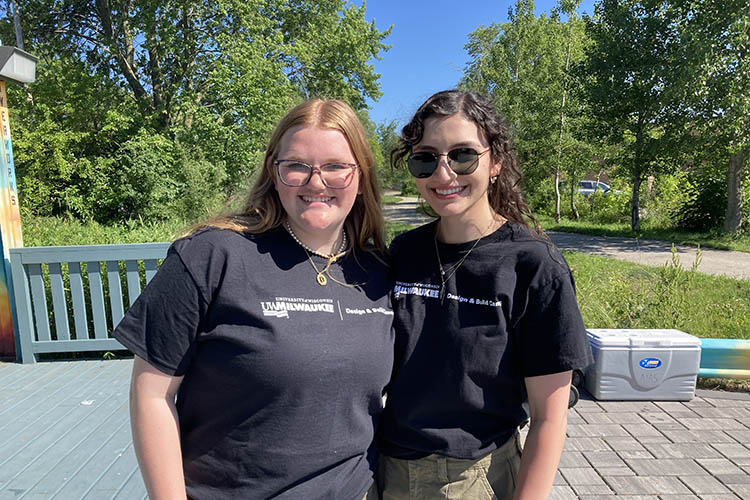
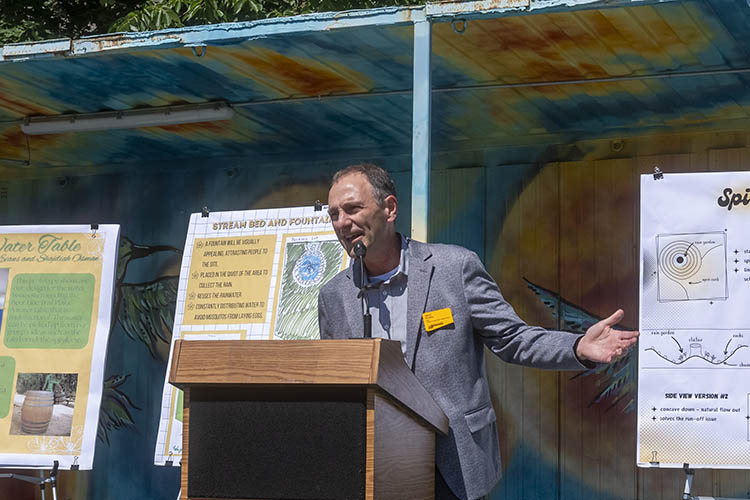
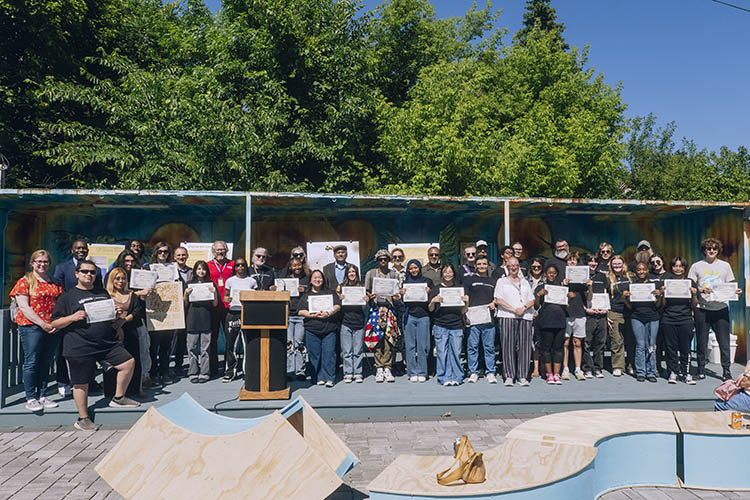
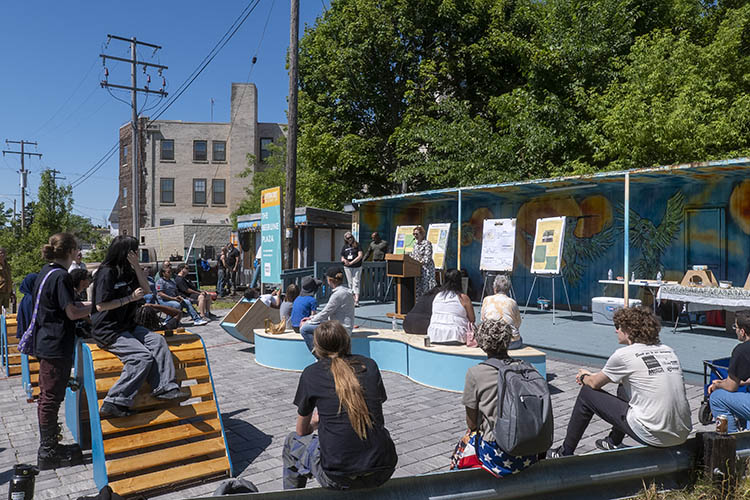
Elizabeth Young (left), a junior in civil engineering, and Danya Almoghrabi, a recent master’s graduate of architecture, volunteered to teach MPS students building skills. CEAS Dean Brett Peters congratulates the MPS students on their camp accomplishments. (Photo by Alvin Connor, Milwaukee Public Schools)MPS students and mentors celebrate the completion of the Beerline Pavilion design/build camp. (Photo by Alvin Connor, Milwaukee Public Schools)MPS students and their families sit on furniture they made as part of the Beerline design and build camp. The camp was cosponsored by the UWM College of Engineering & Applied Science and the UWM School of Architecture & Urban Planning with Riverworks Development Corporation. (Photo by Alvin Connor, Milwaukee Public Schools)
Twenty-one high school students from Milwaukee Public Schools proudly displayed the plaza enhancements they completed at the Beerline Pavilion in the Riverwest neighborhood in June.
The students’ work expanded a previous year’s collaboration to create a plaza along the Beerline Trail that could be used as a place for the community to gather.
Elizabeth Young, a junior in civil engineering, and Danya Almoghrabi, a recent master’s graduate of architecture, joined the team of mentors, teaching MPS students such marketable skills as woodworking, landscaping, welding and storm water control strategies.
“Just think of what you can do now, after the work you’ve done in this camp,” Brett Peters, dean of the College of Engineering & Applied Science, told the gathering at the June 14 reveal event. “As you plan for your careers, we want to continue our engagement with you.”
The camp gives students a wider view of what engineers and architects do, said Chris Beimborn, STEM-outreach specialist for the College of Engineering & Applied Science.
“I feel most proud about the way the students collaborate and support each other,” Beimborn said. “I hope that they will have this group of like-minded peers as a source of motivation going forward.”
“Aside from just learning skills, students gain a sense of power and efficacy in this camp,” said Krisann Rehbein, director of CDS. “Working collaboratively and using the wisdom and skills they already have to make our city a little bit better is an incredible accomplishment.”
Other partners included the Milwaukee Public Schools Foundation and the Fund for Diversity in Tech Education at UWM, a gift from UWM engineering alumnus Satya Nadella (’90 MS computer science) and Anu Nadella.
Five faculty members from the college win UWM internal research funding
Metamaterials that can change shape, a study to determine how zero gravity conditions of space affect breast cancer, and a chemical-imaging instrument that can see the inside of pharmaceutical tablets are the three new research projects being funded by the UWM Graduate School’s Discovery and Innovation Grant (DIG) program. This yearlong, internal seed funding prioritizes new lines of research that have high external funding potential. Hats off to the five researchers from the College of Engineering & Applied Science!
Shape-shifting metamaterial
Daniel Schlitz, research scientist, civil engineering
Rani El Hajjar, professor, civil engineering
Chiu-Tai Law, professor, electrical engineering
The goal of this project is to invent a metamaterial that can change shape, articulate and grasp – like an octopus’ arm.
Metamaterials are engineered with repeating patterns of nano- and micro-scale structures that create unique properties or motion that cannot be found in conventional materials.
The research starts with a polymer that produces a small movement when subjected to an electric field. This material is then engineered into a metamaterial that amplifies the displacement of the polymer members. This means it is capable of locally expanding or contracting to create lifelike movement.
Many of the potential applications are in the field of robotics. The flexibility and potential for integrated sensors can make this an ideal material for soft robotics, where humans wear robotic devices, or the material serves as an artificial muscle for robot mobility.
The effect of microgravity on breast cancer
Qingsu Cheng, assistant professor, biomedical engineering
Changing gravity influences biological processes. In space, for example, astronauts can lose muscle mass faster than they would on Earth without proper diet and exercise.
But currently, the effect of reduced or zero gravity on breast cancer development – inhibition or progression – is not fully understood.
Cheng’s research focuses on the search for new treatments for breast cancer. In his project, he will use primary cells and patient-derived organoids to examine mammographic density in microgravity. Patient-derived organoids are 3D cell cultures that are grown in the lab from tissue samples taken from patients.
Breast tissue density is considered one of the main risk factors for the disease, behind BRCA gene mutation and aging. Results of the project could offer new knowledge of the impact of gravity on biological life and processes.
Hyperspectral spatial-frequency domain imaging of pharmaceutical tablets
Yongjin Sung, associate professor, mechanical engineering
Sung will develop a nondestructive chemical-imaging instrument that can see the inside of pharmaceutical tablets so that scientists can identify the distribution of their active pharmaceutical ingredients.
In drugs that are time-released or involve different delivery profiles, the active ingredients need to be properly distributed within to be effective. At issue are 3D printed tablets, in which a single tablet can contain more than one phase of active ingredients. This allows a patient who needs to take multiple medications to reduce their dose to a single tablet.
The ingredients are mixed in such a way that the various active components, which act in different ways, remain separate from one another.
Existing imaging methods do not work because the tablets are strongly absorbing and highly scattering. Sung will overcome these obstacles with cutting-edge hardware and software.
Energy engineering student org win honors
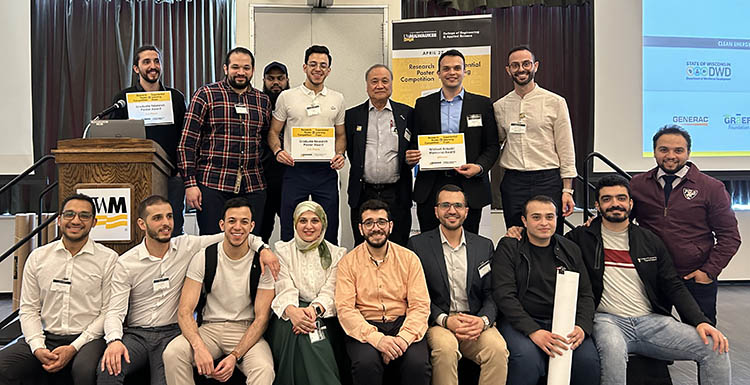
Congratulations to the UWM student chapter of the Association of Energy Engineers (AEE), which was awarded the “Best Overall Chapter Performance Recognition Award” in the 2024 national competition.
In addition, mechanical engineering graduate student Areej Khalil was selected as the “Outstanding Student Chapter Member” in the same competition. Khalil is the current president of the college’s student AEE chapter. Ryoichi Amano is the faculty advisor.
The award recognizes chapters that have demonstrated notable contributions to move the energy profession and industry forward.
UWM’s student chapter was established in late 2022 and is the only one in Wisconsin. At the April meeting of the Wisconsin Association of Energy Engineers, the student organization presented its plans for the coming semester and were nominated for the awards.
The group established a new Instagram page and introduced middle school students at Al Salam School to the fundamentals of energy during the last year.
Gift supports energy engineering research in constructing large wind turbines
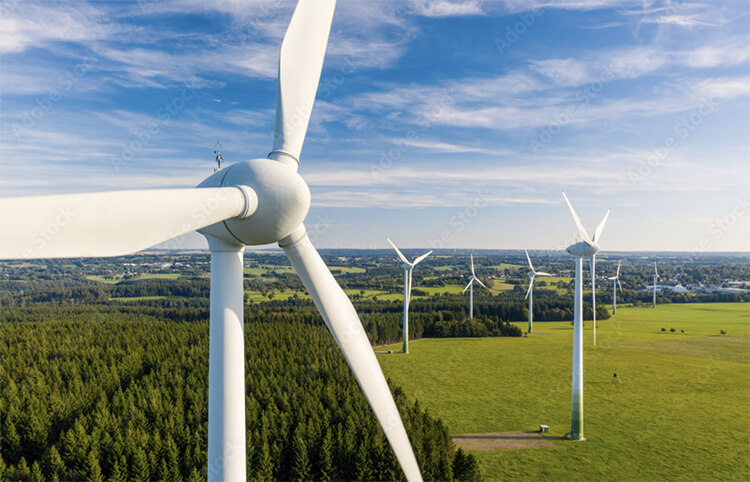
Most wind turbine towers taller than 100 meters are concentrated in the Midwest and Northeast. A $35,000 gift from Invenergy will support energy engineering research into an alternative foundation system for these large, onshore multi-megawatt wind turbine generators.
Tubular towers needed to support large, wind turbine generators are difficult to build, said Sam Helwany, professor, civil & environmental engineering, who received the funding.
Helwany
Such foundations require extensive excavation work with heavy machinery, labor-intensive steel reinforcement, and the removal of groundwater. They also involve a large crane to position the tubular tower at the center of the foundation.
In contrast, he said, the pile foundation system, sporadically used for small and medium-size onshore wind turbines, is easier to construct because it substantially reduces the amount of required construction materials.
With the funding, Helwany will provide a preliminary investigation of the design and optimization of pile foundation systems to verify their long-term reliability with large wind turbine generators.
17 CEAS student athletes named to Horizon League Spring 2024 Honor Roll
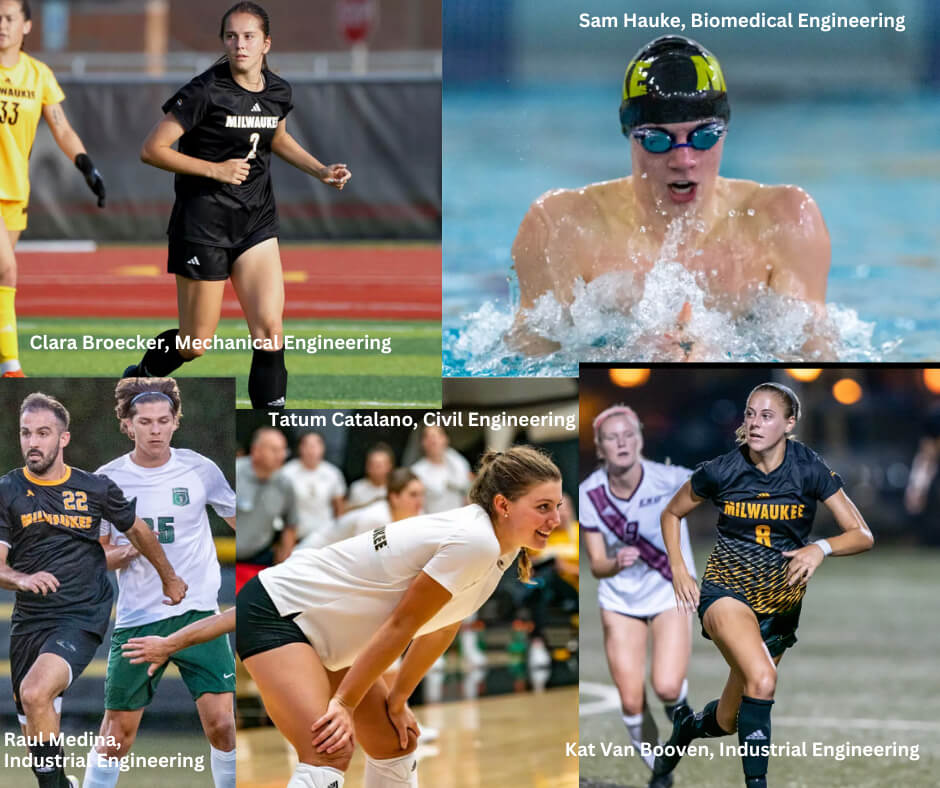
Hats off to the 17 student athletes from our college who joined 145 from UWM who not only demonstrated their commitment as proud competitors in sport, but also earned a place on the 2024 Horizon League Spring Academic Honor Roll.
Candidates for the Honor Roll must meet three criteria: Participation in at least one of the League’s sports during the most recent (or current) season, completion of three semesters (or four quarters, where applicable) as a full-time student at the same member institution, and a cumulative grade-point average of at least 3.2 (on a 4.0 scale).
Men’s Track and Field Nate Griepentrog, senior, biomedical engineering EJ Kruse, senior, computer engineering Lucas Thibert, sophomore, mechanical engineering Bryce Tome, senior, computer science