High number of seniors were hired before graduation
It’s not unusual for our graduates to have job offers by graduation. According to the campus Center for Student Experience and Talent, 98% of graduates from the college were working in the field or continuing their education within six months of earning their degrees in the two-year period 2021-2023. Average starting salaries were $78,000.
Victor Chavez, graduating senior in mechanical engineering, became one of those students when he landed a full-time job at Eaton Corporation after completing an internship at the company.
He was included in the UWM commencement video (at the 2:57 mark) and in the UWM REPORT photo slideshow of graduating seniors who landed jobs in their field before they actually have the diploma in hand.
Chavez will begin his career spending six months at a time in different departments of the company, including product testing, prototype development, and marketing and management.
The college conferred degrees to 301 graduates this semester at commencement on May 18.
TAPCO donates advanced traffic equipment to the college
Traffic & Parking Control Company, LLC (TAPCO), a Wisconsin-based leader in traffic safety and parking solutions, has made a generous donation of advanced traffic equipment to the college’s Institute for Physical Infrastructure and Transportation (IPIT). The equipment will be used in classroom instruction to give transportation engineering students hands-on experience with real-world traffic management technology.
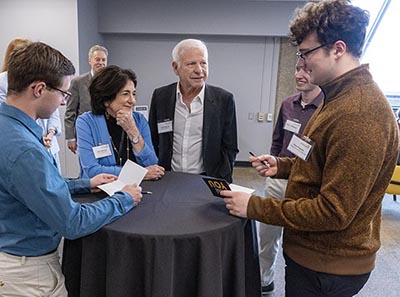
The equipment is installed and awaiting the ribbon-cutting. Joely Overstreet, a master’s student in civil engineering, examines crosswalk buttons. Faculty, TAPCO representatives, and students gather to celebrate the new display.
The new equipment was unveiled and demonstrated at a May 16 event at IPIT’s Northwest Quad campus location, and included leadership from both organizations and students who will benefit from the gift. TAPCO’s Senior ITS Development Manager Lindsay Harvey said it is unique for college students to have experience with this kind of equipment.
The donation includes a traffic signal cabinet, signal head, and two accessible pedestrian crosswalk buttons designed to help people with disabilities safely cross the street. This type of equipment is commonly installed at roadway intersections to manage both vehicle flow and pedestrian safety.
“We are truly grateful to TAPCO for this gift which will be used in classroom instruction with our civil engineering students,” said Xiao Qin, professor and director of UWM’s IPIT. “This gift is a great example of industry partnering with UWM to support student learning and advance community safety.”
Real hardware deepens learning
Until now, students learned the hardware of a traffic signal control system through textbooks or design manuals with illustrations, Qin said. They designed and implemented simulated signal timing through computer software.
The donated equipment will not only give students the opportunity to connect what they’ve learned from the textbook to the real-life equipment but also operate their signal timing commands and immediately observe signal changes.
Students also can conduct research on communication between traffic signals with other devices in a connected environment, cybersecurity on traffic control devices, and system energy consumption.
One of the highlights is the SWARCO McCain 352i ATC Cabinet, a compact but powerful traffic control box that manages traffic lights and other signals. It’s designed to handle complex setups without extra wiring or additional cabinets and is ready for smart technologies such as connected roads and autonomous vehicles.
“Safe and reliable transportation for the traveling public cannot be possible without the expertise and knowledge of traffic engineers and technicians in the field,” said Harvey. “The technology available today is moving at a faster pace than ever, and TAPCO is proud to have this opportunity to share it with UWM engineering students for enhanced learning. We know many of the graduates of UWM stay in Wisconsin, so we hope this investment helps promote a future of improved mobility and safety for our community.”
The donation also features the iDS/iNS Series Accessible Pedestrian Signals, which provide audible cues (beeps or spoken messages) and tactile feedback (vibrations) to indicate when it’s safe to cross. These signals make intersections more accessible and safer for vulnerable road users, including people who are vision impaired or have other disabilities.
Andrew Graettinger, associate dean for research in the college, was also on hand at the event. The equipment was intentionally stationed in a room with windows and outside corridors on three sides so that anyone walking on the floor will have a view of it, he said.
Senior Design teams battle for dominance in project competition
Christian Kenig, Riley Flasch, Cohen Mleziva and Michael Hotchkiss built a testing tool that makes it easy to measure how much force it takes to hammer a nail into different kinds of wood. The team, sponsored by Milwaukee Tool and mentored by teaching faculty Mohamed Yahiaoui, took top honors in the Senior Design Project competition in mechanical engineering.
Students from all departments created a host of real-world solutions in their senior design courses and then presented them to judges. One winning team from each department will be recognized at the Order of the Engineer ceremony on Saturday, May 17.
Senior design projects are the students’ capstone, hands-on learning experience, where they apply what they’ve learned as they participate in a team-based project. Many thanks to GE HealthCare, the overall sponsor of the Senior Design competition, and to all the companies who submitted projects. See the information on all the teams. The other department winners are:
Biomedical Engineering
Designed a trigger signal generator for cardiac 3D mapping applications.
Students:
Alec Kaufmann
Nina Marchigiani
Abhi Roop Reddy Tokala
Nathanael Sovitzky
Advisor: Mohamed Yahiaoui Industry sponsor: UMedec
Civil & Environmental Engineering
Redesigned the intersection of Lincoln Memorial Drive and Clybourn Street in Milwaukee to make it safer and easier to use by drivers, bikers and pedestrians.
Students:
Arshdeep Chahal
Joseph Jutley
Ryder Weisensel
Nathaniel Wurzer
Advisors: Sarah Blackowski and Clayton Cloutier Sponsor: Wisconsin DOT
Computer Science
Designed a campus navigation app to alleviate stress and anxiety associated with way finding at UWM.
Students:
Jia Chen
David Doyle
Mouhameth Fall
Sana Sees
Colin Young
Advisor: Ayesha Nipu
Electrical Engineering
Designed an advanced indoor air quality monitor to ensure safe indoor breathing.
Students:
Trevor Block
Audrey Faison
Stone Mahan
Colton Smith
Jack Wolak
Advisors: William Dussault and Jeff Kautzer
Industrial & Manufacturing Engineering
Worked to create a standardized Six Sigma process to reduce and stabilize the quantity of defects in parts coming out of deburring fabrication.
Students:
Bao Bui
Jessica Martinez
Mustafa Ameen
Advisor: Iftekaruddin Khan Industry sponsor: Krones, Inc.
Materials Science & Engineering
Worked to identify the origin and cause of a catastrophic failure in a pinion gear and make recommendations to prevent identical incidents.
Students:
Kee Jepson
Brett Johnson
Katelyn O’Brien
Sam O’Neill
Advisor: Nidal Abu-Zahra Industry sponsor: BRP Marine Division
Niu receives $50,000 IGNITE Grant to advance lithium-ion batteries with material made from low-cost silicon
Professor Junjie Niu, materials science & engineering, has been awarded a $50,000 IGNITE Grant for Applied Research from WiSys and the Universities of Wisconsin. The grant funds a one-year project aimed at developing more efficient lithium-ion battery technology using an innovative anode material made with low-cost, micro-sized silicon or recycled silicon waste.
Silicon has long been recognized as a promising alternative to graphite, the conventional material used in li-ion battery anodes. It offers significantly higher energy density, packing more energy into a small size and leading to a longer life – an advantage especially important for high-demand applications like electric vehicles.
However, silicon also presents a major challenge: It expands dramatically during charging, leading to mechanical stress and a decline in performance over time.
To address this, Niu’s research will explore a new approach that uses micro-sized silicon particles – sourced from milled scrap silicon rather than costly nanoparticles. These micro-particles will be combined with a conductive polymer to form a composite anode material, replacing the graphite.
The goal is to improve durability by managing the volume changes that typically degrade silicon-based anodes, while managing costs.
The project will evaluate how these silicon micro-particles perform compared to traditional solutions and determine whether this composite material offers superior performance over silicon nanoparticles.
Proposals for the IGNITE Grant were reviewed by experts from private industry, academia, and the UW Office of Academic Affairs. Evaluation criteria included technical merit, the likelihood of successful completion, and the potential for economic impact in Wisconsin.
Ghose receives Microsoft sponsorship to dive into the state of Wisconsin’s AI workforce
The adoption of artificial intelligence is transforming the workplace, but it’s also raising challenges such as job-skill mismatches and uneven adoption rates. Where are vulnerabilities in Wisconsin’s workforce when it comes to AI?
Rina Ghose, professor, industrial & manufacturing engineering, has received sponsorship from Microsoft to extract the status of AI in the workforce at different locations around the state, revealing the impact of AI disruption and regional variations in areas, such as access to workforce training.
The information is needed for guiding policymakers as they help foster growth and workforce readiness in the AI-driven economy.
Ghose specializes in data science and will analyze AI labor force data across the state. Her expertise in Geographic Information Science (GIS) will help her to harness locational intelligence, by analyzing locational data with other datasets to reveal relationships and patterns over time and place.
During the one-year project, Ghose will answer placed-based questions, such as where current and projected employer needs are, where the resources are currently deployed, where the skilled workers are, and where they are needed.
The study’s geospatial aspect makes it unique, she said, because seeing information on a map often addresses distribution questions that can help direct public policy interventions.
“What could really be useful is to know the conditions broken down by localities,” Ghose said.
Time is also important because industry is just beginning to adapt AI to their needs. “So, this year’s job postings can be totally different even from last year’s,” she said.
Ghose and doctoral student Fahimeh Mohebbi also will focus on Milwaukee County as a case study because many industries are located in Milwaukee, and they can gain insight into AI workforce development across different industries. Also, they can potentially find patterns that can help them understand similar challenges in other regions.
“As AI reshapes the labor market, it’s critical that public policy is grounded in data that reflects local realities,” said Jasmine Thomas, Senior Director at Microsoft. “Professor Ghose’s research is compelling and will illuminate geospatial insights for policymakers to advocate for targeted, evidence-based strategies that prepare Wisconsin’s workforce to thrive in the AI economy.”
Microsoft Chairman and CEO Satya Nadella earned his master’s degree in computer science at UWM. Last year Microsoft made a $3.3 billion investment in several projects around the state, which includes establishing the nation’s first manufacturing-focused AI Co-Innovation Lab at UWM’s Connected Systems Institute. The new lab will give students and companies hands-on learning with AI and connect them with Microsoft experts.
Six NMDSI Student Research Scholars from the college named
Six new winners of the Student Research Scholars Program, funded by the Northwestern Mutual Data Science Institute, were announced to collaborate with faculty on applying data science in research this summer. Engineering students being supported during the summer, their projects, and their faculty mentors are:
“Developing an Intelligent Agentic System for Knowledge Transfer and Personalized Therapy in Physical Rehabilitation.”
Student: Tanvir Ahmed
Faculty Mentor: Mohammad Habib Rahman, professor, mechanical and biomedical engineering
“Practical AI Framework with Provable Security, Auditing, and Incentive Mechanisms.”
Student: Hiba Alsghaier
Faculty Mentor: Tian Zhao, associate professor of computer science
“Towards Proactive and Dynamic Pedestrian Safety at Crosswalks Using Trajectory Data.”
Student: Anisha Tasnim
Faculty mentor: Tian Zhao, associate professor of computer science
“Use of AI in Leveraging Alternative Data in Mortgage Industry.”
Student: Sajede Farahani
Faculty Mentor: Wilkistar Otieno,associate professor of industrial & manufacturing engineering
“Predictive Modeling of Uranium Flushing in Contaminated Groundwater Using Machine Learning.”
Student: Abul Borkot Md Rafiqul Hasan
Faculty Mentor: Kishna Pillai, professor of mechanical engineering
“Enhancing Explainable AI through Human-Centered Interaction with Large Language Models.”
Student: Masoud Khani
Faculty Mentor: Jake Luo, associate professor and bioinformatics graduate program director
Student Excellence Awards go to students and student organizations from the college
Four students and two student organizations from the college were recognized in the annual Student Excellence Awards on April 29.
The awards, sponsored by the UWM Student Involvement, honors those who go above and beyond to create a vibrant, supportive and engaged campus environment. Altogether, 21 individual students and six organizations won awards. Here are the college’s honorees:
Student Organization of the Year: Society of Women Engineers and Arab American Association of Engineers and Architects
Outstanding Graduate Students Telemachos Agoudemos (mechanical engineering) and Abul Borkot Md Rafiqul Hasan (mechanical engineering)
Student Organization Leader of the Year: Jaiden Lefeber (civil engineering)
Agent of Change Award: Carol Martinez (materials science & engineering
Avi Shaked and Dr. Babs Waldman greet CEAS scholarship recipients at April reception
Avi Shaked (’80 Electrical Engineering) and spouse Babs Waldman, MD, met with about 30 students at a reception on April 29 celebrating both scholarship donors and recipients for the 2024-25 academic year.
The couple established the Avi Shaked & Babs Waldman Engineering Scholarship for the college in 2005 and have added to the original amount twice since. At over $3 million, the fund has helped nearly 1,100 undergraduate engineering students pay for their degrees.
Ricky Frieseke (right front) and other scholarship recipients chat with the donors at the April reception.
This academic year alone, 87 students from the college received the scholarship. The average award per student was more than $2,000.
The scholarship fund is emblematic of an upward trend in giving this year, UWM Chancellor Mark Mone told the attendees.
“During the last academic year, UWM awarded more than $28 million in student scholarships,” Mone said. “That was an 8% increase over the previous academic year.”
Niu lab boosts energy and safety of next gen li-ion batteries with new coating
A spray-on coating developed by Professor Junjie Niu, materials science & engineering, and his research team has improved the energy density of lithium-metal batteries by 20 to 30 percent –while also reducing the fire risk that has long limited their commercial use. The results, recently published in the journal Small, could accelerate the development of next-generation rechargeable batteries.
“The results surpassed our expectations,” Niu said. “Our coating offers a dual benefit –better performance and better safety.”
Niu’s research focuses on lithium-metal (LM) batteries, a newer type of lithium-based battery that replaces graphite electrodes with solid lithium. LM batteries can hold significantly more energy than traditional lithium-ion batteries, making them attractive for high-demand needs, such as electric vehicles or energy storage for the grid, Niu said.
“With the current li-ion batteries, you can drive, let’s say, 300 miles on a charge,” he said. “With a LM battery, you can double the energy density – maybe 500 to 600 miles. That’s even better than a gas-powered vehicle!”
But there’s a catch: LM batteries are notoriously unstable. The problem stems from dendrites –needle-like structures of lithium that form during charging. Dendrites can pierce the battery’s electrolyte, causing short circuits and even fires.
To address this, Niu’s team developed a spray-on coating that combines MXene compounds –known for high electrical conductivity – with a large-molecule polymer that stabilizes the battery surface. The polymer helps prevent dendrite formation, while the MXene improves charge transport.
The innovation targets a key challenge that has stalled commercial rollout of lithium-metal batteries, despite their promise and the considerable industry investment.
The research was completed with a grant from the National Science Foundation.
Two engineering students take a ride in the ‘Quiz Cart’
How much do you know about Milwaukee and UWM?
Undergrads Daniel Maistelman, mechanical engineering, and Ben Witt, electrical engineering, each were featured in the “Quiz Cart,” a video produced by the Alumni Association in honor of 414 UWM Giving Day.
The “Quiz Cart” videos, modeled after the TV program “Cash Cab,” are shot with passengers in a campus golf cart who answer questions about UWM in order to get a free ride to their destination. However, participants have to disembark if they get three wrong answers. Watch on the Alumni Association’s YouTube channel.