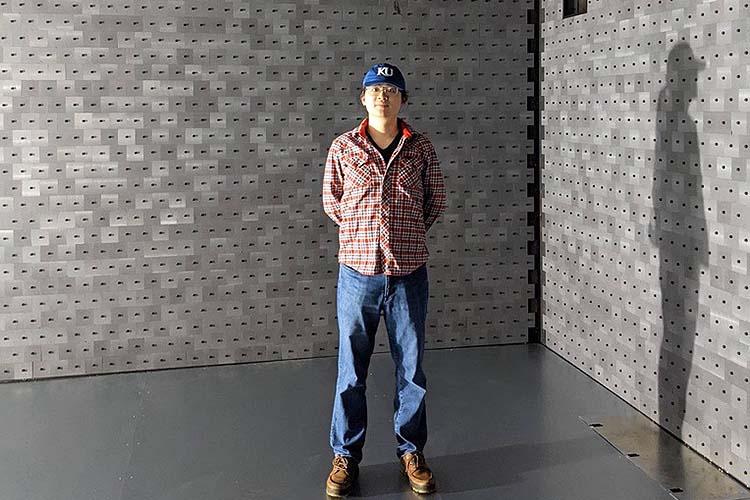
With support from a grant from the U.S. Economic Development Administration, the college is now completing the installation of a unique, full-service Electromagnetic Interference (EMI) testing facility that will be used for research and also available to industry.
Electronic equipment, wireless devices, and communication systems all generate electromagnetic waves that cause interference when placed near other electronic devices.
That disruption can happen through in air or through the wires of the device under test, said James Li, an electrical engineering postdoctoral researcher who is working on the facility. “This chamber allows us to measure and understand those effects,” Li said.
This facility, in the Century City Tower, 4201 N. 27th St., will offer a semi-anechoic or “EMI chamber” that measures noise that travels through the air. It is a shielded room that absorbs electromagnetic energy, creating a “quiet” environment needed to measure interference.
But the EMI chamber is just one part of the space. For power electronics, an equally important capability is measuring the noise that travels through the wires, said Rob Cuzner, professor, electrical engineering, whose lab is overseeing the improvements.
This new facility is designed to test how much unwanted electrical “noise” power electronics, like electric vehicle chargers or solar inverters, send back into the power grid through their wires.
Unique in the region
“Our facility is unique because it’s the only one in the region equipped to do both wired and airborne noise testing in one place,” Cuzner said.
As the demand for electricity climbs and new power electronics are needed to upgrade the aging grid, more Wisconsin companies will be interested in the capabilities of the facility. It also facilitates the development of advanced electric ships and planes, areas of UWM research, he said.
“We will be able to test how new metals and materials affect electronic devices,” Cuzner said. “This matters because newer power technologies, like wide-band gap semiconductors, can run faster and more efficiently – but only if we know how to prevent interference.”
UWM will match the EDA funds for the build-out with $350,000 in cost-share support, to be generated largely by offering testing services to regional industries.
Within six months, the chamber will be available for radiated EMI testing on battery-powered devices and equipment running on standard building power. When fully completed, the chamber will be able to conduct EMI emissions tests on equipment with voltage ratings up to 2,000V and power ratings up to 1.2MVA.
Plans also include developing an EMI technician training program in partnership with area technical colleges, helping meet growing workforce needs.
Four other UWM analysis and testing facilities available to industry
- Advanced Analysis Facility
- Full-Service Machine Shop
- Industrial Training and Assessment Center
- Structural Engineering Lab