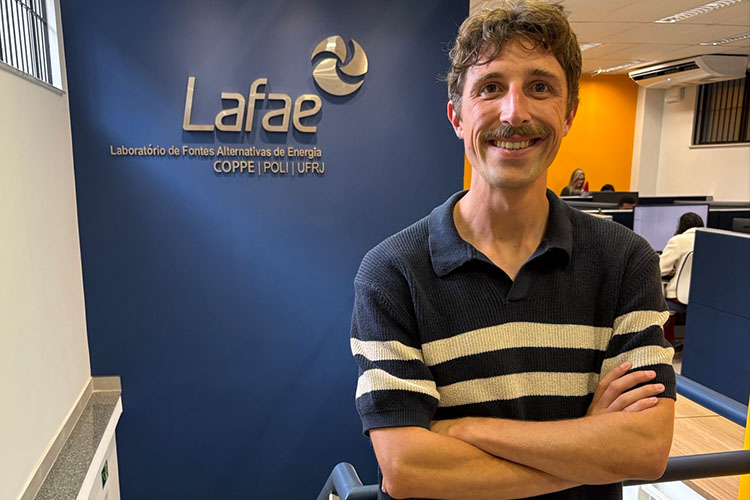
For Eric Schmitt, learning Portuguese was never simply about being able to order a meal or have a conversation while traveling.
He wanted to speak a new language and doing it confidently even in using scientific terms.
“Speaking to get along day-to-day is one thing,” Schmitt said. “But the ability to master a second language in science is another.”
“Steer away from being one-dimensional. Look for opportunities to learn other things too. Learning things like a language can open more doors for you.”
That unusual goal took Schmitt, a master’s student in electrical engineering, to a research laboratory in Rio de Janeiro this summer. There, he worked alongside Brazilian researchers studying renewable energy.
It was an experience that allowed Schmitt to pursue what he calls his “niche”: bringing together technical expertise and new language skills.
Schmitt works in the lab of Professor Rob Cuzner. His research involves shipboard electrical systems and islanded microgrids – electrical networks that can operate independently rather than relying on a larger power grid.
Not a direct path to engineering
While earning his bachelor’s degree, Schmitt gravitated toward physics. He paired it with secondary education and became a high school teacher. After four years though, he found himself craving more intellectual challenge.
Electrical engineering appealed to him because it felt, in his words, “magical” and the research involved would keep it interesting.
Meanwhile, another passion was taking shape.
Schmitt had become interested in speaking Portuguese after meeting someone who was fluent. His curiosity took hold and he has now been taking lessons with a native speaker for four years. He’s also shown up for events like the Cream City Language Exchange group in Milwaukee.
It led to his receiving a UWM travel award to spend the summer of 2025 in São Paulo for an immersive experience. That gave him more confidence communicating in Portuguese. But he wanted to take the next step: using the language in his field of study.
The intersection between research and language
The opportunity came through the Ruggiero-Handelman Field Research Award from UWM’s Center for Latin American & Caribbean Studies. The funding supported Schmitt’s research collaboration with the Laboratory of Alternative Energy Sources at the Federal University of Rio de Janeiro.
The Brazilian researchers were working on energy systems for floating facilities used in offshore oil production. Their work included incorporating renewable sources such as solar, wind and wave energy – closely related to Schmitt’s interest in shipboard microgrids.
The language component made the experience particularly valuable, he said. Few researchers in the Brazilian laboratory spoke English, meaning Schmitt could not fall back on English when discussions became complex.
“It was hard to build a technical vocabulary in another country,” he said. “But this is what I wanted.”
In search of global opportunities
Schmitt also worked with the laboratory’s power-hardware-in-the-loop capabilities, which combine computer simulations with real electrical components. The approach allows researchers to test portions of a system in realistic conditions and identify problems that might not appear in a computer-only simulation.
Now, Schmitt hopes to return to the same laboratory through a Fulbright opportunity, where he would continue working on the same research for a full nine months.
After graduation, he hopes to work in industry on power electronics and renewable energy – and use Portuguese to collaborate with Brazilian researchers and companies.
Schmitt recommends that other engineering students broaden their interests.
“Steer away from being one-dimensional,” he said. “Look for opportunities to learn other things too. Learning things like a language can open more doors for you.”