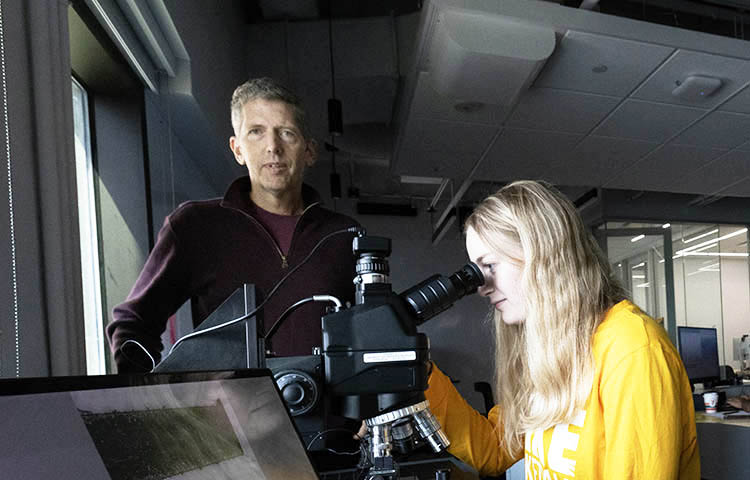
Civil & environmental engineering research at UWM’s College of Engineering & Applied Science is advancing solutions to some of society’s most urgent infrastructure and environmental challenges—while giving students the opportunity to be part of that progress.
As Wisconsin’s only public R1 research university located in a major city on the shores of Lake Michigan, UWM is uniquely positioned to address real-world issues such as aging infrastructure, water quality, climate resilience, sustainable construction and smart cities. Our faculty lead cutting-edge research in structural health monitoring, intelligent infrastructure, transportation systems, water resources and environmental protection—developing technologies and strategies that make communities safer, more efficient and more sustainable.
Students are active participants in this work, collaborating with faculty on funded research projects, contributing to peer-reviewed publications and gaining hands-on experience with advanced tools and methods. These opportunities prepare graduates to lead in industry, government and academia, equipped with both the technical expertise and research experience to tackle complex global challenges.
UWM’s strong partnerships with regional and national industry, government agencies and research centers ensure that our work has real impact—improving infrastructure performance, protecting natural resources and shaping the future of civil and environmental engineering.
At UWM, research isn’t separate from education. It’s an integral part of how we prepare engineers to innovate, lead and make a lasting difference.
Civil & Environmental Engineering Research Areas
Structures and Materials
Structural analysis and design
Earthquake engineering
Mechanics of materials and structures
Construction materials and sustainable design
Geotechnical Engineering
Foundation engineering
Pavement materials and design
Environmental and Water Engineering
Environmental engineering and sustainability
Water resources, hydrology and hydraulics
Environmental fluid mechanics
Transportation Engineering
Transportation systems
Traffic engineering
Civil & Environmental Engineering Research Centers and Labs
The Advanced & Nano Cement Laboratory (ANCL), led by Konstantin Sobolev, uses nanotechnology and nano-engineering to create higher performing and more durable cements and composites to build safer, more dependable roads, bridges and buildings, lower repair and replacement costs, and minimize waste and carbon dioxide emissions.
The Advanced Structures Laboratory (ASL),led by Nathan Salowitz,advances intelligent structures by addressing barriers to real-world use. Their research area includes sensors, data interpretation, structural health monitoring, ultrasonic signals to evaluate materials, automatic damage detection, self-healing materials, and shape memory alloys.
The Automated, Connected & Electric Mobility Systems (ACEMS) Lab, led by Xiaowei (Tom) Shi, focuses on evaluating emerging mobility technologies, including automated and connected vehicles, and developing novel solutions through field experiments and hardware-in-the-loop testing.
The Concrete Advancement Network (CAN), led by Konstantin Sobolev, is an Industry-University Cooperative Research Center (IUCRC), that aims to develop new technologies to produce more efficient, rapidly deployable concrete with reduced dependency on natural resources.
The team at the Institute for Physical Infrastructure and Transportation (IPIT), led by Xiao Qin, bring together researchers across UWM to use research, collaboration, education, and innovation to solve real-world infrastructure and transportation challenges around safety, mobility, and public health.
The Safe and Smart Traffic Lab (S2), led by Xiao Qin, offers research consulting services to facilitate scientific and informed decision making in areas including Highway Safety, Human Factors and Driver Behavior Modeling, Traffic Operations and Control, Transportation Data Analytics, Mathematical Modeling of Urban Transportation Systems, Intelligent Transportation Systems, Geographic Information System (GIS) Application in Transportation, and Impact Analysis.
The Structural Engineering Research Lab (SEL) supports cutting-edge research, education and real-world testing of structures. It encourages collaboration across institutions and provides tools and expertise for faculty, students and industry partners through hands-on learning in mechanics and materials and specialized testing for industry partners.
As an R1 research institution, research is integral to our work at UWM and to the experience of students pursuing graduate degrees. Our college has a wide range of faculty-led labs that perform cutting edge research. Full list of our college’s research labs, centers, and institutes
Funding Partners
UWM is one of only two R1 research universities in Wisconsin, and the only one in Southeast Wisconsin. We’re also a top externally funded institution with robust opportunities for teaching and research assistantships. Partners that support our research include:
Department of Energy (DOE)
National Aeronautics and Space Administration (NASA)
National Institute for Health (NIH)
National Institute on Disability, Independent Living, and Rehabilitation Research (NIDILRR)
National Science Foundation (NSF)
North Atlantic Treaty Organization (NATO)
United States Air Force (USAF)
United States Department of Agriculture (USDA)
United States Department of Veteran’s Affairs (VA)
Regional and national businesses
Undergraduate Research
As an R1 university, research is a significant focus of what we do. Undergraduate and graduate students are encouraged to get involved in research. Undergraduate students can reach out to the UWM Office of Undergraduate Research regarding research opportunities, or contact individual faculty directly.
Poster Competition & Three Minute Thesis
Graduate and undergraduate students have the opportunity to participate in the annual Poster Competition & Three Minute Thesis, a signature event for our college. Students gain valuable experience working with faculty researchers and are invited to share their work with judges from industry, who provide feedback.
Daniel Schlitz, scientist, civil engineering, investigates properties of a shape-shifting metamaterial. Undergraduate Anna Lutz examines the material under the microscope. (UWM Photo – Troye Fox)