What happens when artists create with artificial intelligence while also interrogating it? A new Milwaukee exhibit explores that question through sculptures, prints, interactive pieces and poetry, all born from creative collaboration with AI.
Nathaniel Stern teamed up with Sasha Stiles, who has a concurrent solo exhibit at the Museum of Modern Art in NYC to develop the exhibit “Generation to Generation: Conversing with Kindred Technologies.” Stern has degrees in both mechanical engineering and design and is a UWM professor of both mechanical engineering and visual art & design.
The exhibit invites viewers to consider the relationship and the “always-evolving dialogue” between humans and the tools we invent.
“Overall, we should neither approach with blind optimism nor crippling fear around new technologies,” Stern said. “We’re trying to nuance the conversations from a space of real understanding and use.”
More than a theme
The answer is both, he said. The exhibit highlights human–technology interaction while also grappling with real concerns – like the environmental cost of running large AI systems.
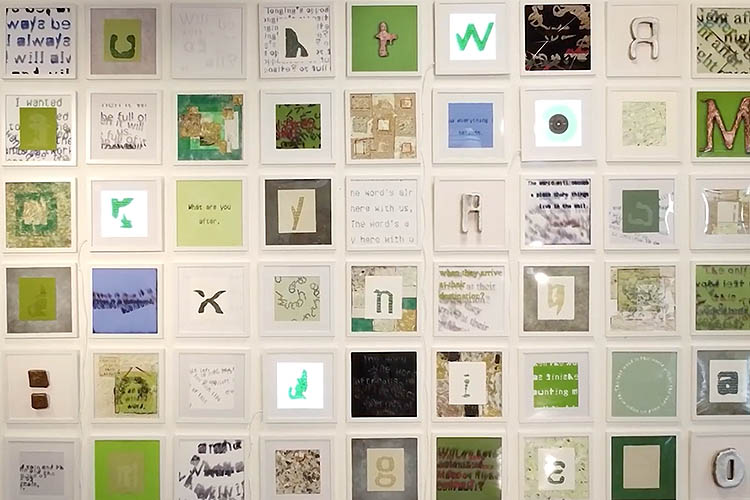
To reduce energy consumption, the artists used AI selectively and with small datasets. For example, they trained their own diffusion model on photos of letters to create a stylized alphabet. Because the model was given minimal data, the results resemble rough, childlike handwriting – an intentional artifact that underscores the trade-offs between creativity, technology, and resource use.
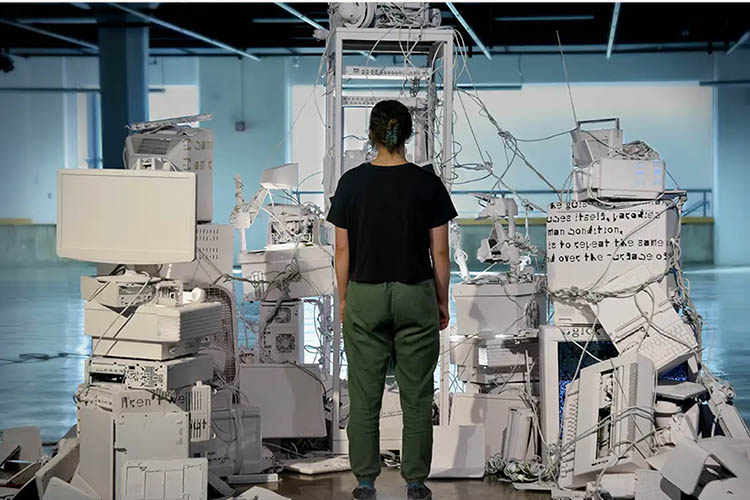
This environmental tension shows up thematically as well. “We’re balancing matters of technology vs. the environment,” Stern said, noting that pieces like the Mother Computer in the installation, Weighing, hint at “Mother Earth.”
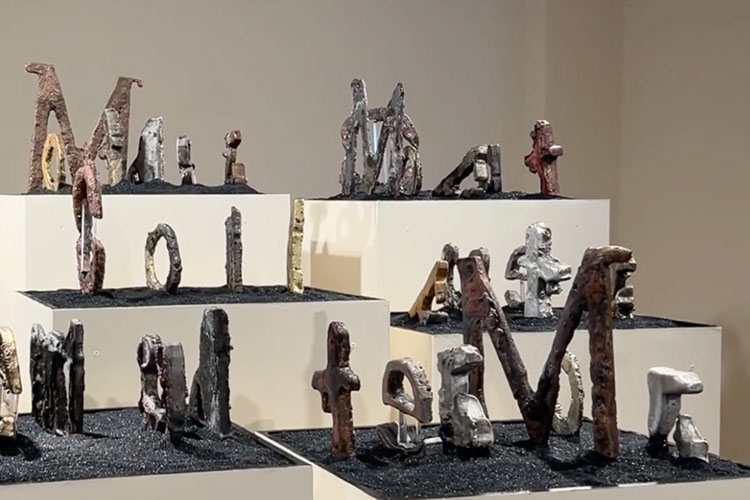
Not everything in the show was computer-driven. Some components rely on decidedly “old school” methods as a nod to technologies of the past. For Weighing, for instance, letters were cast at MetCovery Foundry in Menomonee Falls, Wisconsin, using recovered industrial waste metal. It continues the conversation around human and technology’s evolving side by side.
Is AI really original?
Another question Stern is often asked to debunk: “Is this just artwork stitched together from other people’s creations?”
The creative process, he said, is intentional and transparent with manipulation of the AI tools in nonstandard ways, to invite strategic possibilities. Viewers can decide.
In the piece The E-Waste Land, AI is used only to extend Stern’s own experimental imagery, and all training data comes from owned sources. For this, he used Adobe Firefly’s stable diffusion –feeding in fragments of his abstract images and prompting the system to complete them.
Stiles, meanwhile, works with a large language model that she has fine-tuned on her own contemporary poetry. She treats AI as “a sounding board” – asking it for multiple sentence variations and iterating those until the results emerge in a way she is happy with.
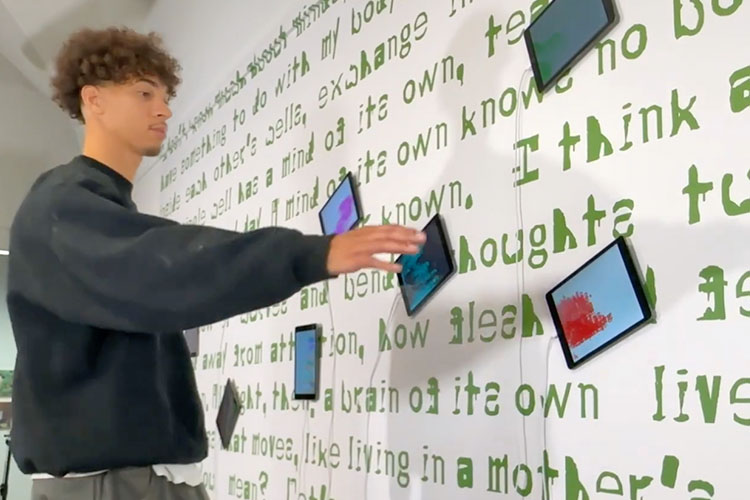
Both artists began incorporating AI into their practices long before the current buzz. For example, Stern custom-built the motion-tracking algorithm used in the interactive installation Still Moving, predating today’s body-tracking tools such as MediaPipe.
The exhibit runs Feb. 12-20 at the Kenilworth Square East Gallery. This research was funded by UWM’s Office of Research. The Milwaukee exhibit was funded by Center for 21st Century Studies and the Lubar Entrepreneurship Center.