
A lesson learned while he was pursuing a doctoral degree in electrical engineering at Michigan State has turned out to be a mantra for Devendra Misra’s long academic career and also one that he passes on to faculty just beginning their careers: Be prepared to pivot and apply your knowledge across disciplines.
Misra, a professor of electrical and biomedical engineering, has spent 40 years at the college, providing service to the administration, teaching hundreds of students and contributing to several different lines of scientific inquiry. He retires today.
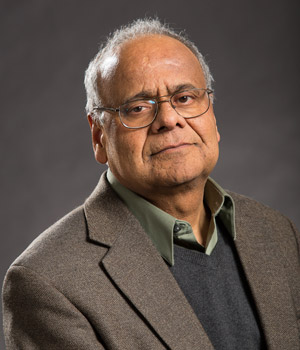
“I was in the electromagnetics field, however my PhD professor pushed me to learn other things too,” he said. “So, I took many other courses, including graduate-level courses in physics and mathematics besides in other areas of electrical engineering. Now, I feel that was very good advice. Things don’t work in isolation. Everything is interconnected.”
It certainly primed him for the many different demands of academia.
Misra’s first task as a new UWM professor in 1985 was quite different from his doctoral work at Michigan State, he remembers. “The chair asked me whether I could teach a required course in electromagnetics to EE majors with almost no mathematical background. My answer was ‘yes.’”
It was a course the college had to begin offering for all students or risk losing its accreditation. In addition, he revised the first electronics course for EE majors, adding a lab component even though electronics was outside his area of expertise.
Early research
As a young researcher, he was involved in federally funded research with a collaborator at the University of Pennsylvania and others to build a life-detection device that would find military wounded personnel on the battlefield from a distance of at least 200 feet.
Misra’s contribution was to show how it could be done with microwaves. Leveraging both state and funding industry, Misra’s work evolved into an ultrasonic sensing device he developed that uses sonar to detect structural defects in pipes.
An article in the UWM Graduate Profiles magazine (now defunct) from fall of 1990 highlighted this work.
After that, the department recognized that electromagnetics could bring in research money and the college then recruited a couple of new faculty members in electromagnetics. Misra, meanwhile, had obtained an engineering education grant from the National Science Foundation to set up a lab with a sequence of courses on telecommunications.

A team player and more
Colleagues, including Chiu Law, associate professor, electrical engineering and computer science, say they were impressed by Misra’s willingness to help junior faculty members. “Since Dr. Misra has a long history and experience in teaching courses in the electromagnetics area, he gave me suggestions and advice when I first started teaching the undergraduate electromagnetics course. Our discussions have continued for teaching other courses in this area throughout my tenure at UWM.”
K. Vairavan, professor emeritus, computer science, got to know Misra well during a time when Vairavan chaired computer science and Misra headed up the electrical engineering half. “Together, the two disciplines comprised the college’s largest department, so I had a great opportunity to work with him and I also served with him on many search committees including those for deans,” Vairavan said.
“He has been a dedicated faculty member and has served the university and the college well in a number of ways,” Vairavan said. “Most recently his contributions have been in the development of the biomedical engineering program. He took much initiative in establishing the program. I know that he organized groups of faculty members to develop the ideas for it.”
Delaying retirement to fill a need
During the 2014-15 school year, Misra said he felt ready to retire. But the college needed someone to help establish the biomedical engineering program that would serve as a department, offering both undergraduate and graduate degrees. Misra had the background to lead the effort and so he agreed to stay on.
The program began accepting students in the spring of 2016. Immediately afterward, Misra began working on the accreditation process which was completed in 2021.
Looking back, he said, he joined the UWM faculty because he was attracted to the climate in the department and the very strong faculty governance at the time. Had he ever considered leaving?
“I thought that, if I moved, I may make more money,” he said. “But if I stayed here, I felt the [quality of] life would be much better.”