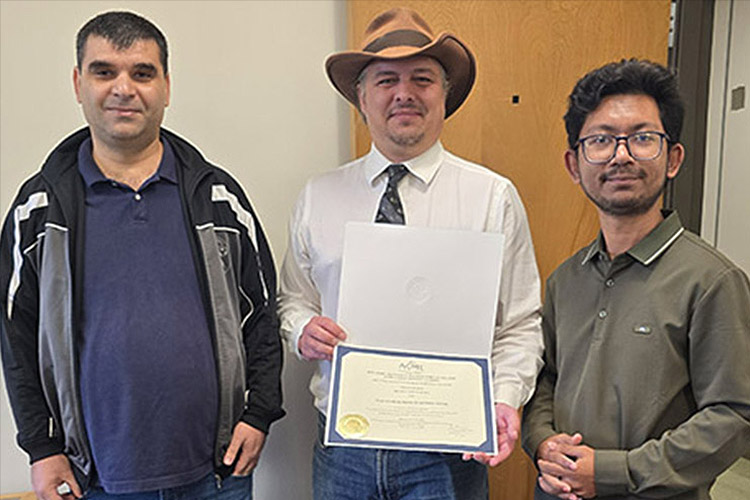
Doctoral candidates Jomah Alzoubi and Md Shahriar Ali and their faculty advisor, Associate Professor Nathan Salowitz, mechanical engineering, recently received the 2026 Best Paper Award in Structural Health Monitoring at the American Society of Mechanical Engineers (ASME) Smart Materials, Adaptive Structures, and Intelligent Systems conference, held September 13–16.
In their paper,”Detecting Simulated Damage in Liquid-Filled Pipes using Ultrasonic Structural Health Monitoring Under Environmental Effect,”the researchers address a long-standing challenge in structural health monitoring: environmental effects on sensors.
Ultrasonic waves transmitted through solid structures can detect problems in pipes without invasive methods such as cutting them open. This approach is called structural health monitoring. However, the ultrasonic signal doesn’t only change when the pipe is damaged. Environment changes can also change the way sound waves travel through the pipe, complicating damage detection.
The researchers describe a way to use ultrasound to detect pipe damage while accounting for changes in environmental conditions. Using simulation and compensation, they developed a way to teach the system how to distinguish between the causes of the signal change.
This approach identifies what caused the change before deciding that something is wrong, Salowitz said.
“Our work demonstrates an approach that negates these environmental effects to accurately distinguish true damage from those environmental changes,” Salowitz said. “This capability represents a major step forward for ensuring the safety and reliability of critical pipeline infrastructure.”