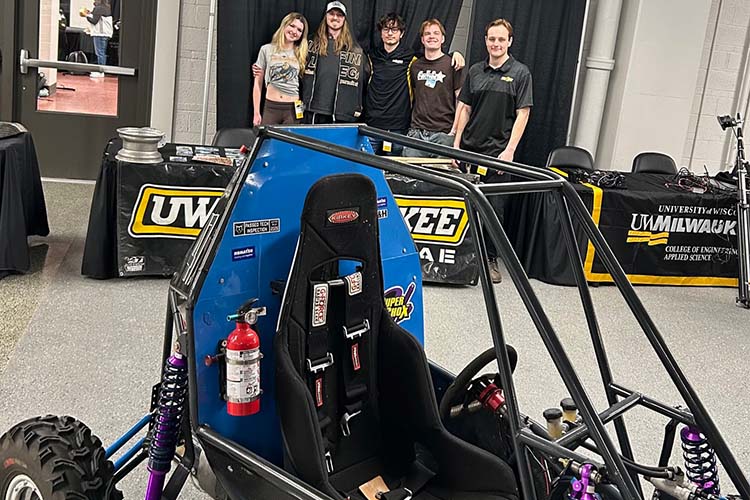
Two mud-splattered, roll-caged vehicles sit in a campus shop, looking equal parts go-kart and homemade tank. Built low and rugged, with exposed suspension and knobby tires, these Baja cars are designed for surviving hours of punishment.
They’re also why a record number of students in the College of Engineering & Applied Science are spending nights and weekends in a garage deep inside the Northwest Quad parking structure, home to the UWM student chapter of the Society for Automotive Engineers (SAE).
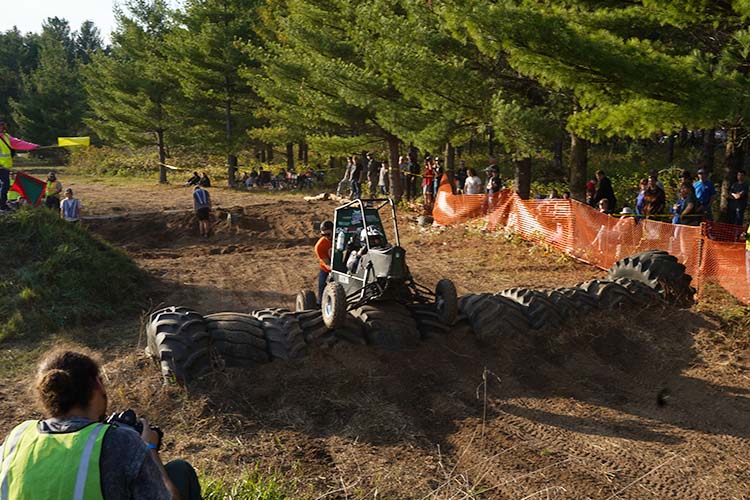
Baja SAE is an intercollegiate design competition challenging students to design and build single-seat, off-road vehicles capable of endurance races.
A strong start: first and second place in regional competitions
This fall, the team placed first and second with two different vehicles in two multi-state, regional competitions – a rare accomplishment in a single year.
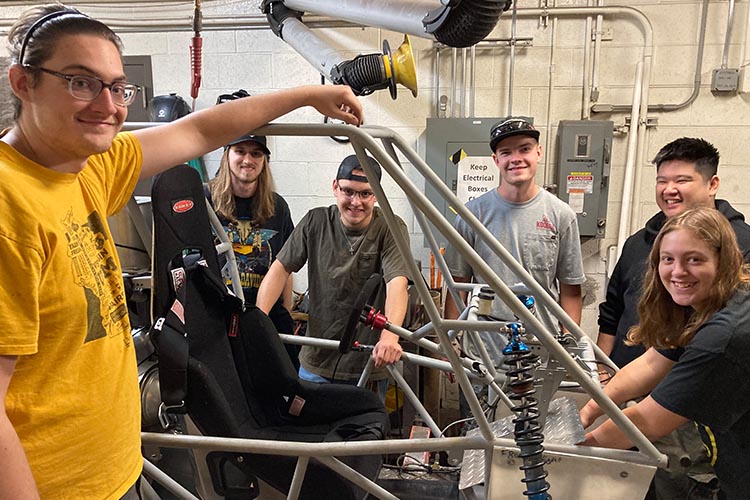
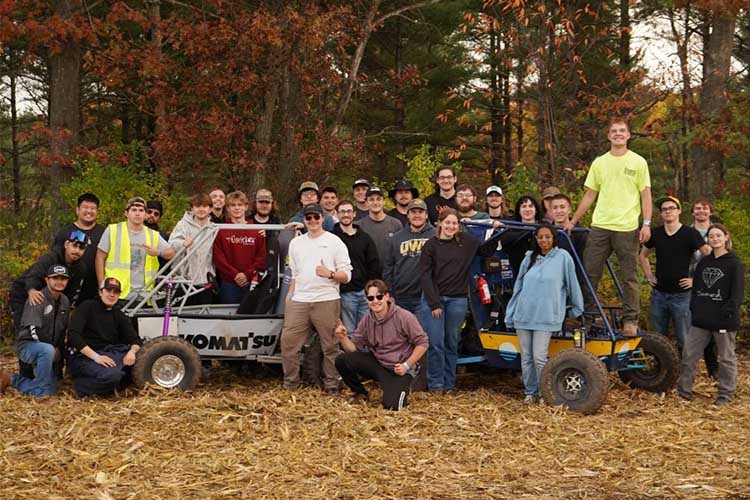
UWM’s SAE student organization has steadily recovered from a dip in membership during COVID to draw more than 40 dues-paying members this fall – the highest in the group’s recorded history, said junior Liam Carroll, the club’s vice president and technical director.
“Some are just car enthusiasts, but it goes much deeper than that,” Carroll said.
The season opened at Backwoods Baja, hosted by UW–Stout, that drew six teams from Wisconsin and seven from surrounding states.
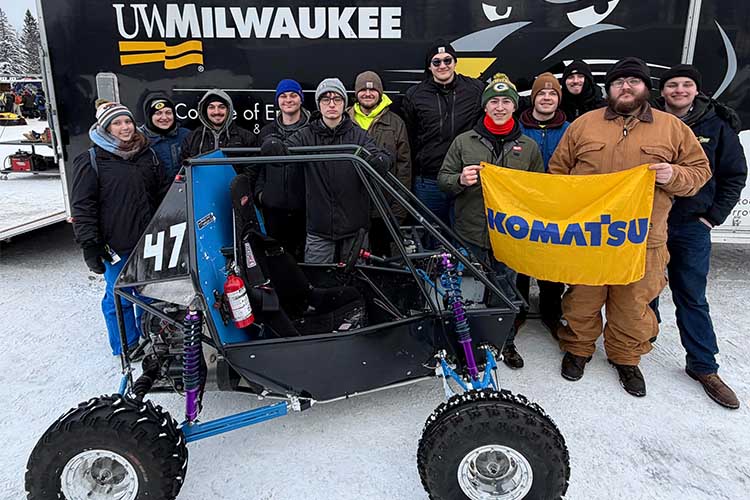
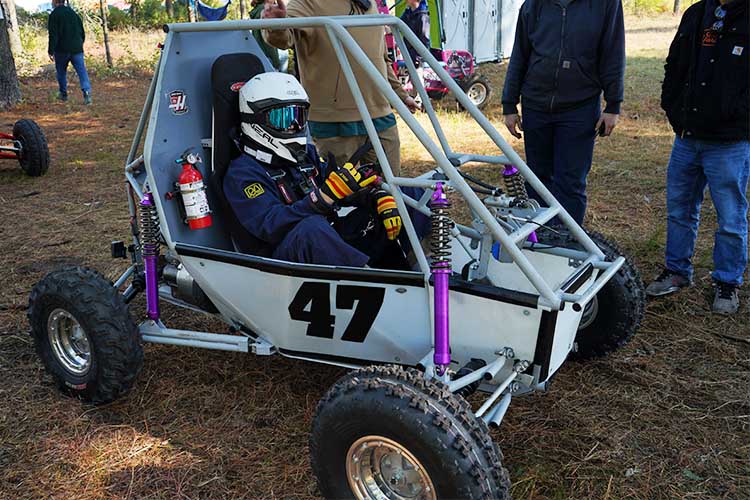
The team brought two cars: No. 46, a rear-wheel-drive workhorse completed in 2020, and No. 47, a newly finished machine sponsored by Komatsu Mining Corp. Car 46 handily captured first place in the four-hour race.
The debut of car 47 wasn’t perfect, but it was promising, ranking 13th out of 30 competitors.
Car 47 marked a major leap forward. It was the team’s first four-wheel-drive design, requiring the drivetrain to run the length of the vehicle rather than stay compact in the rear.
More than 30 UWM students traveled to the competition, reflecting the club’s emphasis on participation and hands-on learning – not just podium finishes.
A second chance
The new design faced its next challenge at Winter Baja, hosted by Michigan Tech in Houghton, Michigan, attracting 19 teams, including teams from Northwestern University and the University of Michigan. Snow and ice turned the course into a traction-starved proving ground – ideal conditions for testing four-wheel drive.
Between the Backwoods and Winter Baja races, the team reworked car 47’s front suspension to improve durability and handling and installed new body panels.
The improvements paid off. Car 47 roared to a second-place finish, completing the hours-long race without a mechanical issue. Meanwhile, car 46 battled through multiple rollovers but still finished in the top 10 among 39 competitors.
Learning through revision
After each race, the students document every design decision, so lessons carry forward to the next car.
“Our strategy compared to other schools is to focus on durability above all else,” said junior Noah Schwebel, the club’s new president. “When weaknesses appear, the team responds with major structural revisions.”
Troubleshooting is central to the experience, but students are also drawn by the community, said Assistant Professor William Musinski, the group’s faculty mentor.
The group is quite interdisciplinary. Electrical engineering and computer science students are developing a data acquisition system, and leaders hope to recruit students in business, marketing, and graphic design majors to help with sponsorships and outreach.
“The student organization has been doing a tremendous job engaging new students, and they are learning from each other in ways that extend well beyond traditional classroom studies. The group also gives them the chance to share information and prepare for internship or co-op opportunities,” Musinski said.
Engineering in real time
Each new vehicle is treated as a clean-sheet design. Car 47, which started in 2021, took far longer than planned to complete.
Now, as the team begins concept work on car 48, they are reconsidering four-wheel drive. While it performed well in winter conditions, it adds weight and complexity, Schwebel said.
“Our organization’s teaching mission is very comprehensive,” Schwebel said. “Compared to other design-challenge organizations, we believe ours is closest to providing a real-world engineering experience. Our goal is to challenge members and prepare them for a professional environment.”
Along the way, students gain more than trophies. They practice cross-functional teamwork, deal with manufacturing constraints, and conduct failure analyses after races.
Many members are “motorheads at heart,” Carroll said. But the real draw isn’t just horsepower.
“It’s the chance to see their ideas survive – or fail – in the harshest environments, then come back to the shop and build something better.”