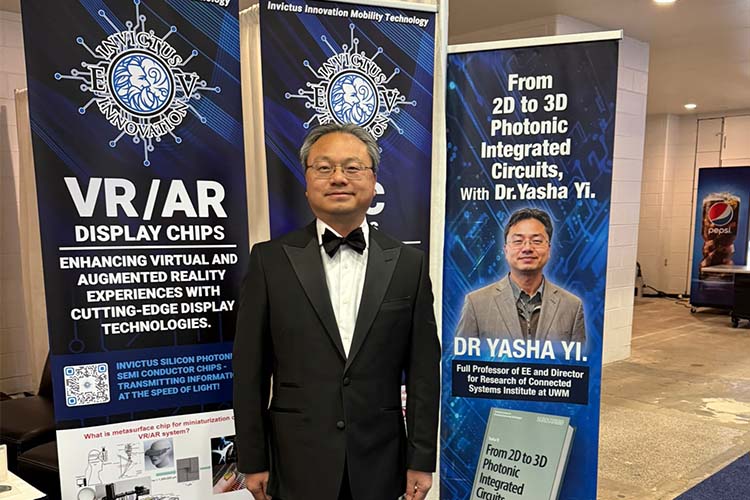
Alex Yasha Yi, professor of electrical engineering and director for research at the Connected Systems Institute, has received sponsorship from Invictus Innovation EV Technology to conduct research that could advance a new kind of computer microchip that moves information with light, rather than electricity.
The technology could offer the speed that the digital age is demanding as traditional microchips reach their performance limits. Next-gen microchip technologies and manufacturing processes could improve everything from handling the intensifying demands of AI data centers to quantum communication systems, self-driving car sensors, and aerospace communications – anything that uses a computer chip.
The two-year, $531,697 industry-supported research grant also includes a workforce development component.
Invictus Innovation EV Technology is a Michigan-based company that focuses on semiconductor chip manufacturing and advanced technology for electric vehicles (EVs). The funding supports both the research and outreach to high school and college students.
From transistors to light
Traditional microchips contain billions of microscopic on/off switches called transistors to control the flow of electrical signals, created by electricity moving through copper wires.
But that strategy won’t be enough to handle the exploding demand of the AI age. Inside massive data centers, chips must exchange staggering amounts of information in real time. The faster they can communicate, the faster AI can run. The traditional mode of information processing is creating traffic jams.
Yi is researching an alternative: Replacing metal wires with tiny on-chip photonic waveguide highways.
Next-gen chips will use tiny beams of light to shuttle data between chips, dramatically increasing speed while reducing heat and energy use.
“For 70 years, we made computer processing faster by shrinking transistors. The next leap won’t come from smaller chips – it will come from helping chips talk to each other at the speed of light.”
Changes to manufacturing too
Another part of the research involves how microchips are manufactured. For a long time, chips were laid out mostly flat, in two dimensions.
Yi’s work proposes 3D chip designs, where components are stacked on top of each other. This approach allows more computing power to fit into a smaller space, while also improving speed and reducing energy use.
For further advances, however, electrical engineering, materials science, physics, chemistry, and mechanical engineering must all work together, as Yi has discussed in his book, “From 2D to 3D Photonic Integrated Circuits,” published this year by SpringerNature.
Yi, who joined the UWM faculty from the University of Michigan last year, has worked with Invictus before. The company has research partnerships focused on building a new information technology service provider for the electric vehicles industry.
A double shortage
The U.S. relies heavily on semiconductor chips produced in other countries. Not only is there a shortage of chips in the U.S., Yi said, there also is a shortage of engineers who are skilled with this technology. In order to attract and retain companies to Wisconsin and the Midwest, the state needs to educate more engineering students.
“The goal is to bridge the skills gap in the semiconductor industry,” he said. “This program is essential for providing the practical hands-on experiences that can replicate the real-world semiconductor manufacturing environment.”
That effort should begin before college. That’s why the project includes outreach partner Spark Photonics, a Massachusetts-based startup that gives K12 students lessons in photonics. Yi said talks to gauge interest are beginning with some Milwaukee area and north Chicago high schools.
At UWM, Yi is leveraging CSI’s capabilities, including the Microsoft AI Co-Innovation Lab, and teaching a special topics course next semester giving students an introduction to photonics using one of Sparks’ software packages.