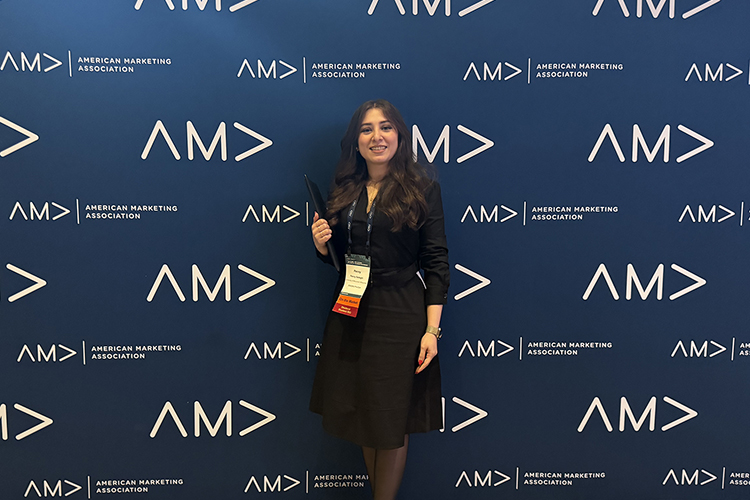
Doctoral student Pouneh “Penny” Sadeghi studies a question that affects more people than they might realize. When companies speak to the public during moments of uncertainty, how do investors, customers, and communities respond?
Penny is a graduate assistant and instructor at the Lubar College whose research examines how corporate messages influence investor reactions and firm value. She looks at real-world events, including trade wars and company announcements about adopting generative artificial intelligence. Using market data, she studies how investors respond in real time and why some messages build confidence while others raise concern.
“At its core, my research is driven by a simple question,” Penny said. “Why do some messages signal strength while others create uncertainty?”
Her findings are meaningful far beyond Wall Street. For everyday citizens, investor reactions can affect retirement accounts, job stability, and even the price of goods and services. When companies communicate clearly and thoughtfully, markets tend to respond more positively. When they remain silent or send mixed signals, uncertainty can grow.
One surprising insight from Penny’s research is that silence can be just as powerful as speaking. “Trade wars and generative AI adoption may seem very different,” she said. “But they both force companies to make high-stakes decisions under uncertainty, with the whole world watching.”
Penny’s path to marketing research began in engineering, where she co-authored a book on automotive engine design. Over time, she became curious about why strong products sometimes fail. “I realized that a great product alone does not guarantee success,” she said. “How it is communicated and perceived matters just as much.”
That curiosity led her to pursue marketing, where she found a balance between analytics, storytelling and human behavior. Her multilingual and cross-cultural background also shapes her work. “It helps me ask better questions and stay open to complexity,” Penny said.
At Lubar, Penny credits faculty mentors and classroom experiences with helping her refine her research voice. She also brings her work into her teaching, connecting course discussions to current market events and emerging technologies.
“The classroom keeps my research grounded in real-world relevance,” she said. “And my research brings fresh insight back to my teaching.”
Penny hopes her work encourages people to think more critically about the messages they see from companies every day. “Our work has the power to inform and influence the world around us,” she said. “That is what motivates me.”