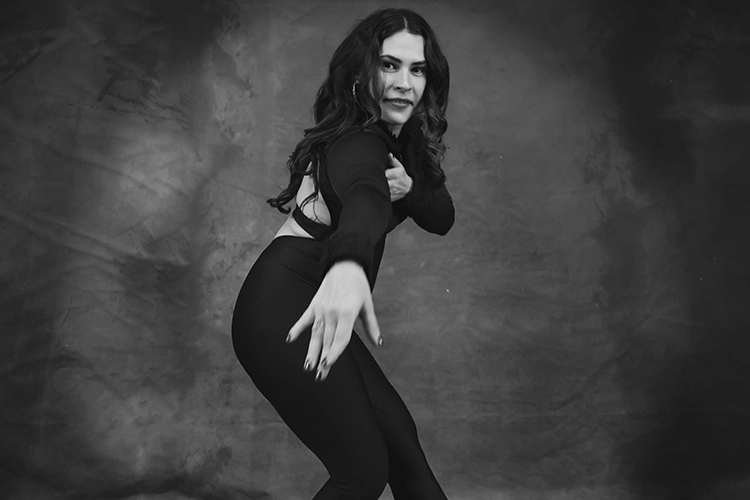
Springdances: We Also Bloom features new works by faculty choreographers Daniel Burkholder, Tiffany Kadani, Dan Schuchart, and Christal Wanger, alongside guest artist Karlies Kelley. Notably, all of this year’s choreographers—faculty and guest alike—are alumni of UWM, bringing a shared lineage of training to the stage.
Exploring themes of growth, resilience, and transformation, the concert reflects on what it means to keep evolving, even in the face of adversity. Ahead of performances, Kelley reflects on returning to her alma mater, collaborating with students, and shaping new work within a community that continues to influence her practice.
You graduated from UWM with a BFA and MFA in dance. What was it like to come back to collaborate with PSOA dance students?
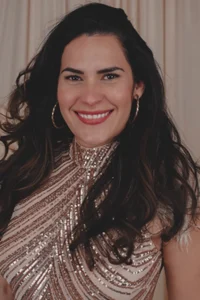
Beyond your studies at UWM, African Diaspora Dance continues to be a focus of your creative practice. How did you bring this into your piece for Springdances?
The dance department has brilliantly shifted the way students learn performance repertoire. Students are required to learn a “Physical Practice” class that is separate from, yet complementary to, the performance class, taught directly by the choreographer.
In Physical Practice, we explore foundational elements of African Diaspora forms such as rumba, orishas, congo, salsa, and cumbia, and how these practices live within parades, house parties, ritual spaces, and staged performance contexts.
These teachings center on individuality within community, musicality and rhythm, cultural history, and play and improvisation. Material from Physical Practice is then woven into the creation of our Springdances work, as students become increasingly able to gather and generate phrases that respond to the music, the space, themselves, the theme, and one another.
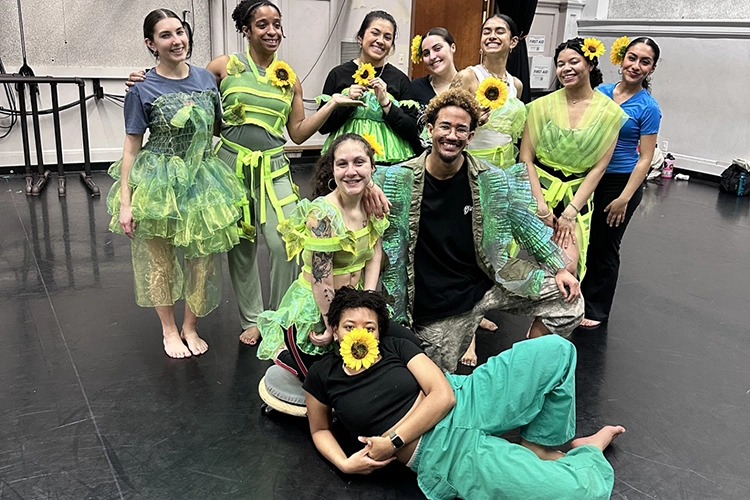
As you’ve been working with students, they have clearly learned a lot from you. What did you gain from them?
There were many nights I lay awake, awed by the dancers’ complexity and brilliance. I had never worked with a dancer with arthrogryposis, a condition that limits joint mobility from birth, and this experience profoundly expanded my understanding of movement, presence, and possibility. I set out to create a work in which each dancer could be seen in their individual greatness—through their histories, their training, and their ways of moving and being. To do so, I had to release my preconceptions, remain fully present, and commit to creating with them, and for them.
As a choreographer, I often find myself shaping narratives of grief or feeling responsible for the joy an audience receives. In this process, I chose to move away from that reliance. If I were asking my dancers to trust their internal impulses, I had to ask the same of myself. This meant practicing movement from the inside out—choosing what feels good, what brings joy, what exists without the need to be explained. Allowing things to live without justification became the core of the work. That was the paradigm of the piece, and it is what my students—directly and indirectly—continued to teach me.
Springdances also features new works by Dance faculty. What can you tell us about your experience working alongside them?
It’s really meaningful to be creating alongside my former teachers, who are now friends and colleagues. Our conversations always feel like a “yes, and” exchange. Even though we’re each working simultaneously in different spaces, the moments we come together are always refreshing and uplifting. Each choreographer brings such a distinct approach to creating and facilitating movement. It’s deeply inspiring to be in their presence and to witness their individual magic unfolding across different corners of the dance department.
What do you hope audiences will take away from Sprindances 2026: We Also Bloom?
There is so much to be sad and mad about, but there is also so much more to be hopeful and joyful for. This concert is proof of that—transforming the mundane into the extraordinary. It reflects on what it means to be truly inclusive, and on what it takes to nurture seeds of goodness for a better now and a more possible tomorrow.
Springdances: We Also Bloom will run April 30 – May 3 in the Jan Serr Studio at Kenilworth Square East. For tickets and more information, visit the PSOA Events Calendar.
Story by Payton Murphy ’27 (Film)