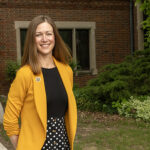
She was an American Field Service exchange student in Japan, just 16 years old and far from her small hometown of Galesburg, Illinois. Sally Lundeen had no idea of the role she’d eventually play in the University of Wisconsin-Milwaukee’s College of Nursing, but during this self-described “life-changing” experience, the seeds were already being planted.
That time abroad fueled the young Lundeen’s interest in international travel and cultural understanding. “We’re all really alike in many ways,” Lundeen says, “but the nuances of various cultures really affect everything – family, education and health.”
The notion directly influenced her vision for the College of Nursing, and she’d help it build longstanding health partnerships locally and worldwide during a 31-year tenure there, including the last 15 as its dean. Now, as Lundeen looks toward her retirement on June 30, she also looks back at helping shape the college’s work in community nursing, global health and interdisciplinary research.
“In my estimation,” Lundeen says, “the role of a good urban research university is to provide ways that our students can connect and create knowledge about the community where we are located, as well as global health.”
Coincidentally, as the college celebrates Lundeen’s impact, it’s also celebrating its 50th anniversary with a series of April events. Included on the schedule are a reception focused on the college’s community partners and a 50 Distinguished Alumni Reception, and so many of those alumni crossed paths with Lundeen.
She came to UWM as a professor in 1985, rose to become the College of Nursing’s interim dean in 1999 and was installed as its permanent dean in 2001. She’s the longest-serving dean in the college’s history, and has guided it through the crucial missions of education, research and community outreach.
Two of the college’s ongoing initiatives – the Silver Spring Community Nursing Center, established in 1987, and the House of Peace Community Nursing Center, established in 1991 – provide primary care and health promotion in poor neighborhoods, and clinical experience for nursing students. “Those centers not only provide remarkable services to people in the community,” Lundeen says, “but give our students an opportunity to see the best of what nursing can be in community settings.”
And the College of Nursing reaches out internationally, continuing research and education partnerships with programs in China, South Korea, Kenya, Malawi and other areas of Asia and Africa. The college’s Center for Global Health Equity supports study abroad programs, research and exchanges of faculty.
All of that occurs within a strong and growing culture of nursing research, with particular emphases on geriatrics, informatics and health technology, global health, community-engaged health and self-management science. In the last five years, two major National Institutes of Health grants have supported the Self-Management Science Center, which researches and promotes better ways for people to manage chronic conditions.
Such work, Lundeen says, has earned the college national and international research renown, and she believes it was a factor in UWM’s elevation to the top tier of research universities. UWM earned “R1” status from the Carnegie Classification of Institutes of Higher Education in 2016, making it one of only 115 schools to have that highest research-centric rating.
Lundeen is a strong proponent of interdisciplinary research and education, matching academic areas such as engineering, information sciences and social welfare with such traditional academic health disciplines as nursing, public health and health sciences. “It’s the way the universities of tomorrow must operate,” Lundeen says. “If we don’t start educating our students together, I don’t know how we can expect them to work together in teams in practice.”
Although she has enjoyed her work as a professor and dean, she looks forward to stepping back and spending more time with her family – including four children, six grandchildren under age 7 and her 95-year-old mother.
She plans to stay involved with UWM and nursing organizations, and spend time on her own research and writing, work largely put aside when she assumed administrative roles and responsibilities.
So Lundeen doesn’t view leaving UWM as a retirement in the traditional sense. “I just see it,” she says, “as a shift in focus and energy.”