Connect – Prepare – Thrive
The Strategic Plan defines the Division of Student Affairs’ key role in supporting students and furthering the mission of the University of Wisconsin-Milwaukee. Developed through extensive planning and feedback from more than 100 Student Affairs staff members, this plan has led to the establishment of goals focused on operations, students, and employees.
The Strategic Plan focuses on helping students feel connected, supported, and successful during their college experience. It highlights the importance of building a welcoming community, offering opportunities to get involved, and providing resources that support students’ well-being and growth both inside and outside the classroom. Overall, the plan is designed to help students develop important life skills, form meaningful relationships, and leave UWM prepared for their future.
Version: 2025-2030 – Final
Last Updated: 05/14/2026
Letter from Vice Chancellor Haag

Dear Colleagues:
The 2020-2023 Strategic Plan was our first attempt at providing a unified vision for the Division of Student Affairs (DSA). During this timeframe we adapted to national changes in higher education and responded to increasing student needs. Our Annnual Reports provide greater detail about the amazing work that the DSA staff conducted during COVID-19, and our Closeout Report summarizes accomplishments and lessons learned. With this foundation laid, we began the year-long process of creating our next strategic plan.
We began by re-examining our Mission, Vision, Values, and Priorities (MVVP) in Summer 2023. Our earlier values were created in 2011 and served us well for many years; however, our divisional mission and values needed to be rearticulated to respond to our students’ changing needs. Once we had these long-term guiding principles in place, we moved on to our operational goals, outlining what we want to accomplish as a Division in the next five years. Each goal was assigned to a champion and a divisional committee, who then created the outcomes, metrics, strategies and tactics. Please see Appendix F for a detailed timeline and the opportunities for feedback.
This strategic work was influenced by three primary factors, and the connection among these factors is visually depicted on page 4 of this document. First, the University was undergoing a “refresh” of the 2030 Action Plan, which “provides the strategic framework for UWM to advance student success and fulfill our dual mission as a research and access institution.” DSA leaders worked closely with 2030 Refresh leaders to ensure that our goals align with and support the larger institutional goals. Please see Appendix E for a chart that details this alignment.
Second, in late 2022, I asked a team to attend the annual Institute on the Curricular Approach sponsored by ACPA. Simply put, the curricular approach is a methodology for identifying what we want students to experience outside of the classroom, organize what we do based upon these goals, and provide roadmaps for students to get there. The team and I were satisfied that we wanted to bring this methodology to UWM, and the resulting student goals and outcomes can be found in Appendix A.
Third, the pandemic and the “Great Resignation” have forced institutions to re-examine their approaches to institutional culture and employee satisfaction. As one example of UWM’s approach, Campus Cares was created as “the campus-wide strategic initiative focusing on health and well-being for the entire UWM campus community.” As we developed student goals, we felt that it was also important to develop employee goals and outcomes. The result can be found in Appendix B.
This document will be our roadmap for the next five years, and I am grateful to everyone who helped develop it and all the many staff who took the time to provide feedback along the way. Some of the work described below is already underway by the time that you read this, and our divisional committees are excited to move from planning to action. Our progress towards this work will be reported out in our Annual Reports, starting with the 2024-2025 report.
Kelly Haag
Vice Chancellor for Student Affairs
Structure of the Strategic Plan
Each goal is assigned to designated leaders who are responsible for turning strategy into action.
Most of work will be inter-departmental, and membership of the teams includes constituents from across Student Affairs as well as those from other campus divisions where appropriate.
Under each goal are outcomes (the specific changes that will result), action plans and timelines and metrics for measuring success. The work of the DSA Strategic Plan will bridge the gap between unit-level goals and metrics and the goals and metrics of UWM as an institution.
Action plans will be reviewed and modified as necessary each year. Progress towards goals will be documented in the DSA Annual Report.
Strategy Framework
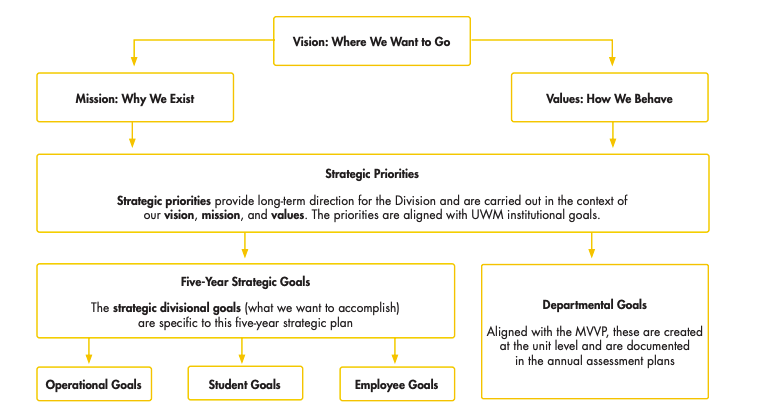
- Notes:
- See Appendix E for how all this divisional work aligns with the 2030 Refresh
- See Appendix G for explanation of terms and acronyms used throughout the document
Vision, Mission, Priorities, and Values
Vision (Where We Want to Go)
All students are supported through their academic journey, have pathways to achieve learning and career goals and are embraced as valuable members of the UWM community.
Mission (Why We Exist)
Our mission is to create an engaging community where students feel they belong at UWM, to develop transformative learning opportunities outside of the classroom, and to provide services and experiences that support and promote student well-being so that students can thrive, persist, and succeed.
Strategic Priorities (Long-Term Direction)
- Belonging: Provide services, experiences, programs, and inclusive spaces that celebrate and honor students’ diverse identities, ensuring everyone feels welcomed, valued, and empowered to be their authentic selves.
- Engagement: Actively engage in collaborative partnerships with both internal and external stakeholders to offer opportunities and pathways for students to connect with one another, our institution, and the city of Milwaukee.
- Learning: Provide opportunities that challenge students, resulting in knowledge acquisition, critical thinking, skill development, and transformational personal growth.
- Well-being: Engage students in a range of initiatives that promote their physical, mental, spiritual, occupational, social, intellectual, and emotional well-being. We provide students with the necessary tools, support, resources, and guidance to navigate their personal health and overall well-being.
- Efficient and Effective Operations: Maintain a division that is appropriately resourced, staffed, and structured to support students and staff.
Values (Principles that Guide Us)
- Student-Centricity: We center our work around students’ needs, interests, and aspirations; we incorporate and elevate student voices; and we work directly with students as we create and enhance programs and services.
- Equity and Inclusion: We cultivate a culture of inclusivity, equity, and belonging through our actions so every member can be their authentic selves.
- Collaboration: We develop strong, trusting relationships with students and colleagues to work across areas and toward a common purpose.
- Leadership: We develop leadership skills in ourselves and students, empower students and staff to take initiative, practice adaptability and accountability, and demonstrate care.
Operational Goal One
Develop and improve policies, organizational structures, programs, and services to foster and sustain an inclusive campus community (Belonging).
Champion(s): Director of Advocacy and Student Engagement
Responsible Committee: Equity and Justice Committee
Alignment: 2030 Refresh Student Goals (See Appendix E for details)
Theory of Action: Students who feel that they belong as part of the UWM community will be more likely to be retained; said differently, students who do not feel that they belong will not stay.
Outcomes
1. Students report feeling they are a part of the UWM community
- Evidence provided in post-event surveys
- Evidence provided in the (NSSE)—15c
- Evidence provided in the National College Health Assessment (NCHA) every three years
- 2023 NSSE report (See Appendix D)
77% of freshmen and 72% of seniors feel they are a part of the UWM community.
2. Students feel valued by UWM
- Evidence provided in NSSE—15b
- 2023 NSSE report (See Appendix D)
85% of freshmen and 77% of seniors feel valued by UWM.
3. Students report feeling comfortable being their authentic selves on campus
- Evidence provided in NSSE—15a
- 2023 NSSE report (See Appendix D)
92% of freshmen and 83% of seniors report feeling comfortable being their authentic selves on campus.
4. Increase re-enrollment rates for sub-communities served by DSA
- Term-to-term re-enrollment rates for first-generation students, Lawton students, military and veteran students, student parents, and DSA student employees1
- Fall 2023 to Spring2024 student re-enrollment data
- First gen: 86.7%
- Lawton: 96.4%
- Military-related: 90.7%
- DSA student employees: 95.7%
Increase re-enrollment rate by 3% for all sub-communities based on 2023-2024 data.
5. Students access and utilize available resources
- Utilization of campus resources (i.e. DOSO, CASE, UREC, SHAW)
- Daily traffic
- Number of clicks for virtual resources
- 2023-2024 data (DOSO, CASE, UREC, SHAW Medical and Counseling)
- See Appendix C
Increase utilization of resources by 3% based on 2023-2024 data.
1 The pilot sub-communities were selected by the Equity & Justice Committee. Other populations can be examined in the future.
Strategies
1. Create opportunities for student groups’ voices to be heard
- Students report feeling they are a part of the UWM community
- Students feel valued by UWM
- Students report feeling comfortable being their authentic selves on campus
- Support and amplify current initiatives such as Student Association listening sessions, and related focus groups
- Create opportunities for feedback from students
- Coming Soon
2. Collaborate with campus partners to implement student access to campus resources using technology (AI) to enable seamless connections and information retrieval
- Students access and utilize available resources
- Implement chatbots or virtual assistants on DSA websites
- Coming Soon
3. Increase support and visibility from campus leaders at programs and initiatives that celebrate the diverse identities of UWM students
- Students report feeling they are a part of the UWM community
- Students feel valued by UWM
- Students report feeling comfortable being their authentic selves on campus
- Communicate event information to campus leaders well in advance through invitations, announcements, and agenda listings
- Create opportunities for campus leaders to be part of the events (i.e. speaking, networking, panel)
- Create opportunities for campus leaders to engage with attendees (students)
- Coming Soon
4. Monitor the re-enrollment status of DSA sub-community students and collaborate with campus partners on targeted outreach campaigns to encourage re-enrollment
- Increase re-enrollment rates for sub-communities served by DSA
- Work with Navigate360 Admins to coordinate undergraduate student outreach campaigns
- Collaborate with UWM Graduate School admins to coordinate graduate student outreach
- Coming Soon
5. Maintain transparent communication about changes in resources and services that affect students
- Students report feeling they are a part of the UWM community
- Students feel valued by UWM
- Students report feeling comfortable being their authentic selves on campus; Students access and utilize available resources
- Provide timely updates when decisions are made, or changes occur and include students in the process, to the extent possible
- Coming Soon
Operational Goal Two
Create intentional opportunities for students to make meaningful connections to other students, faculty, staff, and the greater Milwaukee community (Engagement).1
1 Goal two focuses on the “micro” and “interpersonal” aspects of engagement
Champion(s): Director of Athletics and AVC/Dean of Students
Responsible Committee: Campus Life
Alignment: 2030 Refresh Student Goals (See Appendix E for details)
Theory of Action: Development of relationships with peers, staff, and faculty will increase students’ likelihood of a sense of belonging and retention through graduation.
Outcomes
1. Students feel connected to peers, faculty/ staff, and community members
- NSSE data (13a and 13d)
- Expand use of “Connect/Celebrate” survey
- Adapt survey to include additional elements of connections.
- Benchworks for Elentra, formerly Skyfactor (EBI)D. “Connect” Student Outcomes from Curricular Approach (metric TBD)
- 2023 NSSE report (See Appendix D)
- Connect/Celebrate Survey 23-24 data
- 91% of students agreed or strongly agreed with the statement, “This program helped me make connections to others”
- 71% of students agreed or strongly agreed with the statement, “At this event I met someone who I might become friends with”
Increase % over baseline by 3%• Increase percentage of students who agreed that a program helped them make connections to others to 75%
2. An increase in physical spaces on campus that foster a greater sense of community, engagement, and more time spent on campus by students
- Student Affairs professionals are represented on Physical Environment Committee (PEC) and in any master planning efforts.
- Campus Planning reports on FFE expenditures associated with common spaces in new and renovated buildings.
- Green Space utilization reports associated with each campus quadrant.
- Focus groups and intercept surveys with students
- Metrics regarding off-campus student engagement
- 2023 NSSE report (See Appendix D)
85% of freshmen and 77% of seniors feel valued by UWM.
3. There will be an increase in opportunities to explore the City of Milwaukee and bringing the City to UWM
- Report on partnerships that engage with the City such as discounted/free tickets to local events/activities, in-kind sponsorship relationships that benefit student access, etc.
- Report on existing opportunities for Citywide access to UWM community (while identifying gaps)
- Alumni Engagement in programs/activities including Homecoming & Prowl
- 2023 NSSE report (See Appendix D)
92% of freshmen and 83% of seniors report feeling comfortable being their authentic selves on campus.
Strategies
1. Develop common tracking platform (This strategy has been revised and moved to Goal Seven)
2. Review Event Cadence and calendaring of events
- Students feel connected to peers, faculty/ staff, and community members
- Create an annual rhythm of events and review cadence of events within the division
- Determine programming gaps and share with units to address• Determine what ways events/programs are intentionally supporting connections throughout the year
- Maximize financial resources and student attendance
- Be intentional about marketing, timing of communications, and events as appropriate for time of year and needs of students
- Work with Student Learning Committee regarding Curricular Approach goals and outcomes
- Coming Soon
3. Conduct an analysis of how and why students are engaging or not engaging
- Students feel connected to peers, faculty/ staff, and community members
- An increase in physical spaces on campus that foster a greater sense of community, engagement, and more time spent on campus by students
- Examine different data across departments, including food service, facilities, and interactions with Academic Affairs
- Work with the Assessment Committee and Student Learning and Development Committee to create new assessment tools
- Coming Soon
4. Design events with an intent to build connections and relationships with other students
- Students feel connected to peers, faculty/ staff, and community members
- Help students get connected through event planning process/ committees/advisory councils/shared governance
- Provide professional development offering to the DSA on how to design or redesign initiatives that put relationship building and promoting a sense of belonging at the center (Added 2025)
- “Find your people” initiative to help students find events where they can go alone and find friends (Complete: 2025)
- Respond to the “would benefit from campus clubs/organizations & events” alert in Navigate and reimplement Involvement Ambassador Initiative (Ongoing/Complete 2025)
5. Be actively involved with discussions related to engagement with the Campus Master Planning
- An increase in physical spaces on campus that foster a greater sense of community, engagement, and more time spent on campus by students
- Build on the work started with HGA regarding the six success criteria for the Student Union
- Coming Soon
6. Capitalize on the urban environment
- There will be an increase in opportunities to explore the City of Milwaukee and bringing the City to UWM
- Identify why students are drawn to Milwaukee
- Partner with other units (New Student Orientation, Alumni, Academic Affairs) to help students explore Milwaukee
- Coming Soon
Operational Goal Three
Maximize student engagement, from point of entry to graduation, in a distinctly UWM experience (Engagement).1
1 Goal 3 focuses on the “macro” and “institutional” aspects of engagement
Champion(s): Director of Athletics and AVC/Dean of Students
Responsible Committee: Campus Life
Alignment: 2030 Refresh Student Goals (See Appendix E for details)
Theory of Action: Students who are engaged will have a sense of purpose that keeps them involved and part of the UWM community.
Outcomes
1. Develop a sense of student pride that will be cultivated upon enrollment and extend beyond graduation
- Numbers of new programs, documenting how we are working to increase engagement
- Social/Active Listening, including work to track Discord and other social media participation where students are engaging
- Alumni surveys
- Athletics surveys
- Athletics to include a question in end of season student survey (survey in development; to launch in Spring 2025)
Baseline target to be established following spring 2025 Athletics survey
2. Student participation in events, activities, and programs will see an increase across all identities and demographic groups
- NSSE (14e and 14h)
- Event Attendance Data
- Campus demographic Data
- 2023 NSSE report (See Appendix D)
20% year over year increase from Spring 2026 to Fall 2029
3. Student participation in events, activities, and programs will see an increase across all identities and demographic groups
- NSSE Data
- Campus climate survey (students, staff, and possibly alumni?)
- Tracking cross departmental collaborations for programs/activities
- The mean “Supportive Environment” Score in NSSE was 34.2 for first-year and 32.4 for graduating seniors in 2023
Increase mean “Supportive Environment” score to 35.3—the Great Lakes Public first year mean for 2023
Strategies
1. Develop a “Just Do Two” Messaging Strategy
- Develop a sense of student pride that will be cultivated upon enrollment and extend beyond graduation
- Student participation in events, activities, and programs will see an increase across all identities and demographic groups
- Student participation in events, activities, and programs will see an increase across all identities and demographic groups
- Complete production of a “tool kit” for division units to utilize. “Tool kit” may include: logo/word mark, signage for buildings, social media graphics, etc
- Division units would be strongly encouraged to incorporate strategy into existing messaging
- Messaging strategy would link back to central, online event calendar; individual units could link back to specific events within their areas
- Coming Soon
2. Develop, in consultation with students, faculty and staff across campus, a recommendation on what defines a “Distinct UWM Student Experience”
- Develop a sense of student pride that will be cultivated upon enrollment and extend beyond graduation
- Develop, with a student-led working group, how we define a distinctive UWM experience
- Continue work on student-centric web
- Coming Soon
3. Enhance the current programmatic model that helps 1st year students successfully transition and connect during their first 1-2 months on campus
- Develop a sense of student pride that will be cultivated upon enrollment and extend beyond graduation
- Student participation in events, activities, and programs will see an increase across all identities and demographic groups
- Partner with New Student Programs to handoff to the Division of Student Affairs
- Continue a robust Fall Welcome program o Including, but not limited to Housing (including LLCs), SHAW, CASE, and UREC
- Gather student input in developing and celebrating campus engagement
- Coming Soon
4. Design events with an intent to build connections and relationships with other students
- Student participation in events, activities, and programs will see an increase across all identities and demographic groups
- Help experienced students get connected through event planning process/committees/advisory councils/shared governance
- Develop marketing plan for returning students
- Coming Soon
5. Fund campus level “tradition” programs and activities
- Student participation in events, activities, and programs will see an increase across all identities and demographic groups
- Tactics to be developed
- Coming Soon
6. Encourage faculty/staff to engage with students both inside and outside the classroom
- Student participation in events, activities, and programs will see an increase across all identities and demographic groups
- Develop/create an award that highlights faculty/staff that go above and beyond in creating quality engagement (examples include: STAR Awards and Campus Awards)
- Coming Soon
7. Develop common tracking platform (This strategy has been revised and moved to Goal Seven)
Operational Goal Four
Structure and sequence learning and development opportunities outside the classroom (Learning)
Champion(s): Director of Student Learning, Assessment and Planning
Responsible Committee: Student Learning and Development
Alignment: 2030 Student Goals (See Appendix E for details) Higher Learning Commission accreditation, and UW System Shared Learning Goals
Theory of Action: Intentional learning and development that occurs outside of the classroom equips students for lifelong learning and employment, complementing their curricular experience and increasing the value of higher education.
Outcomes
1. Co-curricular and extra-curricular learning and development opportunities utilize the Student Outcomes (Appendix A) for the ConnectPrepare-Thrive Goals
- Count of opportunities available for each outcome
- An analysis of events calendars
- Aggregate examination of Connect-Prepare-Thrive outcomes
- Anecdotal examples of duplicated programs• Current collaboration around calendaring
- Student learning and development outcomes are not assessed consistently
- 2023 HLC assurance argument
- There is sequenced programming available for all student outcomes
- Units assess outcomes and results are shared widely.
- Current calendaring work is elevated and connected to student goals and (if appropriate) student outcomes
- No findings from HLC
2. DSA staff are equipped to fulfill their role as educators
- Annual feedback from staff who create learning and development programming
- Post-training feedback
- Benchmarks to be developed
- Staff feel supported
- Staff understand components of Curricular Approach
- Staff understand how to sequence developmentally appropriate programming
3. Students can easily navigate opportunities in a way that best meets their individual needs and interests
- An analysis of advertisements for relevant opportunities
- An analysis of events calendars
- Case studies of sequenced programming options
- Student Focus Groups will compare how students utilize the programs to how we thought they would sequence the programs
- Benchmarks to be developed
- All relevant opportunities are tagged and advertised with the appropriate student goal outcome and (if appropriate) student outcomes
- Students can easily access the opportunities available
- The sequencing structure aligns with student development
4. Students can recognize, reflect upon, and articulate their own development
- Annual student employee survey
- Alumni surveys
- Increase the number of programs/opportunities for student growth assessment (e.g., journaling, observations, conversations with supervisors)
- # of DSA student employees engaged in Panther GROW conversations
- Annual student employment results show that GROW conversations have impact on student experience
- Some programs already encourage student reflection
- 90% of DSA student employees engage in Panther GROW
- 50% of co- and extracurricular opportunities with a learning purpose utilize a reflective assessment tool
- No findings from HLC
Strategies
1. Build infrastructure around the curricular approach
- Co-curricular and extra-curricular learning and development opportunities utilize the Student Outcomes (Appendix A) for the ConnectPrepare-Thrive Goals
- DSA staff are equipped to fulfill their role as educators
- Develop rubrics for each outcome• Create centralized CPT outcome mapping and reporting/ assessment infrastructure
- Create additional channels and opportunities for staff in different units to work together on programming/events
- Create a dashboard of programs/outcomes
- Develop facilitation guides and assessment templates
- Provide training for staff
- Develop feedback process from staff
- Include Curricular Approach in onboarding materials
- Relevant departments collect student outcome data
- Coming Soon
2. Collaborate across units to provide students with opportunities and experiences that are aligned with the Student Goals
- Co-curricular and extra-curricular learning and development opportunities utilize the Student Outcomes (Appendix A) for the ConnectPrepare-Thrive Goals
- Students can easily navigate opportunities in a way that best meets their individual needs and interests
- There is ample programming for all Student Goals Programs/ events are tagged with appropriate Student Goals
- Programs/events are promoted with appropriate Student Goals
- Reduce potential for duplication in programming
- Programming is offered in a way where students can find appropriate avenues/on-ramps and meets them where they are at in their journey
- Partner with Academic Affairs to align co-curricular and curricular learning opportunities
- Coming Soon
3. Co-curricular/extra-curricular opportunities that claim a learning purpose use the Student Outcomes or UWM System Shared Learning Goals for assessment
- Co-curricular and extra-curricular learning and development opportunities utilize the Student Outcomes (Appendix A) for the ConnectPrepare-Thrive Goals
- DSA staff are equipped to fulfill their role as educators
- Students can easily navigate opportunities in a way that best meets their individual needs and interests
- Students can recognize, reflect upon, and articulate their own development
- Staff have a clear understanding of Student Outcomes
- Staff assess and document Student Outcomes where appropriate
- Programs/events are tagged with appropriate outcomes
- Programs/events are promoted with appropriate outcomes
- There is ample programming for all Student Outcomes
- Intentional on-ramps and pathways are created by sequencing opportunities that stack well together
- Partner with Academic Affairs to align co-curricular and curricular learning assessment efforts
- Create consistent assessment tool to evaluate staff comfort levels and understanding of creating programming and assessing learning outcomes (Added 2025)
- Coming Soon
4. Increase opportunities for student self-reflection
- Students can recognize, reflect upon, and articulate their own development
- Create a repository of reflective exercises and assessment practices
- Explore the creation of a co/extra-curricular resume
- Coming Soon
Operational Goal Five
Provide high-quality holistic support services that are easily accessible and available to students (Well-being)
Champion(s): Executive Director of SHAW
Responsible Committee: Well-being Committee
Alignment: 2030 Refresh Student Goals (See Appendix E for details)
Theory of Action: Students who have access to conditions that support well-being are more likely to succeed in their academic and personal goals.
Outcomes
1. Close the gap between students that request services and students who receive services
- Average wait time for services
- Adequate funding/ staffing needs for emergency grants, laptops, services through Support U reporting
- Feedback through surveys where student report well-being needs are met
- Benchmarks will be developed
- Measure current wait times or first appointment availability
- Present funds available for services
- Collate results from present existing surveys to create a reference point
- 80% of students are able to utilize service within 1 week of request
- 80% of physical service requests are met with our current funds
- 80% of students on campus report that their well-being needs are being met
2. Students report that UWM provides support for overall well-being
- NSSE data (14f)
- National College Health Assessment (NCHA) Web Survey III
- Satisfaction surveys in SHAW, CLC, Housing, UREC, Dining.
- Participation in UWs Counseling Impact Report administered by UW System Administration
- 2023 NSSE report (See Appendix D)
- I feel that students’ health and well-being is a priority of my college/ university: 50.9% agree/ strongly agree (NCHA)
- I feel that the climate of my college/university encourages free and open discussion about students’ health and wellbeing: 59.7% agree/ strongly agree (NCHA)
- Other benchmarks to be developed
- 68% of first year and 65% of seniors feel UWM emphasizes support for their overall well-being
- 80% of student rate SHAW services as extremely or somewhat satisfied
3. Students utilize services in proportion to campus demographics
- Programs collect demographic data and compare to the demographic composition of the campus
- Measure the current percentage of the current student demographic makeup with the services being provided at SHAW and utilization of You@UWM
- Show an increase in utilization of programs and services by the specific demographic makeup
4. Increase utilization of well-being services
- Use CLI (clinical load index) for counseling numbers & trends
- Collect baseline data about utilization and compare it in time to assess the trend
- Number of visits/ encounters in the medical and counseling clinic, DOSO, Support U, Food Center and Pantry, and other areas
- Measure returning students between semesters to assess continued usage in housing
- Collect metrics from online mental and emotional health modules, such as Mantra Health and You@UWM
- Current utilization trends based on student population
- Current number of students returning between semesters
- Collect present enrollments/utilization of the mental and emotional health online services
- Show and increase in utilization based on total student population
- Show a “fixed percentage” increase in housing returning students
- Show an increase enrollment/utilization of online mental and emotional health services
5. Increase the provision of evidence-based services that promote protective behaviors and the reduction of high-risk behavior
- Data from existing reports, such as HPA program outcomes, the UW Counseling Impact report, and conduct reports from DOSO and Housing
- Number of programs focusing on prevention and reduction of high-risk behavior
- Student-reported data on Impact of services on academics and attendance
- Get baseline data on the number of specific programs related to this category
- Get baseline data on conduct related behaviors using DOS and housing
- Show an increase in utilization of the focused programs
- Show an increase in programs focused in this category
- Show a decrease in conduct related incidents
Strategies
1. Increase awareness of services
- Close the gap between students that request services and students who receive services
- Students report that UWM provides support for overall well-being
- Students utilize services in proportion to campus demographics
- Increase utilization of well-being services
- Increase the provision of evidence-based services that promote protective behaviors and the reduction of high-risk behavior
- Increase marketing efforts and tabling events
- Increase outreach activities such as let’s talk, Ask a Nurse clinic at housing
- Promote and amplify available services through academic partnerships, events and other student-centered activities
- Target marketing to focused and marginalized groups about services and resources
- Increased focused marketing using all mediums
- Collaborate with other departments to increase awareness and referrals to service
- Coming Soon
2. Ensure that services offered align with the UWM population’s needs
- Close the gap between students that request services and students who receive services
- Students report that UWM provides support for overall well-being
- Increase utilization of well-being services
- Increase the provision of evidence-based services that promote protective behaviors and the reduction of high-risk behavior
- Consider hours of operation, such as extended hours and weekend coverage
- Increase the diversity of programs including provision at different timings to increase utilization
- Continue to develop programs that address common high-risk behaviors and promote healthy behaviors
- Periodically conduct services to assess and match services needed by students
- Coming Soon
3. Reduce barriers to utilization of services
- Close the gap between students that request services and students who receive services
- Students report that UWM provides support for overall well-being
- Increase the provision of evidence-based services that promote protective behaviors and the reduction of high-risk behavior
- Examine ways to reduce stigma
- Examine how a student’s financial situation contributes to their use (or lack of use) of services
- Continue to develop virtual services
- Assess policies and procedures with a lens decreasing roadblocks
- Coming Soon
4. Create a welcoming environment for all students
- Students report that UWM provides support for overall well-being
- Students utilize services in proportion to campus demographics
- Increase the provision of evidence-based services that promote protective behaviors and the reduction of high-risk behavior
- Develop culturally appropriate programming that serves the needs of students based on demographics
- Assess policies and procedures with a lens of diversity
- Focus on diversity in recruitment of staff
- Provide resources in all media formats that can be utilized focused on risk reduction and health promotion
- Coming Soon
Operational Goal Six
Enhance employee development by investing in centralized onboarding and training, regular professional development, and coordinated opportunities that support employee development and morale (Efficient and Effective Operations)
Champion(s): Vice Chancellor for DSA
Responsible Committee: Development and Operations Committee
Alignment: 2030 Refresh Employee Goals (See Appendix E for details)
Theory of Action: Employees who feel well trained, supported and valued, will be more likely to be retained.
Outcomes
1. Staff feel respected and valued (Employee Goal 1)
- Employee Survey
- DSA Townhall/listening sessions
- 2019 Employee Survey results
- Benchmarks will be created within year 1
- 90% of survey respondents agree that they feel welcomed, recognized, and motivated
2. Staff are empowered to prioritize student success (Employee Goal 2)
- Employee Survey
- 4th Tuesday session
- Listening Session
- 2019 Employee Survey results
- Benchmark will be created within year 1
- 90% of staff can articulate how their role on campus connects to the mission of DSA
- 90% of student supervisors report access to the training they need
3. Staff thrive personally and professionally (Employee Goal 3)
- Employee Survey
- Number of opportunities promoting health and well-being
- Number of targeted opportunities that enhance employees’ skill set, knowledge base, and career path
- Track employee engagement in committee work, prof dev events, trainings, etc
- 2019 Employee Survey results
- No existing benchmark for numbers of opportunities
- Each year, all DSA Staff participate in at least one opportunity
- 90% of survey respondents demonstrate they understand resources available to them and have the ability to participate
- Increase in numbers of opportunities from 2025 to 2029
4. Divisional operational, budgetary, and HR processes promote employee success, development, and engagement and are efficient, inclusive, transparent, and effective for all employees
- Employee survey
- Number of opportunities
- 4th Tuesday session
- Listening session
- Benchmark will be created within year 1
- 90% of survey respondents demonstrate they are aware of basic HR, operational, and budgetary processes (and/or know where to find them)
- Increase in numbers of opportunities from 2025 to 2029
Strategies
1. Clarify expectations and process for supervisors and staff
- Staff feel respected and valued (Employee Goal 1)
- Staff thrive personally and professionally (Employee Goal 3)
- Require and verify that new supervisors from the division attend the supervisor series put on through HR
- Develop expectations for supervisors and staff to enhance the employee goals
- Create the template or process to encourage and track employee engagement in committee work, prof dev events, trainings, etc
- Develop employee survey
- Coming Soon
2. Develop and/or organize a set of targeted opportunities regarding student success, health and well-being, and professional development
- Staff feel respected and valued (Employee Goal 1)
- Staff are empowered to prioritize student success (Employee Goal 2)
- Staff thrive personally and professionally (Employee Goal 3)
- Define “staff engagement” and then develop or organize a set of offerings and/or pathways (e.g. committee involvement procedure/ how to, etc.), tapping into existing institutional/ community events and groups to increase Student Affairs staff engagement across the institution
- Create standards for posting and what information should be included for each event, including the purpose/ goal/outcome of professional development, who would benefit from attending
- Create a shared calendar of professional development opportunities
- Note: Opportunities should be responsive to employee skill-/competency building
- Work with partners to create pathways to existing opportunities
- Develop a centralized repository of professional development opportunities sorted by topic areas
- Coming Soon
3. Implement proposed onboarding process and develop and offboarding process
- Divisional operational, budgetary, and HR processes promote employee success, development, and engagement and are efficient, inclusive, transparent, and effective for all employees
- Identify staff member(s) to coordinate the administrative elements of the onboarding and offboarding processes
- Assess departmental engagement with (and satisfaction with) onboarding and offboarding processes
- Assess employee engagement with processes
- Coming Soon
4. Establish a continuous recognition program or systemic initiatives to formally acknowledge and celebrate staff who consistently exceed expectations
- Staff feel respected and valued (Employee Goal 1)
- STAR Awards
- DSA Newsletter
- Research, develop, and implement new and innovative methods to recognize and celebrate DSA employees
- Coming Soon
5. Improve Divisional Transparency and Operations
- Divisional operational, budgetary, and HR processes promote employee success, development, and engagement and are efficient, inclusive, transparent, and effective for all employees
- Develop a guide for DSA acronyms
- Increase awareness of divisional resources
- Align HR and DSA processes
- Coming Soon
Operational Goal Seven
Collect, evaluate, and share data regularly to reach informed decisions and link processes for assessment, evaluation of operations, planning and budgeting (Efficient and Effective Operations)
Champion(s): Director of Student Learning, Assessment and Planning
Responsible Committee: Assessment Committee
Alignment: 2030 Refresh fiscal goals and research goals (see Appendix E for details), Higher Learning Commission accreditation
Theory of Action: Engaging in systematic and integrated planning and continuous improvement is essential to the mission and fiscal health of the Division of Student Affairs.
Outcomes
1. All units are engaged in meaningful and intentional assessment
- Unit-level plans and templates are complete and on-time
- Assessment Committee will use template rubrics to evaluate templates
- Unit-level KPIs are provided in the annual divisional report
- Getting divisional feedback (survey and focus group) using the “Measuring a Culture of Evidence” rubric1
- 2022-2023 and 2023-2024 rubric data
- Some data is reported in the divisional annual report, but it is not always consistent or intentionally chosen
- All units participate fully in the annual assessment process2
- 80% of assessment plan rubric criteria are at satisfactory or above3; 95% of assessment reflection rubric criteria are at satisfactory or above
- 100% of units provide KPIs in annual report
- Move closer to ideal state of Culture of Evidence
2. DSA uses data to better understand and improve our services and operations, closing the assessment loop
- Evidence provided in HLC accreditation reports, annual reports, unit assessments and surveys
- Meeting minutes that document data conversations
- No HLC findings in May 2023
- Previous budget narratives
- No findings from HLC
- At least three documented examples each year where divisional data was used to make decisions
3. DSA demonstrates and communicates impact on student and institutional success
- Number of publications/reports that share divisional impact
- Division-level KPIs are shared externally
- Amount of funding (internal and external) raised for divisional initiatives
- Partnerships with other divisions around student success
- Currently have an annual report and a Divisional newsletter
- Previous budget narratives
- No existing Divisional KPIs
- Divisional KPIs are established and shared externally
- Report partnerships with other division focusing on student success, including goal of substantially increasing philanthropic dollars raised for divisional priorities
- See https://www.fau.edu/student/assessment/pdf/culture-of-evidence-rubic.pdf
- Units are expected to complete templates on time or ask for an extension. We anticipate that there are times when it makes sense for a unit to go “offline” from the assessment process for one year due to extreme situations, such as leadership vacancy.
- We recognize that units who try new assessment techniques will sometimes need to start over with “developing practices,” so we want to allow for learning and experimentation.
Strategies
1. Develop regular training and continue building assessment infrastructure
- All units are engaged in meaningful and intentional assessment
- DSA demonstrates and communicates impact on student and institutional success
- Create standardized onboarding for new leaders/POCs on assessment process
- Monitor divisional needs for training and create opportunities for deeper learning and skill development
- Develop question banks for surveys
- Train units on storytelling with data, how to link data to budget narratives
- Work with units on 2-4 most important KPIs to share annually
- Share best practices (Ongoing)
- Provide feedback to units via plan and template rubrics (Infrastructure complete 2025; feedback is ongoing)
2. Create a centralized process for examining divisional data
- DSA uses data to better understand and improve our services and operations, closing the assessment loop
- Determine a process for rolling unit-level data into division-level metrics; these should be connected to the Strategic Plan
- Create real-time tools for monitoring important divisional metrics
- Develop a divisional data dashboard
- Create process for leadership to examine dashboard at least twice a year
- Determine a process for rolling unit-level data into divisional-level metrics (added 2025)
- Coming Soon
3. Develop a process for including students into the assessment process
- All units are engaged in meaningful and intentional assessment
- Explore partnerships with Student Association
- Explore partnerships with units that have student employees or routine touchpoints with students
- Explore opportunities for focus groups
- Develop a structure to tap student feedback (added 2025)
- Coming Soon
4. Create a Culture of Evidence
- DSA demonstrates and communicates impact on student and institutional success
- Defining a “culture of evidence” (Added 2025)
- Assess who stakeholders are
- Partnering with other divisions
- Help staff better understand connection among assessment, budgets, and fundraising
- Success stories/testimonials regarding DSA impact on students coupled with evidence
- Develop a process and materials for assessing and communicating student outcomes (with Student Learning and Development Committee)
- Bake assessment into different aspects of division: Data and Assessment Day, 4th Tuesday DSA meetings, DSA newsletter (Complete 2025)
5. Develop infrastructure to track student utilization of programs, support services, and events in DSA (moved from Goals Two and Three and modified in 2025)
- Coming Soon
- Coming Soon
- Coming Soon
Appendicies
Connect-Prepare-Thrive: As a result of engaging in experiences beyond the classroom, Panthers will grow personally and professionally and make meaningful contributions in their communities.
Connect
One Sentence Description for Students: Panthers engage with the university community, embrace new people and diverse perspectives, and express their authentic selves.
Longer Narrative for Staff: Panthers connect to their peers, faculty and staff, and the larger Milwaukee community to help shape a holistic understanding of themselves, their passions, and goals, and an appreciation for diverse perspectives. Panthers seek and contribute to communities that foster acceptance and meaningful connections.
Outcomes – Panthers will be able to:
- Establish relationships that create a sense of belonging through supportive networks of people.
- Express an understanding and appreciation of diverse perspectives.
- Contribute to communities in ways that promote acceptance and connection.
Prepare
One Sentence Description for Students: Panthers build a well-rounded set of skills, practical knowledge, and experiences to ensure they are career-ready, community-minded, and well-prepared to participate in an ever-changing future.
Longer Narrative for Staff: Panthers proactively develop skills in communication, critical thinking, collaboration, professionalism, and leadership to ensure they are ready for life after college. Panthers hone these skills and additional Panther Edge competencies through engagement in personal and professional development opportunities. As they apply these practical skills in their present life, they are also investing in their future.
Outcomes – Panthers will be able to:
- Understand resources available to students that support personal and professional growth.
- Engage in experiences that help achieve personal and professional growth.
- Develop skills in alignment with the Panther Edge competencies.
- Recognize one’s skills and express how to apply them to future goals.
Thrive
One Sentence Description for Students: Panthers thrive as they pursue personal growth and well-being, build resilience, and embrace social responsibility.
Longer Narrative for Staff: To thrive is to grow and develop in healthy ways. Panthers who thrive become increasingly self aware, knowledgeable, compassionate, and skilled to improve their well-being and actively contribute to the well-being of others. Thriving Panthers request and offer support when needed. They engage in and reflect on opportunities outside the classroom that help them to discover talents, enhance personal strengths and abilities, explore interests, and build resilience. Panthers who thrive develop a sense of meaning and purpose.
Outcomes – Panthers will be able to:
- Demonstrate awareness of their personal wellness across multiple areas, such as physical, emotional, social, cultural, intellectual, financial, environmental, spiritual and occupational.
- Develop skills to navigate challenges with openness and resilience.
- Reflect on their evolving identities, purpose, and meaning.
- Apply knowledge and empathy to support the well-being of others.
Goal 1: All staff feel respected and valued.
Narrative: When staff work in an inclusive, safe, and open environment where all thoughts, ideas, beliefs, cultures, and identities are welcome, respected, and appreciated, morale increases, and creativity and innovation thrive.
Outcomes
- Staff experience an environment that is welcoming to all people.
- Staff are appropriately recognized.
- Staff feel motivated to do their best work.
Goal 2: Staff are empowered to prioritize student success.
Narrative: When staff are engaged and believe their work is meaningful, they take ownership of their role in student success as well as the success of the UWM Community.
Outcomes:
- Staff recognized that their role on campus connects to the mission of DSA.
- Staff engage in student success conversations, work, or committees as appropriate for their role and with support from supervisors.
- Staff who supervise students report increased confidence in their ability to lead and guide students.
Goal 3: Staff thrive personally and professionally.
Narrative: Continued growth through support, professional development, and networking is vital to the well-being of all staff.
Outcomes:
- Staff understand the support and professional development resources available to them.
- Staff have access and ability to participate in networking and/or professional development opportunities.
| Resource Center | Fall 2023 | Winterim 2023 | Spring 2024 | Summer 2024 | Comment |
|---|---|---|---|---|---|
| UREC | 173,941 | 9,976 | 170,852 | 26,546 | These are the total number of accesses/ participations, not the unique count. Data include entries to UREC facilities, intramural activities, group fitness classes, personal training sessions, and Outdoor Pursuits programs. |
| SHAW-Counseling | 4,010 | 3,098 | These are the total number of appointments, not the unique count. | ||
| SHAW-Medical | 4,746 | 3,781 | These are the total number of appointments, not the unique counts. Data include appointments with medical providers, nursing staff, Influenza Outreach Clinic, and lab. | ||
| MAVRC | 674 | 29 | 1,805 | 430 | These are the total number of accesses, not the unique count. Data include daily traffic, events, and programs. Data does not include training, workshop, tabling or services conducted over the phone or email. |
| LGBTQ+RC | 1,649 | 1,219 | These are the total number of accesses, not the unique count. Data include daily traffic, events, and programs. Data does not include training, workshop, tabling or services conducted over the phone or email. | ||
| FG+RC | 1,633 | 1,876 | These are the total number of accesses, not the unique count. Data include daily traffic, events, and programs. Data does not include training, workshop, tabling or services conducted over the phone or email. | ||
| WRC | 2,114 | 947 | These are the total number of accesses, not the unique count. Data include daily traffic, events, and programs. Data does not include training, workshop, tabling or services conducted over the phone or email. | ||
| OCRC | N/A | N/A | Office interactions 149Events: 734 | Office interactions 160Events: 1,501 | Office interactions include phone calls and emails because the off-campus population often prefers to communicate remotely and they are tracked the same way as in person interactions. OCRC events and presentations do not include general tabling interactions. Spring: Jan 1-May 17; Summer: May 18-Aug 31 |
2023 Results
| Indicate the quality of your interactions with the following people at your institution | Percent of first-year students who indicated a 6 or 7 on a scale from 1 (poor) to 7 (excellent) | Percent of seniors who indicated a 6 or 7 on a scale from 1 (poor) to 7 (excellent) |
|---|---|---|
| Students (13a) | 40% | 53% |
| Student services staff (career services, student activities, housing, etc.) (13d) | 41% | 35% |
| How much does your institution emphasize the following? | Percent of first-year students who responded “very much” or “quite a bit” | Percent of seniors who responded “very much” or “quite a bit” |
|---|---|---|
| Providing support to help students succeed academically (14b) | 70% | 66% |
| Encouraging contact among students from diff backgrounds (soc, racial/eth, religious, etc.) (14d) | 60% | 56% |
| Providing opportunities to be involved socially (14e) | 68% | 64% |
| Providing support for your overall well-being (recreation, health care, counseling, etc.) (14f) | 65% | 62% |
| Helping you manage your non-academic responsibilities (14g) | 43% | 34% |
| Attending campus activities and events (performing arts, athletic events, etc) (14h) | 63% | 55% |
| Attending events that address important social, economic, or political issues (14i) | 48% | 46% |
| To what extent do you agree or disagree with the following statements? | Percent of first-year students who agree or strongly agree | Percent of Seniors who agree or strongly agree |
|---|---|---|
| “I feel comfortable being myself at this institution” (15a) | 89% | 89% |
| “I feel valued by this institution” (15b) | 82% | 74% |
| “I feel like part of the community at this institution” (15c) | 74% | 69% |
| DSA Operational Goal | 2030 Refresh Goal(s) | 2030 Refresh Strategies |
|---|---|---|
| Goal 1: Develop and improve policies, organizational structures, programs, and services to foster and sustain an inclusive campus community | STUDENT GOAL: Advancing Student Success and Closing Equity Gaps | • STRATEGY A: Provide, improve, and increase student access to equitable, coordinated, holistic student support services and resources. Emphasis on Milwaukee‐area students, and first‐ generation, underrepresented, and low‐income populations• STRATEGY B: Elevate and celebrate diverse voices of students using inclusive excellence practices. Create more equitable and inclusive practices and programming to address belonging, justice, and inclusion and help students make meaningful connections with other students, faculty, staff, and the greater Milwaukee community |
| STUDENT GOAL: Grow Enrollment Through Coordinated Recruitment, Retention, and Partnerships | • STRATEGY B: Improve access, recruitment, and retention for students, specifically students from the Milwaukee community, and first generation, underrepresented, and low-income populations | |
| Goal 2: Create intentional opportunities for students to make meaningful connections to other students, faculty, staff, and the greater Milwaukee community | STUDENT GOAL: Advancing Student Success and Closing Equity Gaps | • STRATEGY B: Elevate and celebrate diverse voices of students using inclusive excellence practices. Create more equitable and inclusive practices and programming to address belonging, justice, and inclusion and help students make meaningful connections with other students, faculty, staff, and the greater Milwaukee community |
| Goal 3: Maximize student engagement, from point of entry to graduation, in a distinctly UWM experience | STUDENT GOAL: Advancing Student Success and Closing Equity Gaps | • STRATEGY C: Maximize student extra and co-curricular engagement in a distinctly UWM experience regardless of modality, from point of interest to graduation |
| Goal 4: Structure and sequence learning and development opportunities outside the classroom | STUDENT GOAL: Innovating Curriculum for Student Success and Workforce Needs | • STRATEGY D: Create a comprehensive experiential learning framework to build on what students learn inside the classroom through hands-on experience and community connections• STRATEGY E: Create undergraduate academic and experiential maps that chart a path from point of interest through matriculation to graduation including key co- and extra-curricular development milestones, experiences, and career competencies |
| Goal 5: Provide high-quality holistic support services that are easily accessible and available to students | STUDENT GOAL: Advancing Student Success and Closing Equity Gaps | • STRATEGY A: Provide, improve, and increase student access to equitable, coordinated, holistic student support services and resources. Emphasis on Milwaukee‐area students, and first‐ generation, underrepresented, and low‐income populations. |
| Goal 6: Enhance employee development by investing in centralized onboarding and training, regular professional development, and coordinated opportunities that support employee development and morale) | EMPLOYEE GOAL: Engaging Our Workforce and Supporting Employee SuccessEMPLOYEE GOAL: Fostering an Inclusive Workplace Environment | • STRATEGY: Promote opportunities for professional development for all employees• STRATEGY: Develop engagement baseline targets to evaluate and address the quality of the employee experience• STRATEGY: Increase retention and advancement by evaluating and addressing employee policies, practices, and procedures |
| Goal 7: Collect, evaluate, and share data regularly to reach informed decisions and link processes for assessment, evaluation of operations, planning and budgeting | FISCAL GOAL: Leveraging Financial Resources to Meet Strategic Goals | • STRATEGY: Implement budget model changes and utilize the annual budget process to align unit incentives, support institutional priorities, and drive institutional change. |
| REASERCH GOAL: Strengthen Partnerships with Community Organizations & Community Members as an UrbanServing Institution | • STRATEGY: Increase recognition and storytelling around UWM’s community impact |
| Month | Main Area of Focus | Feedback Opportunities and Milestones |
|---|---|---|
| June 2023 | Planning for the future | • VC Haag shared draft at the June 15 Divisional meeting |
| July 2023 | Mission, Vision, Values, Priorities (MVVP) “Refresh” | • MVVP all staff survey closed July 17• July 27, 2023 virtual MVVP Discussion with KH and all staff that included Microsoft Form feedback opportunities |
| Aug 2023 | MVVP “Refresh” | |
| Sept 2023 | Divisional 5-year Goals & Outcomes (D5) | • MVVP feedback discussed at ILT Aug. 1 |
| Oct 2023 | Divisional 5-year Goals & Outcomes (D5) | • D5 all staff survey closed on October 9• Focus group was held on October 10• ILT reviewed feedback on Oct. 17• SG concept presented to the Student Association |
| Nov 2023 | Student Goals (SG) | • First draft of SG presented to DSA at in-person Nov. 1 session with external consultant facilitating and gathering feedback |
| Dec 2023 | Student Goals (SG) Employee Goals (EG) | • SG presented on Dec.11 to staff outside DSA and a Microsoft Form was used to gather feedback Dec. 11-Dec. 15 |
| Jan 2024 | Employee Goals (EG) | • SG feedback from about 100 students. Peer Health Educators, the Women’s Resource Center, Student Association, and Housing were invited as well as any students who wanted to join a focus group• EG feedback was sought at DSA virtual divisional meeting on January 23 via small group work• EG all staff survey closed on Jan. 30 |
| Feb 2024 | Employee Goals (EG) | • ILT reviews SG on Feb. 6 |
| March 2024 | Student Outcomes (SO) | • SO brainstorming meeting was held on March 7 with multiple committees and representatives from the Center for Student Experience and Talent• ILT provides EG feedback on March 19 |
| April 2024 | Student Outcomes (SO) Employee Outcomes (EO) | • SO feedback was gathered via World Café approach at DSA divisional meeting on April 23 (in person only)• SO feedback gathered on April 25 via virtual meeting that included staff both inside and outside DSA |
| May 2024 | Action Plans (AP) Employee Outcomes (EO) | • SO feedback was gathered at four student group meetings and one open focus group session |
| June 2024 | Action Plans (AP) Employee Outcomes (EO) | • Committees worked on action plans |
| July 2024 | Action Plans (AP) Employee Outcomes (EO) | • ILT reviewed SO draft and feedback on June 18 |
| Aug 2024 | 20-23/24 Plan Celebration | • Committees worked on action plans |
| Sept 2024 | Action Plans (AP) | • EO feedback gathered at the August 20 divisional potluck meeting |
| Oct 2024 | Action Plans (AP) | • Committees worked on action plans |
| Nov 2024 | Action Plans (AP) | • Feedback gathered from ILT• Survey to all staff for final comments about the plan and the overall process closes on Nov. 26 |
| Dec 2024 | Final draft due to VC Haag for final review | • Survey feedback discussed with committees• VC Haag made final edits |
4th Tuesday Session: An hour has historically been held on the “4th Tuesday of each month” for divisional staff to be used for presentations, divisional work/updates, celebrations and professional development.
ACPA: College Student Educators International.
CASE: Centers for Advocacy and Student Engagement. CASE comprises the WRC, LGBTQ+RC, MAVRC, and First Generation+RC.
CLC: Children’s Learning Center.
Co-curricular: Learning activities, programs and experiences that reinforce the institution’s mission and values and complement the formal curriculum (HLC definition)
Curricular: The lessons and academic context taught in a school or in a specific course or program (HLC definition 2023)
CPT: Connect-Prepare-Thrive. These are the three student goals.
Culture of Evidence: We would like to move the division towards a culture of evidence. See rubric from this source for more detailed explanations: Spurlock, R.S. & Johnston, A.J. (2012). Measuring a Culture of Evidence. In M. Culp & G. Dungy (Eds.), Building a Culture of Evidence (p. 65). Washington, DC: NASPA.
Curricular Approach: A methodology for identifying what we want students to experience outside of the classroom, organize what we do based upon these goals, and provide roadmaps for students to get there. See Kerr, K.G., Edwards, K.E., Tweedy, J.F., Lichterman, H., & Knerr, A.R.: (2020). The Curricular Approach to Student Affairs: A Revolutionary Shift for Learning Beyond the Classroom (1st ed.). Routledge.
DOSO: Dean of Students Office.
DSA: Division of Student Affairs.
Extra-curricular: “Extra-curricular” activities are activities for students that are not in support of their course of study. They may grow efficacy or be socially or otherwise relevant but not specifically designed to support the curriculum. (HLC definition)
FFE Expenditures: FF&E costs are the expenses associated with acquiring and delivering furniture, fixtures, and equipment (FF&E) for a construction project.
HGA: Hammel Green and Abrahamson (HGA) is an architectural firm that offers services in the following areas: interior design, landscape architecture, planning, project management, and engineering. HGA led the planning, including pre-occupancy and post-occupancy assessment for the Student Union renovation project.
HLC: The Higher Learning Commission, UWM’s accrediting body.
- HLC assurance argument: A narrative in which the institution explains how it meets HLC’s Criteria for Accreditation (HLC definition)
- HLC criteria: The framework for determining an institution’s accreditation (HLC definition).
- HLC findings: What the HLC found during its evaluation. A report submitted by the peer review team to HLC documenting its findings and recommendation following an evaluation (HLC definition).
HPA: Health Promotion & Advocacy.
KPIs: Key Performance Indicators.
Lawton: The Lawton Undergraduate Minority Retention Grant Program (Lawton Program) is designed to provide financial assistance to need-based statutorily designated minority undergraduate students to improve their opportunities for retention and graduation and reduce the burden of student debt. See https://uwm.edu/firstgen/programs/lawton-scholars/
LGBTQ+RC: The Lesbian, Gay, Bisexual, Transgender, Queer + Resource Center.
MAVRC: Military and Veterans Resource Center.
MVVP: Mission, Vision, Values, Priorities.
NCHA: National College Health Assessment. Administered every three years.
NSSE: National Survey of Student Engagement. Administered every three years.
OCRC: Off-Campus Resource Center.
POC: Point of Contact.
Re-enrollment rate: The percentage of a cohort who graduated before or re-enrolled for the next term.
SET: Center for Student Engagement and Talent.
SHAW: Student Health and Wellness Center.
STAR Awards: Staff That Are Remarkable Awards are given at an annual award ceremony and are nominated by Division of Student Affairs staff.
SupportU: As part of fostering a culture of support at UWM, DOSO developed and launched Support U, a set of student services that includes emergency grants, food pantry, and comprehensive student support case management. Support U also launched a student support comprehensive skill-building workshop for the campus community, focused on creating a culture of care for students in need.
Panther GROW: Panther GROW® (Guided Reflection on Work) uses brief, structured conversations between student employees and supervisors to help students connect the skills and knowledge they are gaining in the classroom with the work they are doing, and vice versa. See https://uwm.edu/set/panther-grow/
Well-being: A positive state linked to health, quality of life, and the ability to contribute to the world with a sense of meaning and purpose. An individual’s wellness and the community and environment around them — where they live, learn, work, and play -all shape well-being.
WRC: Women’s Resource Center.