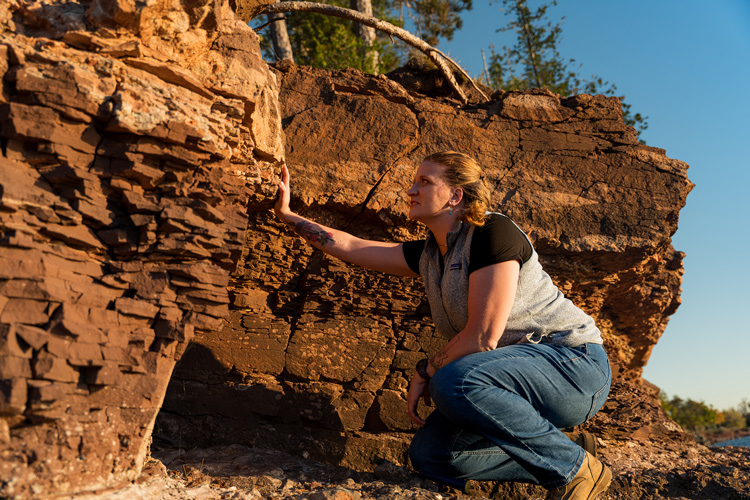
You might think Antarctica is the most remote place someone’s career might take them. UWM alum Libby Ives traversed Antarctica’s ice landscapes to study glacial sediments laid down more than 300 million years ago, but years later, she found herself even farther afield — literally, if not scientifically — when she applied her sedimentary skills to analyzing Martian landscapes for NASA.
By studying ancient landscapes, her work offers valuable insights about a planet’s environment — past, present and future. But the Waukesha, Wisconsin native didn’t always know geology was her path.
“I knew I wanted to do science, and I knew I wanted to be outside a lot,” Ives said. She discovered her passion for geosciences as an undergraduate at Northern Michigan University, where she was drawn in by the interdisciplinary nature of the field. “You get to use your physics, biology and chemistry knowledge, and you get to put it all together to tell the story of the Earth and how things came to be.”
Reading the rocks of Earth and Mars
After graduation, she planned to take a few additional classes at UW-Milwaukee as a post-baccalaureate student, but then an opportunity arose to travel to Iceland for a field expedition with UWM professor Tom Hooyer, followed by an offer to join his lab as a graduate researcher. She jumped in, studying glacial geology for her master’s degree. After Hooyer passed away in 2016, Ives finished her project at Iowa State University.
After a stint away from academia, Ives returned to UWM for her geosciences PhD. Her advisor, John Isbell, was gearing up for an expedition to Antarctica to study sedimentary rocks from the Late Paleozoic Ice Age, which was the last time the planet was cold enough to have ice sheets at both poles — over 300 million years ago.
The trip unexpectedly landed Ives in an IMAX documentary. A Chicago-based film company had partnered with the Field Museum and the Natural History Museums of Los Angeles County to produce “Dinosaurs of Antarctica,” following the paleontologists on the same field team as Ives. “They were looking for people to help tell the story of Antarctica’s deep history,” she said. “It was a right place, right time sort of thing.”
While in Milwaukee, Ives worked with the Wisconsin Geological and Natural History Survey on a geologic mapping project, an experience that would prepare her for another big opportunity. In 2022, Ives joined NASA’s Jet Propulsion Laboratory as a postdoctoral researcher with the Mars 2020 mission. Her role: interpret images taken by the Perseverance rover to reconstruct the geologic history of Mars.
“I’m a physical sedimentologist,” she explained. “So, I think about how individual grains of sand or mud were transported — by air, water or glaciers — and what that tells us about the environment that deposited them.”
Returning to her roots
Now back in the Midwest, Ives is a geologist with the Michigan Geological Survey, where she’s helping build a new research program on the state’s glacial geology. She’s also teaching upper-level geology at her undergrad alma mater.
After a career that’s spanned continents and planets, Ives is glad to have landed somewhere she can grow roots. Yet the impacts of her work reach far and wide, revealing how landscapes respond to climate shifts, informing how geological resources are managed, and deepening our understanding of Mars’ geology and past climate.