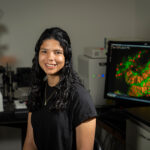
Ron Cisler became dean of the College of Health Sciences in July after serving as director for the Center for Urban Population Health since 2003.
A professor in the Department of Health Informatics and Administration in the College of Health Sciences, Cisler also is an affiliate professor in the Zilber School of Public Health and in the Department of Population Health Sciences at the University of Wisconsin School of Medicine and Public Health in Madison. Here, he talks about the challenges and opportunities he sees in Milwaukee.
What has been your top priority in your first six months on the job?
My major focus has been enrollment and retention, particularly among undergrad students. There’s been a downturn in enrollment campus-wide, but in the College of Health Sciences, we’ve been flat and have maintained our enrollments pretty consistently over the last three to five years. We’ve been challenged by campus to increase our enrollments, so we’ve focused on who we’re enrolling, and retaining our freshmen to sophomores.
Our major requirements for freshmen include anatomy and physiology, chemistry, and biology. Our retention is slightly lower than the campus average, due to those intensive basic courses. We’ve put an early-warning system in place to monitor student progress. Some students find out pretty objectively and early that maybe this is not for them and some may not reenroll the following year.
What’s the biggest challenge of your job as dean of the College of Health Sciences?
It’s being asked as a college to grow our enrollment at a time when we’re at capacity and experiencing cuts to our infrastructure. It’s going to be difficult to keep our enrollment. We have the potential for high growth, but investments aren’t at the level they need to be in order to train more students. That’s the biggest challenge.
What would you say are the college’s strengths?
The wide variety and diversity of our programs. We do a nice job spanning the continuum of biomedical sciences and health care to community health. We have the types of programs that in the future will be funded through policies driven by the Affordable Care Act. I think we’re nimble enough to respond to this changing health care environment.
Where do you think the college needs to improve?
In the area of prevention and wellness. It’s a great opportunity, particularly in the area of worker health or employee health.
We do have a number of people working to address total worker health, not just nutrition, exercise, and things related to cardiovascular issues, or diabetes, but also work-related injuries and absenteeism due to injuries.
We’ve partnered with some local companies to look at what they’re doing in total worker health and in employee health overall, and we have some research proposals out related to interdisciplinary and inter-professional approaches to worker-employee health.
What do you see as the college’s role in the region? How is it positioning itself to be a leader in health care?
Our advisory board is made up of leaders in the health care industry across our region, from Aurora, Froedtert, Wheaton Franciscan, now Ascension, — all of the major health care providers. We also have members from the Medical College of Wisconsin and smaller community-based organizations that provide health services. We’ve pulled them together to make sure we’re part of leading health care in our community. We’re also talking with the health care systems about health careers to hear what they project their needs will be in the next five to 10 years. We want to make sure we are training our students accordingly.
Another big area is making sure that we’re growing leaders in the health administration sector. We’ve started discussions about a cross-sector, cross-disciplinary, inter-professional program to train our students as future health care leaders. We just got approval, even in these tough times, for a master’s in health care administration because there’s a huge need in our state. We also have a future health care executives student group on our campus. We’re involved in many different ways on the leadership landscape and in making sure that we understand the region’s needs and are responsive.
What are your goals for the College of Health Sciences over the next two years?
We are in the process of strengthening our inter-institutional partnerships. For example, there’s a lot of potential collaboration and crossover with the Medical College of Wisconsin and UW School of Medicine and Public Health. We have some great synergies with Aurora already, so we’re going to try to advance those. We need to come in a concerted effort from UWM to these other institutions, so we’re working with nursing and public health primarily, as well as with some of the other schools and colleges to provide programs in simulation, in health care transformation, in business leadership, and health care leadership.
The other goal is to increase our enrollment and retain our top quality students. We also want to look at the transfer students coming in, and to open up the market for degree completion. There are a number of people out there who have a year, two or three toward a degree and never completed it. UW colleges across the state are doing this. We’re combining experience plus their existing credits to help them complete their degree, mostly online. People can get their bachelor’s degree so they can move on and maybe go to graduate school.
Then finally, our diversity. We are already fairly diverse; about 23 percent of our students are of color. But I think we can do better in our African-American communities. We have to look at pipeline possibilities that identify bright minority students in high school or earlier. We have a program at the university called the McNair Scholars where we get some of the best and brightest people, typically of African-American descent, as well as other nationalities and ethnicities, and give them research experience in high school. Hopefully some of these students will come to UWM and see its value. We’re heavily involved in that effort.
The chancellor has talked about the importance of preserving UWM’s research mission. What steps are you taking at the College of Health Sciences to do that?
We believe in the importance of strong research capacity and strong research staff. We invest regularly in research, for example, with graduate student awards for research, tied to the faculty who are their advisors. We invest direct dollars in competitive amounts to seed their research. We also have a seed fund for our junior faculty, providing grants for two projects of up to $15,000 annually, and we’ve continued to do that, even with our budget cuts.
We invest a quarter of a million dollars each year in our four research centers: the Center for Urban Population Health; the UWM Center for Aging and Translational Research; the Rehabilitation, Research, and Disability Design (R2D2) Center and the Biomedical and Data Language Processing Center. We also have the SPARC Award, which seeds larger grants for faculty in our college, and we give one of those a year at about $30,000. We might have to cut those in small amounts proportional to our overall cuts, but we’re going to continue to invest as heavily as we can in research.