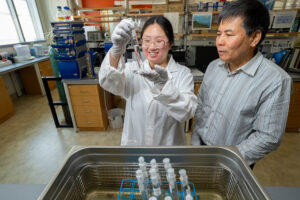
In David Heathcote’s lab, an African clawed frog that was the first vertebrate to be cloned is helping uncover the details of how our human senses develop.

Heathcote, a professor of biological sciences, and graduate student Peter Feuk, are investigating a recent discovery that showed the frog’s skin produces the neurotransmitter serotonin for a short time early in development – just when neurons involved in the sense of touch are growing to the skin.
The researchers want to know whether the serotonin guides or enhances this process.
Understanding the origins of the sense of touch becomes pretty important when you consider that these are the first sensory neurons to develop in the animal and that they help mediate its hatching response.
This kind of research, says Heathcote, illustrates that, even before birth, organisms, including humans, have functional circuits of neurons that mediate specific behaviors.