It seemed odd to the paramedics assigned to the rig that rolls out of Engine 36 on Milwaukee’s northside: For one week straight, they’d been responding to daily 6:45 a.m. calls from the same address.
Capt. Michael Wright, who was assigned to Engine 36’s paramedic unit at the time, decided to look into it. The patient, a woman in her 70s, had diabetes. Her husband thought he was following doctor’s orders by giving his wife insulin first thing every morning. But it resulted in a massive blood sugar drop.
“She didn’t need the insulin every morning,” said Wright, now coordinator for the Milwaukee Fire Department’s community paramedic program. “She just needed breakfast.”
Every day, paramedics across the country speed out of fire houses, red lights flashing and sirens blaring, to address medical problems that are not – or should not be – true emergencies. It’s health care at its costliest.
Looking for a solution, Wright and other emergency responders turned to the UWM College of Nursing for help in developing Wisconsin’s first training program to teach paramedics to address patients’ needs before their problems become true emergencies. As the college celebrates its 50th anniversary, this program – done in collaboration with the Milwaukee Fire Department, Milwaukee County Emergency Medical Services and the Medical College of Wisconsin – is just the latest of many partnerships designed to teach students and address the city’s medical needs.
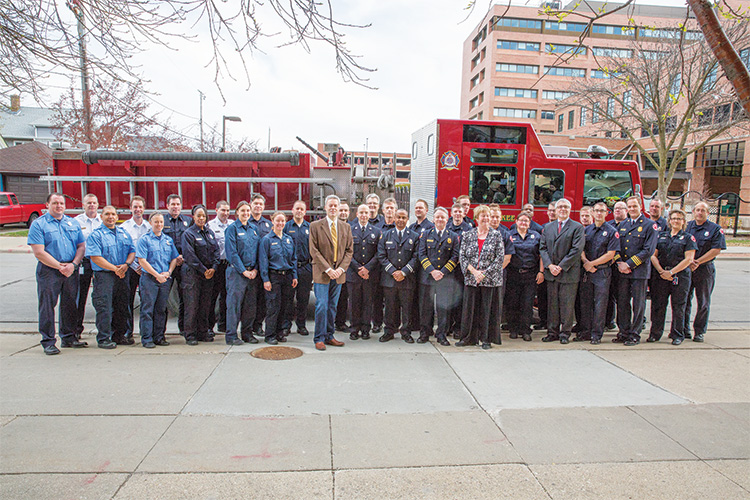
On Sept. 25, families, friends and fire chiefs gathered at UWM to watch paramedics from Milwaukee, West Allis, North Shore, Greenfield and Madison become the first graduating class in the Mobile Integrated Healthcare Program, receiving their certificates from Kim Litwack, associate dean of the College of Nursing.
The paramedics who volunteered for the program began training in April. Along with online courses, they completed 40 hours of laboratory work at the College of Nursing and did additional clinical work at six locations in Milwaukee.
The need for the paramedic partnership is great. In Milwaukee, just 100 people placed almost 7 percent of the 62,663 emergency medical calls placed in 2014. Paramedics trained in the Community Paramedic Curriculum will not only teach their patients self-care, but will connect them with existing services to prevent future emergencies.
Sally Lundeen, dean of the College of Nursing, emphasized that the project is in concert with the Wisconsin Idea, the University of Wisconsin System mission statement that emphasizes the universities’ connection to the community.
“We are on the ground in areas of Milwaukee that have high health care needs and are addressing care coordination, health promotion and prevention,” said Lundeen, who has nearly 40 years’ experience establishing community-based health care programs in Milwaukee and Chicago.
The first graduating class of paramedics completed instruction on delivering health care in the community and managing chronic illnesses. Topics covered included asthma and infant mortality, two major health problems in Milwaukee.
For phase two, 22 local medics will be trained to go into the homes of participating 911 callers, visiting each patient four times over three months to complete home assessments, provide education and connect the patients with services that meet their needs. They will also reach out to the homeless population.
Milwaukee firefighter and paramedic Andrew Hargarten is taking a double-duty approach to his education. The College of Nursing Class of 2010 graduate just received his certificate from the paramedic training program and is enrolled in UWM’s doctorate of nursing practice program.
He explained that similar programs elsewhere have proved to be cost effective with better medical outcomes. “Fort Worth, Texas, has extensive data. Among other things, they significantly reduced the readmission of patients. With the Affordable Care Act, hospitals are penalized if a patient is readmitted within 30 days, so it saved the hospitals money. The number of paramedic runs went way down, and that saved money for the taxpayers.”
Kim Litwack, who is leading the program, said that while paramedics are well trained to provide “red light” emergency care, they aren’t trained to address less urgent calls from “yellow light” or “green light” patients.
“An asthmatic patient who has run out of needed medication would be a ‘yellow light’ call,” she said. “The patient needs to be evaluated to determine why they’ve run out of their medication so he or she doesn’t become a ‘red light’ patient requiring emergency transport. The partnership with the College of Nursing, with an emphasis on health
promotion, assessment and education, is a natural fit.”
Despite success in training its first cohort of community-based paramedics, the program is still in its early days, said Lundeen. Ongoing funding is needed for the curriculum/training to reach its full potential as a cost and lifesaver across southeastern Wisconsin.
“We need to have coordination to make sure that not only are we providing the services, but that we are not duplicating what others are doing. We need to figure out how to sustain these new models,” Lundeen said. “It’s a good investment, and funding the program is a good decision.”